Thank you for visiting SNEWPapers!
Sign up free
Literary
August 24, 1849
Wisconsin Tribune
Mineral Point, Iowa County, Wisconsin
What is this article about?
Masonic address by Wm. R. Smith delivered June 24, 1849, at Melody Lodge No. 2, Platteville, Wisconsin, on St. John the Baptist's festival. It extols Freemasonry's principles of friendship, moral virtue, piety, and universal brotherhood, critiques worldly friendships, and concludes with an ode on Masonry's light in the West.
Clipping
OCR Quality
95%
Excellent
Full Text
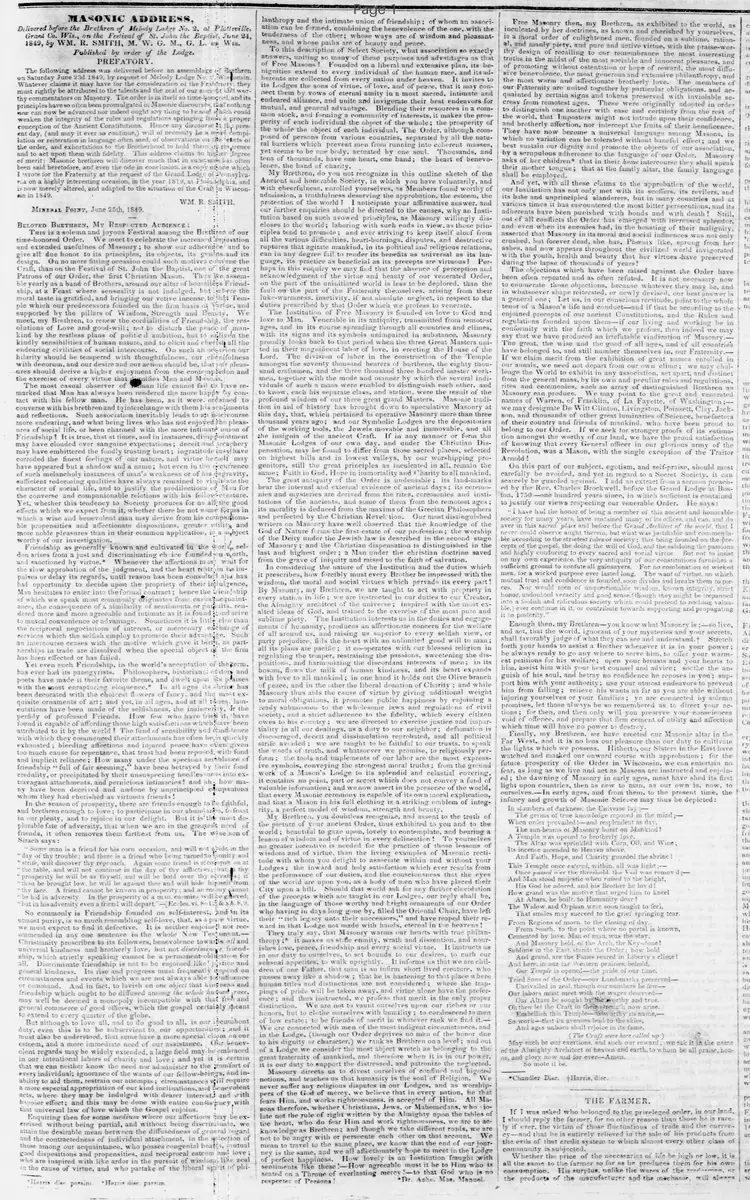
MASONIC ADDRESS.
Delivered before the Brethren of Melody Lodge No. 2. at Platteville, Grant Co. Wis., on the Festival of St. John the Baptist, June 24, 1849, by WM. R. SMITH, M. W. G. M., G. L. of Wis.
Published by order of the Lodge.
PREFATORY.
The following address was delivered before an assemblage of Brethren on Saturday June 23d 1849, by request of Melody Lodge No. 2. Wisconsin.
Whatever claims it may have for the consideration of the Fraternity, they must rightly be attributed to the talents and the zeal of our ancient and worthy commentators on Masonry. The order is in itself so time-honoured, and its principles have so often been promulgated in Masonic discourses, that nothing new can now be advanced nor indeed ought any thing to be said which could weaken the integrity of the rules and regulations springing from a proper conception of the Ancient Constitutions. Hence any discourse to be present day, (and may it ever so continue,) will of necessity be a mere compilation or reiteration in language often used, of observations on the objects of the order, and exhortations to the Brotherhood to hold them in reverence and to act upon them with fidelity. This address claims no higher degree of merit: Masonic brethren will discover much that in substance has often been said heretofore, and even the ode in conclusion is a copy of one which I wrote for the Fraternity at the request of the Grand Lodge of Pennsylvania on a highly interesting occasion, in the year 1817, at Philadelphia, and is now merely altered, and adapted to the situation of the Craft in Wisconsin in 1849.
WM. R. SMITH
MINERAL POINT. June 25th. 1849
Beloved Brethren, My Respected Audience:
This is a solemn and joyous Festival among the Brethren of our time-honored Order. We meet to celebrate the increased reputation and extended usefulness of Masonry; to show our adherence and to give all due honor to its principles, its objects, its genius, and its design. On no more fitting occasion could such motives convene the Craft, than on the Festival of St. John the Baptist, one of the great Patrons of our Order, the first Christian Mason. Thus we assemble yearly as a band of Brothers, around our altar of boundless Friendship, at a Feast where sensuality is not indulged, but where the moral taste is gratified, and bringing our votive incense to that Temple which our predecessors founded on the firm basis of nature, and supported by the pillars of Wisdom, Strength and Beauty. We meet, my Brethren, to renew the cordialities of Friendship, the resolutions of Love and good-will; not to disturb the peace of mankind by the restless plans of political ambition, but to enliven the kindly sensibilities of human nature, and to elicit and cherish all the endearing civilities of social intercourse. On such an occasion our hilarity should be tempered with thoughtfulness, our cheerfulness with decorum, and our desire and our action should be, that our pleasures should derive a higher enjoyment from the contemplation and the exercise of every virtue that dignifies Men and Masons.
The most casual observer of human life cannot fail to have remarked that Man has always been rendered the more happy by contact with his fellow man. He has been, as it were, ordained to converse with his brethren and to interchange with them his sentiments and reflections. Such association inevitably leads to an intercourse more endearing, and what being lives who has not enjoyed pleasures of social life, or been charmed with the more intimate union of Friendship? It is true, that at times, and in instances, disappointment may have clouded over sanguine expectations; deceit and treachery may have embittered the fondly trusting heart; ingratitude may have corroded the finest feelings of our nature, and virtue herself may have appeared but a shadow and a name; but even in the occurrence of such melancholy instances of man's weakness or of his depravity, sufficient redeeming qualities have always remained to vindicate the character of social life, and to justify the predilections of Man for the converse and companionable relations with his fellow-creature.
Yet, whether this tendency to Society procures for us all the good effects which we expect from it, whether there be not some forms in which a wise and benevolent man may derive from his companionable propensities and affectionate dispositions, greater utility and more noble pleasures than in their common application, is a subject worthy of our investigation.
Friendship as generally known and cultivated in the world, seldom arises from a just and discriminating choice founded on worth, and sanctioned by virtue. Whenever the affections must wait for the slow approbation of the judgment, and the heart restrain its impulses or delay its regards, until reason has been consulted and has had opportunity to decide upon the propriety of their indulgence, Man hesitates to enter into the formal contract; hence the Friendship of which we speak most commonly originates from casual acquaintance, the consequence of a similarity of sentiments or pursuits, rendered more and more agreeable and intimate as it is found conducive to mutual convenience or advantage. Sometimes it is little else than the reciprocal negotiations of interest, or mercenary exchange of services which the selfish employ to promote their advantage. Such an intercourse ceases with the motive which gave it birth, as partnerships in trade are dissolved when the special object of the firm has been effected or has failed.
Yet even such Friendship, in the world's acceptation of the term, has ever had its panegyrists. Philosophers, historians, statesmen and poets have made it their favorite theme, and dwelt upon its praises with the most enrapturing eloquence. In all ages shrine has been decorated with the choicest flowers of fancy, and the most exquisite ornaments of art; and yet, in all ages, and at all times, lamentations have been made of the selfishness, the insincerity, or the perfidy of professed Friends. How few who have tried it, have found it capable of affording those high satisfactions which have been attributed to it by the world? The fund of sensibility and confidence with which they commenced their attachments has often been quickly exhausted: bleeding affections and injured peace have often given too much cause for repentance, that trust had been reposed, with fond and implicit reliance; How many under the specious semblance of friendship "full of fair seeming," have been betrayed by their fond credulity, or precipitated by their unsuspecting heedlessness into extravagant attachments, and pernicious intimacies! and ah. how many have been deceived and undone by unprincipled companions whom they had cherished as virtuous friends!
In the season of prosperity, there are friends enough to be faithful, and brethren enough to love; to participate in our abundance, to feast in our plenty, and to rejoice in our delight. But it is the most deplorable fate of adversity, that when we are in the greatest need of friends, it often removes them farthest from us. The wise son of Sirach says:
"Some man is a friend for his own occasion, and will not abide in the day of thy trouble: and there is a friend who being turned to amity and strife, will discover thy reproach. Again some friend is a companion on at the table, and will not continue in the day of thy affliction; out thy prosperity he will be as thyself, and will be bold over thy servants; if thou be brought low, he will be against thee and will hide himself from thy face. A friend cannot be known in prosperity; and an enemy cannot be hid in adversity In the prosperity of a man, enemies will be grieved; but in his adversity even a friend will depart."-Eccles. vi. 8- 10, 18, 9.
So commonly is Friendship founded on self-interest, and in its utmost purity, is so much resembling self-love, that, as a pure virtue, we must expect to find it defective. It is neither enjoined nor recommended in any one sentence in the whole New Testament.—
Christianity prescribes to its followers, benevolence towards all and universal kindness and brotherly love, but not discriminating friendship, which strictly speaking cannot be a permanent obligation for all. Discriminate friendship is not to be enjoined like justice and general kindness. Its rise and progress must frequently depend on circumstances and events which we are not always able to influence or command. And in fact, to lavish on one object that kindness and friendship which ought to be diffused among the whole human race, may well be deemed a monopoly incompatible with that free and general commerce of good offices, which the gospel certainly meant to extend to every quarter of the globe.
But although to love all, and to do good to all, is our indisputable duty, even this is to be subservient to our opportunities; and it must also be understood, that some have a more special claim on our esteem, and a more immediate need of our assistance. Our benevolent regards may be widely extended, a large field may be embraced in our intentional labors of charity and love; and yet it is certain that we can neither know the need nor administer to the comfort of every individual; ignorance of the wants of our fellow-beings, and inability to aid them, restrain our attempts; circumstances will require a more especial appropriation of our kind inclinations and benevolent acts, where they may be indulged with dearer interest and with happier effect; and this may be done with entire consistency with that universal law of love which the Gospel enjoins.
Enquiring then for some medium where our affections may be exercised without being partial, and without being discriminate, we attain the desirable mean between the diffusedness of general regard and the contractedness of individual attachment, in the selection of those among our acquaintance, who possess congenial hearts, mutual good dispositions and propensities, and reciprocal esteem and love; who are inspired with like ardor in the pursuit of wisdom like zeal in the cause of virtue, and who partake of the liberal spirit of philanthropy and the intimate union of friendship; of whom an association can be formed, combining the benevolence of the one, with the tenderness of the other; whose ways are of wisdom and pleasantness, and whose paths are of beauty and peace.
To this description of Select Society, what association so exactly answers, uniting so many of these purposes and advantages as that of Free Masons? Founded on a liberal and extensive plan, its benignities extend to every individual of the human race, and its adherents are collected from every nation under heaven. It invites to its Lodges the sons of virtue, of love, and of peace, that it may connect them by vows of eternal amity in a most sacred, intimate and endeared alliance, and unite and invigorate their best endeavors for mutual, and general advantage. Blending their resources in a common stock, and forming a community of interests, it makes the prosperity of each individual the object of the whole; the prosperity of the whole the object of each individual. The Order, although composed of persons from various countries, separated by all the natural barriers which prevent men from running into coherent masses, yet seems to be one body, actuated by one soul. Thousands, and tens of thousands, have one heart, one hand; the heart of benevolence, the hand of charity.
My Brethren, do you not recognize in this outline sketch of the Ancient and honorable Society, in which you have voluntarily, and with cheerfulness, enrolled yourselves, as Members found worthy of admission, a truthfulness deserving the approbation, the esteem, the protection of the world? I anticipate your affirmative answer, and our further enquiries should be directed to the causes, why an Institution based on such avowed principles, as Masonry willingly discloses to the world; laboring with such ends in view, as those principles tend to promote; and ever striving to keep itself aloof from all the various difficulties, heart-burnings, disputes, and destructive ruptures that agitate mankind, in its political and religious relations, can in any degree fail to render its benefits as universal as its language, its practice as beneficial as its precepts are virtuous? Perhaps in this enquiry we may find that the absence of perception and acknowledgment of the virtue and beauty of our venerated Order, on the part of the uninitiated world is less to be deplored, than the fault on the part of the Fraternity themselves, arising from their luke-warmness, inactivity, if not absolute neglect, in respect to the duties prescribed by that Order which we profess to venerate.
The Institution of Free Masonry is founded on love to God and love to Man. Venerable in its antiquity, transmitted from remotest ages, and in its course spreading through all countries and climes, with its signs and its symbols unimpaired in substance, Masonry proudly looks back to that period when the three Great Masters united in their magnificent labor of love, in erecting the House of the Lord. The division of labor in the construction of the Temple amongst the seventy thousand bearers of burthens, the eighty thousand craftsmen, and the three thousand three hundred master workmen, together with the mode and manner by which the several individuals of such a mass were enabled to distinguish each other, and to know, each his separate class, and station, were the result of the profound wisdom of our three great grand Masters. Masonic tradition in aid of history has brought down to speculative Masonry at this day, that, which pertained to operative Masonry more than three thousand years ago; and our Symbolic Lodges are the depositories of the working tools, the Jewels movable and immovable, and all the insignia of the ancient Craft. If in any manner or form the Masonic Lodges of our own day, and under the Christian Dispensation, may be found to differ from those sacred places, selected on highest hills and in lowest valleys, by our worshipping progenitors, still the great principles as inculcated in all, remain the same; Faith in God, Hope in immortality and Charity to all mankind.
The great antiquity of the Order is undeniable; its land-marks bear the internal and external evidence of ancient days; its ceremonies and mysteries are derived from the rites, ceremonies and institutions of the ancients, and some of them from the remotest ages; its morality is deduced from the maxims of the Grecian Philosophers and perfected by the Christian Revelation. Our most distinguished writers on Masonry have well observed that the knowledge of the God of Nature forms the first estate of our profession; the worship of the Deity under the Jewish law is described in the second stage of Masonry; and the Christian dispensation is distinguished in the last and highest order; a Man under the christian doctrine saved from the grave of iniquity and raised to the faith of salvation.
In considering the nature of the Institution and the duties which it prescribes, how forcibly must every Brother be impressed with the wisdom, the moral and social virtues which pervade its every part! By Masonry, my Brethren, we are taught to act with propriety in every station in life; we are instructed in our duties to our Creator, the Almighty architect of the universe; inspired with the most exalted ideas of God, and trained to the exercise of the most pure and sublime piety. The Institution interests us in the duties and engagements of humanity, produces an affectionate concern for the welfare of all around us, and raising us superior to every selfish view, or party prejudice, fills the heart with an unlimited good will to man; all its plans are pacific; it co-operates with our blessed religion in regulating the temper, restraining the passions, sweetening the dispositions, and harmonizing the discordant interests of men; in its bosom, flows the milk of human kindness, and its heart expands with love to all mankind; in one hand it holds out the Olive branch of peace, and in the other the liberal donation of Charity; and while Masonry thus aids the cause of virtue by giving additional weight to moral obligations, it promotes public happiness by enjoining a ready submission to the wholesome laws and regulations of civil society, and a strict adherence to the fidelity, which every citizen owes to his country; we are directed to exercise justice and impartiality in all our dealings, as a duty to our neighbor; defamation is discouraged, deceit and dissimulation reprobated, and all political strife avoided; we are taught to be faithful to our trusts, to speak the words of truth, and whatsoever we promise, to religiously perform: the tools and implements of our labor are the most expressive symbols, conveying the strongest moral truths; from the ground work of a Mason's Lodge to its splendid and celestial covering, it contains no point, part or secret which does not convey a fund of valuable information; and we now assert in the presence of the world, that every Masonic ceremony is capable of its own moral explication, and that a Mason in his full clothing is a striking emblem of integrity, a perfect model of wisdom, strength and beauty.
My Brethren, you doubtless recognize, and assent to the truth of the picture of your ancient Order, thus exhibited to you and to the world; beautiful to gaze upon, lovely to contemplate, and bearing a lesson of wisdom and of virtue in every delineation! To yourselves no greater incentive is needed for the practice of those lessons of wisdom and of virtue, than the living examples of Masonic rectitude with whom you delight to associate within and without your Lodges; the inward and holy satisfaction which ever results from the performance of our duties, and the consciousness that the eyes of the world are upon you, as a body of men who have placed their City upon a hill. Should that world ask for any further elucidation of the precepts which are taught in our Lodges, our reply shall be, in the language of those worthy and bright ornaments of our Order who having in days long gone by, filled the Oriental Chair, have left their "rich legacy unto their successors," and have reaped their reward in that Lodge not made with hands, eternal in the heavens!
They truly say, that Masonry warms our hearts with true philanthropy; it makes us stifle enmity, wrath and dissention, and nourishes love, peace, friendship and every social virtue. It instructs us in our duty to ourselves, to set bounds to our desires, to curb our sensual appetites, to walk uprightly. It informs us that we are children of one Father, that man is an infirm short lived creature, who passes away like a shadow; that he is hastening to that place where human titles and distinctions are not considered; where the trappings of pride will be taken away, and virtue alone have the preference; and thus instructed, we profess that merit is the only proper distinction. We are not to vaunt ourselves upon our riches or our honors, but to clothe ourselves with humility; to condescend to men of low estate; to be friends of merit in whatever rank we find it. We are connected with men of the most indigent circumstances, and in the Lodge, (though our Order deprives no man of the honor due to his dignity or character.) we rank as Brethren on a level; and out of a Lodge we consider the most abject wretch as belonging to the great fraternity of mankind, and therefore when it is in our power, it is our duty to support the distressed, and patronize the neglected.
Masonry directs us to divest ourselves of confined and bigoted notions, and teaches us that humanity is the soul of Religion. We never suffer any religious disputes in our Lodges, and as worshippers of the God of mercy, we believe that in every nation, he that fears Him, and works righteousness, is accepted of Him. All Masons therefore, whether Christians, Jews, or Mahomedans, who violate not the rule of right written by the Almighty upon the tables of the heart, who do fear Him and work righteousness, we are to acknowledge as Brethren; and though we take different roads, we are not to be angry with or persecute each other on that account. We mean to travel to the same place, we know that the end of our journey is the same, and we all affectionately hope to meet in the Lodge of perfect happiness. How lovely is an Institution fraught with sentiments like these!-How agreeable must it be to Him who is seated on a Throne of everlasting mercy!-to that God who is no respecter of Persons!
Dr. Ashe. Mas. Manuel.
Free Masonry then, my Brethren, as exhibited to the world, as inculcated by her doctrines, as known and cherished by yourselves, is a moral order of enlightened men, founded on a sublime, rational, and manly piety, and pure and active virtue, with the praiseworthy design of recalling to our remembrance the most interesting truths in the midst of the most sociable and innocent pleasures, and of promoting without ostentation or hope of reward, the most diffusive benevolence, the most generous and extensive philanthropy, and the most warm and affectionate brotherly love. The members of our Fraternity are united together by particular obligations, and acquainted by certain signs and tokens preserved with inviolable secrecy from remotest ages. These were originally adopted in order to distinguish one another with ease and certainty from the rest of the world, that Imposters might not intrude upon their confidence, and brotherly affection, nor intercept the fruits of their beneficence. They have now become a universal language among Masons, in which no variation can be tolerated without baneful effect; and we best sustain our dignity and promote the objects of our association, by a scrupulous adherence to the language of our Order. Masonry asks of her children that in their home intercourse they shall speak their mother tongue; that at the family altar, the family language shall be employed.
And yet, with all these claims to the approbation of the world, our Institution has not only met with its scoffers, its revilers, and its base and unprincipled slanderers, but in many countries and at various times it has encountered the most bitter persecutions, and its adherents have been punished with bonds and with death! Still, out of all conflicts the Order has emerged with increased splendor, and even when its enemies had, in the boasting of their malignity, asserted that Masonry in its moral and social influences was not only crushed, but forever dead, she has, Phænix like, sprung from her ashes, and now appears throughout the civilized world invigorated with the youth, health and beauty that her virtues have preserved during the lapse of thousands of years!
The objections which have been raised against the Order have been often repeated and as often refuted. It is not necessary now to enumerate those objections, because whatever they may be, and in whatsoever shape reiterated, or newly devised, our best answer is a general one; Let us, in our conscious rectitude, point to the whole tenor of a Mason's life and conduct-and if that be according to the enjoined precepts of our ancient Constitutions, and the Rules and regulations founded upon them-if our living and working be in conformity with the faith which we profess, then indeed we may say that we have produced an irrefutable vindication of Masonry.--
The great, the wise and the good of all ages, and of all countries have belonged to, and still number themselves in, our Fraternity.-- If we claim merit from the exhibition of great names enrolled in our annals, we need not depart from our own clime; we may challenge the World to exhibit in any association, set apart, and distinct from the general mass, by its own and peculiar rules and regulations, rites and ceremonies, such an array of distinguished Brethren as Masonry can produce. We may point to the great and venerated names of Warren, of Franklin, of La Fayette, of Washington;-- we may designate De Witt Clinton, Livingston, Poinsett, Clay, Jackson, and thousands of other great luminaries of Science, benefactors of their country and friends of mankind, who have been proud to belong to our Order. If we seek for stronger proofs of its estimation amongst the worthy of our land, we have the proud satisfaction of knowing that every General officer in our glorious army of the Revolution, was a Mason, with the single exception of the Traitor Arnold!
On this part of our subject, egotism, and self-praise, should most carefully be avoided, and yet in regard to a Secret Society, it can scarcely be guarded against. I add an extract from a sermon preached by the Rev. Charles Brockwell, before the Grand Lodge at Boston, 1750-one hundred years since, in which sufficient is contained to justify our views respecting our venerable Order. He says:
"I have had the honor of being a member of this ancient and honorable society for many years, have sustained many of its offices, and can, and do aver in this sacred place and before the Grand Architect of the world, that I never could observe aught therein, but what was justifiable and commendable according to the strictest rules of society: this being founded on the precepts of the gospel, the doing the will of God, and the subduing the passions and highly conducing to every sacred and social virtue But not to insist on my own experience, the very antiquity of our constitutions furnishes a sufficient ground to confute all gainsayers. For no combination of wicked men, for a wicked purpose ever lasted long. The want of virtue, on which mutual trust and confidence is founded, soon divides and breaks them to pieces. Nor would men of unquestionable wisdom, known integrity, strict honor, undoubted veracity and good sense, (though they might be trepanned into a foolish and ridiculous society which could pretend to nothing valuable,) ever continue in it, or contribute towards supporting and propagating it to posterity."
Enough then, my Brethren--you know what Masonry is;-so live, and act, that the world, ignorant of your mysteries and your secrets, shall favorably judge of what they can see and understand. Stretch forth your hands to assist a Brother whenever it is in your power; be always ready to go any where to serve him, to offer your warmest petitions for his welfare; open your breasts and your hearts to him, assist him with your best counsel and advice; soothe the anguish of his soul, and betray no confidence he reposes in you; support him with your authority; use your utmost endeavors to prevent him from falling; relieve his wants as far as you are able without injuring yourselves or your families; ye are connected by solemn promises, let those always be so remembered as to direct your actions; for then, and then only will you preserve your consciences void of offence, and prepare that firm cement of utility and affection which time will have no power to destroy.
Finally, my Brethren, we have erected our Masonic altar in the Far West, and it is no less our pleasure than our duty to cultivate the lights which we possess. Hitherto, our Sisters in the East have watched and marked our onward course with approbation; for the future prosperity of the Order in Wisconsin, we can entertain no fear, as long as we live and act as Masons are instructed and enjoined; the dawning of Masonry in early ages, must have shed its first light upon countries, then as new to man, as our own is, now, to ourselves.-In early ages, and from them, to the present time, the infancy and growth of Masonic Science may thus be depicted:
In slumbers of darkness, the Universe lay;
The germs of true knowledge reposed in the mind:-
When order prevailed!-and resplendent as day.
The sun-beams of Masonry burst on Mankind!
A Temple was opened to brotherly love,
The Altar was sprinkled with Corn, Oil, and Wine;
Its incense ascended to Heaven above,
And Faith, Hope, and Charity guarded the shrine!
This Temple once entered, within, all was light;—
Once passed o'er the threshold, the Veil was remov'd:
And Man stood majestic when raised to the height,
Vis God be adored, and his Brother he lov'd!
How grand was the motive that urged him to kneel ,
At Altars, he built, to Humanity dear!
The Widow and Orphan were soon taught to feel,
That smiles may succeed to the grief springing tear.
From Regions of morn, to the closing of day.
From youth, to the noontide where no portal is known,
Cemented by love, Man of man, Was the star,
And Masonry held, of the Arch, the Key-stone!
Sublime in the East, stands the Order: how bold
And grand, are the Fanes reared in Liberty's clime!
And here, in our far western prairies, behold,
Our Temple is opened-the pride of our time,
Tried Sons of the Order-our Land-marks preserved
Unrivalled in zeal, though our numbers be few-
Our labors must meet with the wages deserved- .
Our Altars be sought by the worthy and true.
Oh then let the Craft in their strength now arise,
Embellish this Temple—as worthy its name,
So, work--that its avenues lead to the skies,
And ages unborn shall rejoice in its fame.
(The Craft rose here called up.)
May such be our exertions, and such our reward, we ask it in the name of the Almighty Architect of heaven and earth, to whom be all praise, honor, and glory now and for ever-Amen.
So mote it be.
•Chandler Disc. Harris, disc.
Delivered before the Brethren of Melody Lodge No. 2. at Platteville, Grant Co. Wis., on the Festival of St. John the Baptist, June 24, 1849, by WM. R. SMITH, M. W. G. M., G. L. of Wis.
Published by order of the Lodge.
PREFATORY.
The following address was delivered before an assemblage of Brethren on Saturday June 23d 1849, by request of Melody Lodge No. 2. Wisconsin.
Whatever claims it may have for the consideration of the Fraternity, they must rightly be attributed to the talents and the zeal of our ancient and worthy commentators on Masonry. The order is in itself so time-honoured, and its principles have so often been promulgated in Masonic discourses, that nothing new can now be advanced nor indeed ought any thing to be said which could weaken the integrity of the rules and regulations springing from a proper conception of the Ancient Constitutions. Hence any discourse to be present day, (and may it ever so continue,) will of necessity be a mere compilation or reiteration in language often used, of observations on the objects of the order, and exhortations to the Brotherhood to hold them in reverence and to act upon them with fidelity. This address claims no higher degree of merit: Masonic brethren will discover much that in substance has often been said heretofore, and even the ode in conclusion is a copy of one which I wrote for the Fraternity at the request of the Grand Lodge of Pennsylvania on a highly interesting occasion, in the year 1817, at Philadelphia, and is now merely altered, and adapted to the situation of the Craft in Wisconsin in 1849.
WM. R. SMITH
MINERAL POINT. June 25th. 1849
Beloved Brethren, My Respected Audience:
This is a solemn and joyous Festival among the Brethren of our time-honored Order. We meet to celebrate the increased reputation and extended usefulness of Masonry; to show our adherence and to give all due honor to its principles, its objects, its genius, and its design. On no more fitting occasion could such motives convene the Craft, than on the Festival of St. John the Baptist, one of the great Patrons of our Order, the first Christian Mason. Thus we assemble yearly as a band of Brothers, around our altar of boundless Friendship, at a Feast where sensuality is not indulged, but where the moral taste is gratified, and bringing our votive incense to that Temple which our predecessors founded on the firm basis of nature, and supported by the pillars of Wisdom, Strength and Beauty. We meet, my Brethren, to renew the cordialities of Friendship, the resolutions of Love and good-will; not to disturb the peace of mankind by the restless plans of political ambition, but to enliven the kindly sensibilities of human nature, and to elicit and cherish all the endearing civilities of social intercourse. On such an occasion our hilarity should be tempered with thoughtfulness, our cheerfulness with decorum, and our desire and our action should be, that our pleasures should derive a higher enjoyment from the contemplation and the exercise of every virtue that dignifies Men and Masons.
The most casual observer of human life cannot fail to have remarked that Man has always been rendered the more happy by contact with his fellow man. He has been, as it were, ordained to converse with his brethren and to interchange with them his sentiments and reflections. Such association inevitably leads to an intercourse more endearing, and what being lives who has not enjoyed pleasures of social life, or been charmed with the more intimate union of Friendship? It is true, that at times, and in instances, disappointment may have clouded over sanguine expectations; deceit and treachery may have embittered the fondly trusting heart; ingratitude may have corroded the finest feelings of our nature, and virtue herself may have appeared but a shadow and a name; but even in the occurrence of such melancholy instances of man's weakness or of his depravity, sufficient redeeming qualities have always remained to vindicate the character of social life, and to justify the predilections of Man for the converse and companionable relations with his fellow-creature.
Yet, whether this tendency to Society procures for us all the good effects which we expect from it, whether there be not some forms in which a wise and benevolent man may derive from his companionable propensities and affectionate dispositions, greater utility and more noble pleasures than in their common application, is a subject worthy of our investigation.
Friendship as generally known and cultivated in the world, seldom arises from a just and discriminating choice founded on worth, and sanctioned by virtue. Whenever the affections must wait for the slow approbation of the judgment, and the heart restrain its impulses or delay its regards, until reason has been consulted and has had opportunity to decide upon the propriety of their indulgence, Man hesitates to enter into the formal contract; hence the Friendship of which we speak most commonly originates from casual acquaintance, the consequence of a similarity of sentiments or pursuits, rendered more and more agreeable and intimate as it is found conducive to mutual convenience or advantage. Sometimes it is little else than the reciprocal negotiations of interest, or mercenary exchange of services which the selfish employ to promote their advantage. Such an intercourse ceases with the motive which gave it birth, as partnerships in trade are dissolved when the special object of the firm has been effected or has failed.
Yet even such Friendship, in the world's acceptation of the term, has ever had its panegyrists. Philosophers, historians, statesmen and poets have made it their favorite theme, and dwelt upon its praises with the most enrapturing eloquence. In all ages shrine has been decorated with the choicest flowers of fancy, and the most exquisite ornaments of art; and yet, in all ages, and at all times, lamentations have been made of the selfishness, the insincerity, or the perfidy of professed Friends. How few who have tried it, have found it capable of affording those high satisfactions which have been attributed to it by the world? The fund of sensibility and confidence with which they commenced their attachments has often been quickly exhausted: bleeding affections and injured peace have often given too much cause for repentance, that trust had been reposed, with fond and implicit reliance; How many under the specious semblance of friendship "full of fair seeming," have been betrayed by their fond credulity, or precipitated by their unsuspecting heedlessness into extravagant attachments, and pernicious intimacies! and ah. how many have been deceived and undone by unprincipled companions whom they had cherished as virtuous friends!
In the season of prosperity, there are friends enough to be faithful, and brethren enough to love; to participate in our abundance, to feast in our plenty, and to rejoice in our delight. But it is the most deplorable fate of adversity, that when we are in the greatest need of friends, it often removes them farthest from us. The wise son of Sirach says:
"Some man is a friend for his own occasion, and will not abide in the day of thy trouble: and there is a friend who being turned to amity and strife, will discover thy reproach. Again some friend is a companion on at the table, and will not continue in the day of thy affliction; out thy prosperity he will be as thyself, and will be bold over thy servants; if thou be brought low, he will be against thee and will hide himself from thy face. A friend cannot be known in prosperity; and an enemy cannot be hid in adversity In the prosperity of a man, enemies will be grieved; but in his adversity even a friend will depart."-Eccles. vi. 8- 10, 18, 9.
So commonly is Friendship founded on self-interest, and in its utmost purity, is so much resembling self-love, that, as a pure virtue, we must expect to find it defective. It is neither enjoined nor recommended in any one sentence in the whole New Testament.—
Christianity prescribes to its followers, benevolence towards all and universal kindness and brotherly love, but not discriminating friendship, which strictly speaking cannot be a permanent obligation for all. Discriminate friendship is not to be enjoined like justice and general kindness. Its rise and progress must frequently depend on circumstances and events which we are not always able to influence or command. And in fact, to lavish on one object that kindness and friendship which ought to be diffused among the whole human race, may well be deemed a monopoly incompatible with that free and general commerce of good offices, which the gospel certainly meant to extend to every quarter of the globe.
But although to love all, and to do good to all, is our indisputable duty, even this is to be subservient to our opportunities; and it must also be understood, that some have a more special claim on our esteem, and a more immediate need of our assistance. Our benevolent regards may be widely extended, a large field may be embraced in our intentional labors of charity and love; and yet it is certain that we can neither know the need nor administer to the comfort of every individual; ignorance of the wants of our fellow-beings, and inability to aid them, restrain our attempts; circumstances will require a more especial appropriation of our kind inclinations and benevolent acts, where they may be indulged with dearer interest and with happier effect; and this may be done with entire consistency with that universal law of love which the Gospel enjoins.
Enquiring then for some medium where our affections may be exercised without being partial, and without being discriminate, we attain the desirable mean between the diffusedness of general regard and the contractedness of individual attachment, in the selection of those among our acquaintance, who possess congenial hearts, mutual good dispositions and propensities, and reciprocal esteem and love; who are inspired with like ardor in the pursuit of wisdom like zeal in the cause of virtue, and who partake of the liberal spirit of philanthropy and the intimate union of friendship; of whom an association can be formed, combining the benevolence of the one, with the tenderness of the other; whose ways are of wisdom and pleasantness, and whose paths are of beauty and peace.
To this description of Select Society, what association so exactly answers, uniting so many of these purposes and advantages as that of Free Masons? Founded on a liberal and extensive plan, its benignities extend to every individual of the human race, and its adherents are collected from every nation under heaven. It invites to its Lodges the sons of virtue, of love, and of peace, that it may connect them by vows of eternal amity in a most sacred, intimate and endeared alliance, and unite and invigorate their best endeavors for mutual, and general advantage. Blending their resources in a common stock, and forming a community of interests, it makes the prosperity of each individual the object of the whole; the prosperity of the whole the object of each individual. The Order, although composed of persons from various countries, separated by all the natural barriers which prevent men from running into coherent masses, yet seems to be one body, actuated by one soul. Thousands, and tens of thousands, have one heart, one hand; the heart of benevolence, the hand of charity.
My Brethren, do you not recognize in this outline sketch of the Ancient and honorable Society, in which you have voluntarily, and with cheerfulness, enrolled yourselves, as Members found worthy of admission, a truthfulness deserving the approbation, the esteem, the protection of the world? I anticipate your affirmative answer, and our further enquiries should be directed to the causes, why an Institution based on such avowed principles, as Masonry willingly discloses to the world; laboring with such ends in view, as those principles tend to promote; and ever striving to keep itself aloof from all the various difficulties, heart-burnings, disputes, and destructive ruptures that agitate mankind, in its political and religious relations, can in any degree fail to render its benefits as universal as its language, its practice as beneficial as its precepts are virtuous? Perhaps in this enquiry we may find that the absence of perception and acknowledgment of the virtue and beauty of our venerated Order, on the part of the uninitiated world is less to be deplored, than the fault on the part of the Fraternity themselves, arising from their luke-warmness, inactivity, if not absolute neglect, in respect to the duties prescribed by that Order which we profess to venerate.
The Institution of Free Masonry is founded on love to God and love to Man. Venerable in its antiquity, transmitted from remotest ages, and in its course spreading through all countries and climes, with its signs and its symbols unimpaired in substance, Masonry proudly looks back to that period when the three Great Masters united in their magnificent labor of love, in erecting the House of the Lord. The division of labor in the construction of the Temple amongst the seventy thousand bearers of burthens, the eighty thousand craftsmen, and the three thousand three hundred master workmen, together with the mode and manner by which the several individuals of such a mass were enabled to distinguish each other, and to know, each his separate class, and station, were the result of the profound wisdom of our three great grand Masters. Masonic tradition in aid of history has brought down to speculative Masonry at this day, that, which pertained to operative Masonry more than three thousand years ago; and our Symbolic Lodges are the depositories of the working tools, the Jewels movable and immovable, and all the insignia of the ancient Craft. If in any manner or form the Masonic Lodges of our own day, and under the Christian Dispensation, may be found to differ from those sacred places, selected on highest hills and in lowest valleys, by our worshipping progenitors, still the great principles as inculcated in all, remain the same; Faith in God, Hope in immortality and Charity to all mankind.
The great antiquity of the Order is undeniable; its land-marks bear the internal and external evidence of ancient days; its ceremonies and mysteries are derived from the rites, ceremonies and institutions of the ancients, and some of them from the remotest ages; its morality is deduced from the maxims of the Grecian Philosophers and perfected by the Christian Revelation. Our most distinguished writers on Masonry have well observed that the knowledge of the God of Nature forms the first estate of our profession; the worship of the Deity under the Jewish law is described in the second stage of Masonry; and the Christian dispensation is distinguished in the last and highest order; a Man under the christian doctrine saved from the grave of iniquity and raised to the faith of salvation.
In considering the nature of the Institution and the duties which it prescribes, how forcibly must every Brother be impressed with the wisdom, the moral and social virtues which pervade its every part! By Masonry, my Brethren, we are taught to act with propriety in every station in life; we are instructed in our duties to our Creator, the Almighty architect of the universe; inspired with the most exalted ideas of God, and trained to the exercise of the most pure and sublime piety. The Institution interests us in the duties and engagements of humanity, produces an affectionate concern for the welfare of all around us, and raising us superior to every selfish view, or party prejudice, fills the heart with an unlimited good will to man; all its plans are pacific; it co-operates with our blessed religion in regulating the temper, restraining the passions, sweetening the dispositions, and harmonizing the discordant interests of men; in its bosom, flows the milk of human kindness, and its heart expands with love to all mankind; in one hand it holds out the Olive branch of peace, and in the other the liberal donation of Charity; and while Masonry thus aids the cause of virtue by giving additional weight to moral obligations, it promotes public happiness by enjoining a ready submission to the wholesome laws and regulations of civil society, and a strict adherence to the fidelity, which every citizen owes to his country; we are directed to exercise justice and impartiality in all our dealings, as a duty to our neighbor; defamation is discouraged, deceit and dissimulation reprobated, and all political strife avoided; we are taught to be faithful to our trusts, to speak the words of truth, and whatsoever we promise, to religiously perform: the tools and implements of our labor are the most expressive symbols, conveying the strongest moral truths; from the ground work of a Mason's Lodge to its splendid and celestial covering, it contains no point, part or secret which does not convey a fund of valuable information; and we now assert in the presence of the world, that every Masonic ceremony is capable of its own moral explication, and that a Mason in his full clothing is a striking emblem of integrity, a perfect model of wisdom, strength and beauty.
My Brethren, you doubtless recognize, and assent to the truth of the picture of your ancient Order, thus exhibited to you and to the world; beautiful to gaze upon, lovely to contemplate, and bearing a lesson of wisdom and of virtue in every delineation! To yourselves no greater incentive is needed for the practice of those lessons of wisdom and of virtue, than the living examples of Masonic rectitude with whom you delight to associate within and without your Lodges; the inward and holy satisfaction which ever results from the performance of our duties, and the consciousness that the eyes of the world are upon you, as a body of men who have placed their City upon a hill. Should that world ask for any further elucidation of the precepts which are taught in our Lodges, our reply shall be, in the language of those worthy and bright ornaments of our Order who having in days long gone by, filled the Oriental Chair, have left their "rich legacy unto their successors," and have reaped their reward in that Lodge not made with hands, eternal in the heavens!
They truly say, that Masonry warms our hearts with true philanthropy; it makes us stifle enmity, wrath and dissention, and nourishes love, peace, friendship and every social virtue. It instructs us in our duty to ourselves, to set bounds to our desires, to curb our sensual appetites, to walk uprightly. It informs us that we are children of one Father, that man is an infirm short lived creature, who passes away like a shadow; that he is hastening to that place where human titles and distinctions are not considered; where the trappings of pride will be taken away, and virtue alone have the preference; and thus instructed, we profess that merit is the only proper distinction. We are not to vaunt ourselves upon our riches or our honors, but to clothe ourselves with humility; to condescend to men of low estate; to be friends of merit in whatever rank we find it. We are connected with men of the most indigent circumstances, and in the Lodge, (though our Order deprives no man of the honor due to his dignity or character.) we rank as Brethren on a level; and out of a Lodge we consider the most abject wretch as belonging to the great fraternity of mankind, and therefore when it is in our power, it is our duty to support the distressed, and patronize the neglected.
Masonry directs us to divest ourselves of confined and bigoted notions, and teaches us that humanity is the soul of Religion. We never suffer any religious disputes in our Lodges, and as worshippers of the God of mercy, we believe that in every nation, he that fears Him, and works righteousness, is accepted of Him. All Masons therefore, whether Christians, Jews, or Mahomedans, who violate not the rule of right written by the Almighty upon the tables of the heart, who do fear Him and work righteousness, we are to acknowledge as Brethren; and though we take different roads, we are not to be angry with or persecute each other on that account. We mean to travel to the same place, we know that the end of our journey is the same, and we all affectionately hope to meet in the Lodge of perfect happiness. How lovely is an Institution fraught with sentiments like these!-How agreeable must it be to Him who is seated on a Throne of everlasting mercy!-to that God who is no respecter of Persons!
Dr. Ashe. Mas. Manuel.
Free Masonry then, my Brethren, as exhibited to the world, as inculcated by her doctrines, as known and cherished by yourselves, is a moral order of enlightened men, founded on a sublime, rational, and manly piety, and pure and active virtue, with the praiseworthy design of recalling to our remembrance the most interesting truths in the midst of the most sociable and innocent pleasures, and of promoting without ostentation or hope of reward, the most diffusive benevolence, the most generous and extensive philanthropy, and the most warm and affectionate brotherly love. The members of our Fraternity are united together by particular obligations, and acquainted by certain signs and tokens preserved with inviolable secrecy from remotest ages. These were originally adopted in order to distinguish one another with ease and certainty from the rest of the world, that Imposters might not intrude upon their confidence, and brotherly affection, nor intercept the fruits of their beneficence. They have now become a universal language among Masons, in which no variation can be tolerated without baneful effect; and we best sustain our dignity and promote the objects of our association, by a scrupulous adherence to the language of our Order. Masonry asks of her children that in their home intercourse they shall speak their mother tongue; that at the family altar, the family language shall be employed.
And yet, with all these claims to the approbation of the world, our Institution has not only met with its scoffers, its revilers, and its base and unprincipled slanderers, but in many countries and at various times it has encountered the most bitter persecutions, and its adherents have been punished with bonds and with death! Still, out of all conflicts the Order has emerged with increased splendor, and even when its enemies had, in the boasting of their malignity, asserted that Masonry in its moral and social influences was not only crushed, but forever dead, she has, Phænix like, sprung from her ashes, and now appears throughout the civilized world invigorated with the youth, health and beauty that her virtues have preserved during the lapse of thousands of years!
The objections which have been raised against the Order have been often repeated and as often refuted. It is not necessary now to enumerate those objections, because whatever they may be, and in whatsoever shape reiterated, or newly devised, our best answer is a general one; Let us, in our conscious rectitude, point to the whole tenor of a Mason's life and conduct-and if that be according to the enjoined precepts of our ancient Constitutions, and the Rules and regulations founded upon them-if our living and working be in conformity with the faith which we profess, then indeed we may say that we have produced an irrefutable vindication of Masonry.--
The great, the wise and the good of all ages, and of all countries have belonged to, and still number themselves in, our Fraternity.-- If we claim merit from the exhibition of great names enrolled in our annals, we need not depart from our own clime; we may challenge the World to exhibit in any association, set apart, and distinct from the general mass, by its own and peculiar rules and regulations, rites and ceremonies, such an array of distinguished Brethren as Masonry can produce. We may point to the great and venerated names of Warren, of Franklin, of La Fayette, of Washington;-- we may designate De Witt Clinton, Livingston, Poinsett, Clay, Jackson, and thousands of other great luminaries of Science, benefactors of their country and friends of mankind, who have been proud to belong to our Order. If we seek for stronger proofs of its estimation amongst the worthy of our land, we have the proud satisfaction of knowing that every General officer in our glorious army of the Revolution, was a Mason, with the single exception of the Traitor Arnold!
On this part of our subject, egotism, and self-praise, should most carefully be avoided, and yet in regard to a Secret Society, it can scarcely be guarded against. I add an extract from a sermon preached by the Rev. Charles Brockwell, before the Grand Lodge at Boston, 1750-one hundred years since, in which sufficient is contained to justify our views respecting our venerable Order. He says:
"I have had the honor of being a member of this ancient and honorable society for many years, have sustained many of its offices, and can, and do aver in this sacred place and before the Grand Architect of the world, that I never could observe aught therein, but what was justifiable and commendable according to the strictest rules of society: this being founded on the precepts of the gospel, the doing the will of God, and the subduing the passions and highly conducing to every sacred and social virtue But not to insist on my own experience, the very antiquity of our constitutions furnishes a sufficient ground to confute all gainsayers. For no combination of wicked men, for a wicked purpose ever lasted long. The want of virtue, on which mutual trust and confidence is founded, soon divides and breaks them to pieces. Nor would men of unquestionable wisdom, known integrity, strict honor, undoubted veracity and good sense, (though they might be trepanned into a foolish and ridiculous society which could pretend to nothing valuable,) ever continue in it, or contribute towards supporting and propagating it to posterity."
Enough then, my Brethren--you know what Masonry is;-so live, and act, that the world, ignorant of your mysteries and your secrets, shall favorably judge of what they can see and understand. Stretch forth your hands to assist a Brother whenever it is in your power; be always ready to go any where to serve him, to offer your warmest petitions for his welfare; open your breasts and your hearts to him, assist him with your best counsel and advice; soothe the anguish of his soul, and betray no confidence he reposes in you; support him with your authority; use your utmost endeavors to prevent him from falling; relieve his wants as far as you are able without injuring yourselves or your families; ye are connected by solemn promises, let those always be so remembered as to direct your actions; for then, and then only will you preserve your consciences void of offence, and prepare that firm cement of utility and affection which time will have no power to destroy.
Finally, my Brethren, we have erected our Masonic altar in the Far West, and it is no less our pleasure than our duty to cultivate the lights which we possess. Hitherto, our Sisters in the East have watched and marked our onward course with approbation; for the future prosperity of the Order in Wisconsin, we can entertain no fear, as long as we live and act as Masons are instructed and enjoined; the dawning of Masonry in early ages, must have shed its first light upon countries, then as new to man, as our own is, now, to ourselves.-In early ages, and from them, to the present time, the infancy and growth of Masonic Science may thus be depicted:
In slumbers of darkness, the Universe lay;
The germs of true knowledge reposed in the mind:-
When order prevailed!-and resplendent as day.
The sun-beams of Masonry burst on Mankind!
A Temple was opened to brotherly love,
The Altar was sprinkled with Corn, Oil, and Wine;
Its incense ascended to Heaven above,
And Faith, Hope, and Charity guarded the shrine!
This Temple once entered, within, all was light;—
Once passed o'er the threshold, the Veil was remov'd:
And Man stood majestic when raised to the height,
Vis God be adored, and his Brother he lov'd!
How grand was the motive that urged him to kneel ,
At Altars, he built, to Humanity dear!
The Widow and Orphan were soon taught to feel,
That smiles may succeed to the grief springing tear.
From Regions of morn, to the closing of day.
From youth, to the noontide where no portal is known,
Cemented by love, Man of man, Was the star,
And Masonry held, of the Arch, the Key-stone!
Sublime in the East, stands the Order: how bold
And grand, are the Fanes reared in Liberty's clime!
And here, in our far western prairies, behold,
Our Temple is opened-the pride of our time,
Tried Sons of the Order-our Land-marks preserved
Unrivalled in zeal, though our numbers be few-
Our labors must meet with the wages deserved- .
Our Altars be sought by the worthy and true.
Oh then let the Craft in their strength now arise,
Embellish this Temple—as worthy its name,
So, work--that its avenues lead to the skies,
And ages unborn shall rejoice in its fame.
(The Craft rose here called up.)
May such be our exertions, and such our reward, we ask it in the name of the Almighty Architect of heaven and earth, to whom be all praise, honor, and glory now and for ever-Amen.
So mote it be.
•Chandler Disc. Harris, disc.
What sub-type of article is it?
Essay
Poem
What themes does it cover?
Friendship
Moral Virtue
Religious
What keywords are associated?
Masonic Address
Freemasonry
Friendship
Moral Virtue
Philanthropy
Brotherly Love
St John Baptist
Wisconsin Lodge
What entities or persons were involved?
Wm. R. Smith, M. W. G. M., G. L. Of Wis.
Literary Details
Title
Masonic Address.
Author
Wm. R. Smith, M. W. G. M., G. L. Of Wis.
Subject
Delivered Before The Brethren Of Melody Lodge No. 2. At Platteville, Grant Co. Wis., On The Festival Of St. John The Baptist, June 24, 1849
Form / Style
Masonic Oration In Prose Concluding With An Ode
Key Lines
This Is A Solemn And Joyous Festival Among The Brethren Of Our Time Honored Order. We Meet To Celebrate The Increased Reputation And Extended Usefulness Of Masonry; To Show Our Adherence And To Give All Due Honor To Its Principles, Its Objects, Its Genius, And Its Design.
The Institution Of Free Masonry Is Founded On Love To God And Love To Man.
Free Masonry Then, My Brethren, As Exhibited To The World, As Inculcated By Her Doctrines, As Known And Cherished By Yourselves, Is A Moral Order Of Enlightened Men, Founded On A Sublime, Rational, And Manly Piety, And Pure And Active Virtue...
In Slumbers Of Darkness, The Universe Lay;
The Germs Of True Knowledge Reposed In The Mind:
When Order Prevailed! And Resplendent As Day.
The Sun Beams Of Masonry Burst On Mankind!
Oh Then Let The Craft In Their Strength Now Arise,
Embellish This Temple—As Worthy Its Name,
So, Work That Its Avenues Lead To The Skies,
And Ages Unborn Shall Rejoice In Its Fame.