Thank you for visiting SNEWPapers!
Sign up free
Weekly National Intelligencer
Washington, District Of Columbia
What is this article about?
Extract from Capt. Fremont's expedition journal describing a party's armed mule journey into the Rocky Mountains, ascent of a 13,570-foot peak on August 13-15, 1842, with vivid natural descriptions, and return perils including a boat capsizing in a canyon, losing gear but recovering most.
Clipping
OCR Quality
Full Text
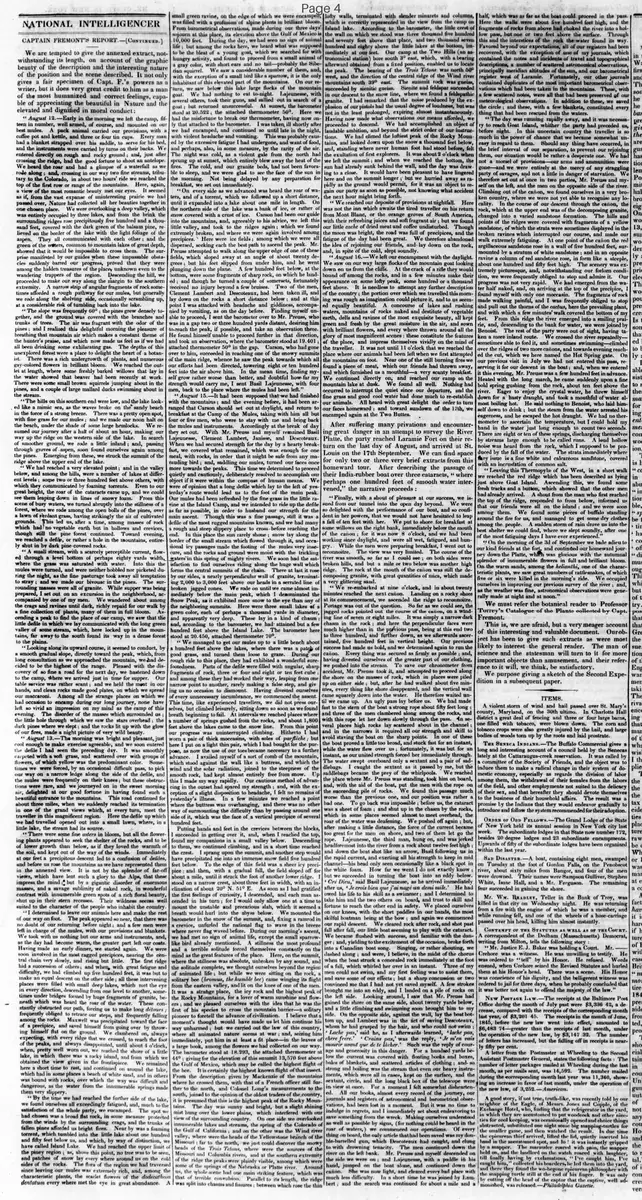
"August 12.-Early in the morning we left the camp, fifteen in number, well armed, of course, and mounted on our best mules. A pack animal carried our provisions, with a coffee pot and kettle, and three or four tin cups. Every man had a blanket strapped over his saddle, to serve for his bed, and the instruments were carried by turns on their backs. We entered directly on rough and rocky ground; and, just after crossing the ridge, had the good fortune to shoot an antelope. We heard the roar and had a glimpse of a waterfall as we rode along; and, crossing in our way two fine streams, tributary to the Colorado, in about two hours' ride we reached the top of the first row or range of the mountains. Here, again, a view of the most romantic beauty met our eyes. It seemed as if, from the vast expanse of uninteresting prairie we had passed over, Nature had collected all her beauties together in one chosen place. We were overlooking a deep valley, which was entirely occupied by three lakes, and from the brink the surrounding ridges rose precipitously five hundred and a thousand feet, covered with the dark green of the balsam pine, relieved on the border of the lake with the light foliage of the aspen. They all communicated with each other; and the green of the waters, common to mountain lakes of great depth, showed that it would be impossible to cross them. The surprise manifested by our guides when these impassable obstacles suddenly barred our progress, proved that they were among the hidden treasures of the place, unknown even to the wandering trappers of the region. Descending the hill, we proceeded to make our way along the margin to the southern extremity. A narrow strip of angular fragments of rock sometimes afforded a rough pathway for our mules, but generally we rode along the shelving side, occasionally scrambling up, at a considerable risk of tumbling back into the lake.
"The slope was frequently 60°; the pines grew densely together, and the ground was covered with the branches and trunks of trees. The air was fragrant with the odor of the pines; and I realized this delightful morning the pleasure of breathing that mountain air which makes a constant theme of the hunter's praise, and which now made us feel as if we had all been drinking some exhilarating gas. The depths of this unexplored forest were a place to delight the heart of a Botanist. There was a rich undergrowth of plants, and numerous gay-colored flowers in brilliant bloom. We reached the outlet at length, where some freshly barked willows that lay in the water showed that beaver had been recently at work. There were some small brown squirrels jumping about in the pines, and a couple of large mallard ducks swimming about in the stream.
"The hills on this southern end were low, and the lake looked like a mimic sea, as the waves broke on the sandy beach in the force of a strong breeze. There was a pretty open spot, with fine grass for our mules; and we made our noon halt on the beach, under the shade of some large hemlocks. We resumed our journey after a halt of about an hour, making our way up the ridge on the western side of the lake. In search of smoother ground, we rode a little inland; and, passing through groves of aspen, soon found ourselves again among the pines. Emerging from these, we struck the summit of the ridge above the upper end of the lake.
"We had reached a very elevated point; and in the valley below, and among the hills, were a number of lakes at different levels; some two or three hundred feet above others, with which they communicated by foaming torrents. Even to our great height, the roar of the cataracts came up, and we could see them leaping down in lines of snowy foam. From this scene of busy waters, we turned abruptly into the stillness of a forest, where we rode among the open boles of the pines, over a lawn of verdant grass, having strikingly the air of cultivated grounds. This led us, after a time, among masses of rock which had no vegetable earth but in hollows and crevices, though still the pine forest continued. Toward evening, we reached a defile, or rather a hole in the mountains, entirely shut in by dark pine-covered rocks.
"A small stream, with a scarcely perceptible current, flowed through a level bottom of perhaps eighty yards width, where the grass was saturated with water. Into this the mules were turned, and were neither hobbled nor picketed during the night, as the fine pasturage took away all temptation to stray; and we made our bivouac in the pines. The surrounding masses were all of granite. While supper was being prepared, I set out on an excursion in the neighborhood, accompanied by one of my men. We wandered about among the crags and ravines until dark, richly repaid for our walk by a fine collection of plants, many of them in full bloom. Ascending a peak to find the place of our camp, we saw that the little defile in which we lay communicated with the long green valley of some stream, which, here locked up in the mountains, far away to the south found its way in a dense forest to the plains.
"Looking along its upward course, it seemed to conduct, by a smooth gradual slope, directly toward the peak, which, from long consultation as we approached the mountain, we had decided to be the highest of the range. Pleased with the discovery of so fine a road for the next day, we hastened down to the camp, where we arrived just in time for supper. Our table service was rather scant: and we held the meat in our hands, and clean rocks made good plates, on which we spread our maccaroni. Among all the strange places on which we had occasion to encamp during our long journey, none have left so vivid an impression on my mind as the camp of this evening. The disorder of the masses which surrounded us; the little hole through which we saw the stars overhead: the dark pines where we slept; and the rocks lit up with the glow of our fires, made a night picture of very wild beauty.
"August 13.-The morning was bright and pleasant, just cool enough to make exercise agreeable, and we soon entered the defile I had seen the preceding day. It was smoothly carpeted with a soft grass, and scattered over with groups of flowers, of which yellow was the predominant color. Sometimes we were forced, by an occasional difficult pass, to pick our way on a narrow ledge along the side of the defile, and the mules were frequently on their knees; but these obstructions were rare, and we journeyed on in the sweet morning air, delighted at our good fortune in having found such a beautiful entrance to the mountains. This road continued for about three miles, when we suddenly reached its termination in one of the grand views which, at every turn, meet the traveller in this magnificent region. Here the defile up which we had travelled opened out into a small lawn, where, in a little lake, the stream had its source.
"There were some fine asters in bloom, but all the flowering plants appeared to seek the shelter of the rocks, and to be of lower growth than below, as if they loved the warmth of the soil, and kept out of the way of the winds. Immediately at our feet a precipitous descent led to a confusion of defiles, and before us rose the mountains as we have represented them in the annexed view. It is not by the splendor of far-off views, which have lent such a glory to the Alps, that these impress the mind; but by a gigantic disorder of enormous masses, and a savage sublimity of naked rock, in wonderful contrast with innumerable green spots of a rich floral beauty, shut up in their stern recesses.
Their wildness seems well suited to the character of the people who inhabit the country.
"I determined to leave our animals here and make the rest of our way on foot. The peak appeared so near, that there was no doubt of our returning before night; and a few men were left in charge of the mules, with our provisions and blankets. We took with us nothing but our arms and instruments, and, as the day had become warm, the greater part left our coats. Having made an early dinner, we started again. We were soon involved in the most ragged precipices, nearing the central chain very slowly, and rising but little. The first ridge hid a succession of others; and when, with great fatigue and difficulty, we had climbed up five hundred feet, it was but to make an equal descent on the other side; all these intervening places were filled with small deep lakes, which met the eye in every direction, descending from one level to another, sometimes under bridges formed by huge fragments of granite, beneath which was heard the roar of the water. These constantly obstructed our path, forcing us to make long detours; frequently obliged to retrace our steps, and frequently falling among the rocks. Maxwell was precipitated toward the face of a precipice, and saved himself from going over by throwing himself flat on the ground. We clambered on, always expecting, with every ridge that we crossed, to reach the foot of the peaks, and always disappointed, until about 4 o'clock, when, pretty well worn out, we reached the shore of a little lake, in which there was a rocky island, and from which we obtained the view given in the frontispiece. We remained here a short time to rest, and continued on around the lake, which had in some places a beach of white sand, and in others was bound with rocks, over which the way was difficult and dangerous, as the water from the innumerable springs made them very slippery.
"By the time we had reached the further side of the lake, we found ourselves all exceedingly fatigued, and, much to the satisfaction of the whole party, we encamped. The spot we had chosen was a broad flat rock, in some measure protected from the winds by the surrounding crags, and the trunks of fallen pines afforded us bright fires. Near by was a foaming torrent, which tumbled into the little lake about one hundred and fifty feet below us, and which, by way of distinction, we have called Island Lake. We had reached the upper limit of the piney region; as, above this point, no tree was to be seen, and patches of snow lay everywhere around us on the cold sides of the rocks. The flora of the region we had traversed since leaving our mules was extremely rich, and, among the characteristic plants, the scarlet flowers of the dodecatheon dentatum everywhere met the eye in great abundance. A small green ravine, on the edge of which we were encamped, was filled with a profusion of alpine plants in brilliant bloom. From barometrical observations, made during our three days' sojourn at this place, its elevation above the Gulf of Mexico is 10,000 feet. During the day, we had seen no sign of animal life; but among the rocks here, we heard what was supposed to be the bleat of a young goat, which we searched for with hungry activity, and found to proceed from a small animal of a gray color, with short ears and no tail-probably the Siberian squirrel. We saw a considerable number of them, and, with the exception of a small bird like a sparrow, it is the only inhabitant of this elevated part of the mountains. On our return, we saw below this lake large flocks of the mountain goat. We had nothing to eat to-night. Lajeunesse, with several others, took their guns, and sallied out in search of a goat; but returned unsuccessful. At sunset, the barometer stood at 20.522; the attached thermometer 50°. Here we had the misfortune to break our thermometer, having now only that attached to the barometer. I was taken ill shortly after we had encamped, and continued so until late in the night, with violent headache and vomiting. This was probably caused by the excessive fatigue I had undergone, and want of food, and perhaps, also, in some measure, by the rarity of the air. The night was cold, as a violent gale from the north had sprung up at sunset, which entirely blew away the heat of the fires. The cold, and our granite beds, had not been favorable to sleep, and we were glad to see the face of the sun in the morning. Not being delayed by any preparation for breakfast, we set out immediately.
"On every side as we advanced was heard the roar of waters, and of a torrent, which we followed up a short distance, until it expanded into a lake about one mile in length. On the northern side of the lake was a bank of ice, or rather of snow covered with a crust of ice. Carson had been our guide into the mountains, and, agreeably to his advice, we left this little valley, and took to the ridges again; which we found extremely broken, and where we were again involved among precipices. Here were ice fields; among which we were all dispersed, seeking each the best path to ascend the peak. Mr. Preuss attempted to walk along the upper edge of one of these fields, which sloped away at an angle of about twenty degrees; but his feet slipped from under him, and he went plunging down the plane. A few hundred feet below, at the bottom, were some fragments of sharp rock, on which he landed; and though he turned a couple of somersets, fortunately received no injury beyond a few bruises. Two of the men, Clement Lambert and Descoteaux, had been taken ill, and lay down on the rocks a short distance below; and at this point I was attacked with headache and giddiness, accompanied by vomiting, as on the day before. Finding myself unable to proceed, I sent the barometer over to Mr. Preuss, who was in a gap two or three hundred yards distant, desiring him to reach the peak, if possible, and take an observation there. He found himself unable to proceed further in that direction, and took an observation, where the barometer stood at 19.401, attached thermometer 50 in the gap. Carson, who had gone over to him, succeeded in reaching one of the snowy summits of the main ridge, whence he saw the peak towards which all our efforts had been directed, towering eight or ten hundred feet into the air above him. In the mean time, finding myself grow rather worse than better, and doubtful how far my strength would carry me, I sent Basil Lajeunesse, with four men, back to the place where the mules had been left."
"August 15.--It had been supposed that we had finished with the mountains; and the evening before, it had been arranged that Carson should set out at daylight, and return to breakfast at the Camp of the Mules, taking with him all but four or five men, who were to stay with me and bring back the mules and instruments. Accordingly at the break of day they set out. With Mr. Preuss and myself remained Basil Lajeunesse, Clement Lambert, Janisse, and Descoteaux. When we had secured strength for the day by a hearty breakfast, we covered what remained, which was enough for one meal, with rocks, in order that it might be safe from any marauding bird; and, saddling our mules, turned our faces once more towards the peaks. This time we determined to proceed quietly and cautiously, deliberately resolved to accomplish our object if it were within the compass of human means. We were of opinion that a long defile which lay to the left of yesterday's route would lead us to the foot of the main peak. Our mules had been refreshed by the fine grass in the little ravine at the Island Camp, and we intended to ride up the defile as far as possible, in order to husband our strength for the main ascent. Though this was a fine passage, still it was a defile of the most rugged mountains known, and we had many a rough and steep slippery place to cross-before reaching the end. In this place the sun rarely shone; snow lay along the border of the small stream which flowed through it, and occasional icy passages made the footing of the mules very insecure, and the rocks and ground were moist with the trickling waters in this spring of mighty rivers. We soon had the satisfaction to find ourselves riding along the huge wall which forms the central summits of the chain. There at last it rose by our sides, a nearly perpendicular wall of granite, terminating 2,000 to 3,000 feet above our heads in a serrated line of broken jagged cones. We rode on until we came almost immediately below the main peak, which I denominated the Snow Peak, as it exhibited more snow to the eye than any of the neighboring summits. Here were three small lakes of a green color, each of perhaps a thousand yards in diameter, and apparently very deep. These lay in a kind of chasm; and, according to the barometer, we had attained but a few hundred feet above the Island Lake. The barometer here stood at 20.450, attached thermometer 70°.
"We managed to get our mules up to a little bench about a hundred feet above the lakes, where there was a patch of good grass, and turned them loose to graze. During our rough ride to this place, they had exhibited a wonderful surefootedness. Parts of the defile were filled with angular, sharp fragments of rock, three or four and eight or ten feet cube; and among these they had worked their way, leaping from one narrow point to another, rarely making a false step, and giving us no occasion to dismount. Having divested ourselves of every unnecessary incumbrance, we commenced the ascent. This time, like experienced travellers, we did not press ourselves, but climbed leisurely, sitting down so soon as we found breath beginning to fail. At intervals we reached places where a number of springs gushed from the rocks, and about 1,800 feet above the lakes came to the snow line. From this point our progress was uninterrupted climbing. Hitherto I had worn a pair of thick moccasins, with soles of parflèche; but here I put on a light thin pair, which I had bought for the purpose, as now the use of our toes became necessary to a further advance. I availed myself of a sort of comb of the mountain, which stood against the wall like a buttress, and which the wind and the solar radiation, joined to the steepness of the smooth rock, had kept almost entirely free from snow. Up this I made my way rapidly. Our cautious method of advancing in the outset had spared my strength; and, with the exception of a slight disposition to headache, I felt no remains of yesterday's illness. In a few minutes we reached a point where the buttress was overhanging, and there was no other way of surmounting the difficulty than by passing around one side of it, which was the face of a vertical precipice of several hundred feet.
Putting hands and feet in the crevices between the blocks, I succeeded in getting over it, and, when I reached the top, found my companions in a small valley below. Descending to them, we continued climbing, and in a short time reached the crest. I sprang upon the summit, and another step would have precipitated me into an immense snow field five hundred feet below. To the edge of this field was a sheer icy precipice; and then, with a gradual fall, the field sloped off for about a mile, until it struck the foot of another lower ridge. I stood on a narrow crest, about three feet in width, with an inclination of about 20° N. 51° E. As soon as I had gratified the first feelings of curiosity, I descended, and each man ascended in his turn; for I would only allow one at a time to mount the unstable and precarious slab, which it seemed a breath would hurl into the abyss below. We mounted the barometer in the snow of the summit, and, fixing a ramrod in a crevice, unfurled the national flag to wave in the breeze where never flag waved before. During our morning's ascent, we had met no sign of animal life, except the small sparrow-like bird already mentioned. A stillness the most profound and a terrible solitude forced themselves constantly on the mind as the great features of the place. Here, on the summit, where the stillness was absolute, unbroken by any sound, and the solitude complete, we thought ourselves beyond the region of animated life; but while we were sitting on the rock, a solitary bee (bromus, the humble bee) came winging its flight from the eastern valley, and lit on the knee of one of the men. It was a strange place, the icy rock and the highest peak of the Rocky Mountains, for a lover of warm sunshine and flowers; and we pleased ourselves with the idea that he was the first of his species to cross the mountain barrier-a solitary pioneer to foretell the advance of civilization. I believe that a moment's thought would have made us let him continue his way unharmed; but we carried out the law of this country, where all animated nature seems at war; and, seizing him immediately, put him in at least a fit place-in the leaves of a large book, among the flowers we had collected on our way. The barometer stood at 18.293, the attached thermometer at 44°; giving for the elevation of this summit 13,570 feet above the Gulf of Mexico, which may be called the highest flight of the bee. It is certainly the highest known flight of that insect. From the description given by Mackenzie of the mountains where he crossed them, with that of a French officer still further to the north, and Colonel Long's measurements to the south, joined to the opinion of the oldest traders of the country, it is presumed that this is the highest peak of the Rocky Mountains. The day was sunny and bright, but a slight shining mist hung over the lower plains, which interfered with our view of the surrounding country. On one side we overlooked innumerable lakes and streams, the spring of the Colorado of the Gulf of California: and on the other was the Wind river valley, where were the heads of the Yellowstone branch of the Missouri; far to the north, we just could discover the snowy heads of the Trois Tetons, where were the sources of the Missouri and Columbia rivers, and at the southern extremity of the ridge the peaks were plainly visible, among which were some of the springs of the Nebraska or Platte river. Around us, the whole scene had one main striking feature, which was that of terrible convulsion. Parallel to its length, the ridge was split into chasms and fissures: between which rose the lofty walls, terminated with slender minarets and columns which is correctly represented in the view from the camp on Island lake. According to the barometer, the little crest of the wall on which we stood was three thousand five hundred and seventy feet above that place, and two thousand seven hundred and eighty above the little lakes at the bottom, immediately at our feet. Our camp at the Two Hills (an astronomical station) bore south 3° east, which, with a bearing afterward obtained from a fixed position, enabled us to locate the peak. The bearing of the Trois Tetons was north 50 west, and the direction of the central ridge of the Wind river mountains south 39 east. The summit rock was gneiss, succeeded by sienitic gneiss. Sienite and feldspar succeeded in our descent to the snow line, where we found a feldspathic granite. I had remarked that the noise produced by the explosion of our pistols had the usual degree of loudness, but was not in the least prolonged, expiring almost instantaneously. Having now made what observations our means afforded, we proceeded to descend. We had accomplished an object of laudable ambition, and beyond the strict order of our instructions. We had climbed the loftiest peak of the Rocky Mountains, and looked down upon the snow a thousand feet below, and, standing where never human foot had stood before, felt the exultation of first explorers. It was about 2 o'clock when we left the summit; and when we reached the bottom, the sun had already sunk behind the wall, and the day was drawing to a close. "It would have been pleasant to have lingered here and on the summit longer; but we hurried away as rapidly as the ground would permit, for it was an object to regain our party as soon as possible, not knowing what accident the next hour might bring forth.
"We reached our deposit of provisions at nightfall. Here was not the inn which awaits the tired traveller on his return from Mont Blanc, or the orange groves of South America, with their refreshing juices and soft fragrant air; but we found our little cache of dried meat and coffee undisturbed. Though the moon was bright, the road was full of precipices, and the fatigue of the day had been great. We therefore abandoned the idea of rejoining our friends, and lay down on the rock, and, in spite of the cold, slept soundly.
"August 16.-We left our encampment with the daylight. We saw on our way large flocks of the mountain goat looking down on us from the cliffs. At the crack of a rifle they would bound off among the rocks, and in a few minutes make their appearance on some lofty peak, some hundred or a thousand feet above. It is needless to attempt any further description of the country; the portion over which we travelled this morning was rough as imagination could picture it, and to us seemed equally beautiful. A concourse of lakes and rushing waters, mountains of rocks naked and destitute of vegetable earth, dells and ravines of the most exquisite beauty, all kept green and fresh by the great moisture in the air, and sown with brilliant flowers, and everywhere thrown around all the glory of most magnificent scenes: these constitute the features of the place, and impress themselves vividly on the mind of the traveller. It was not until 11 o'clock that we reached the place where our animals had been left when we first attempted the mountains on foot. Near one of the still burning fires we found a piece of meat, which our friends had thrown away, and which furnished us a mouthful-a very scanty breakfast. We continued directly on, and reached our camp on the mountain lake at dusk. We found all well. Nothing had occurred to interrupt the quiet since our departure, and the fine grass and good cool water had done much to re-establish our animals. All heard with great delight the order to turn our faces homeward; and toward sundown of the 17th, we encamped again at the Two Buttes. After suffering many privations and encountering great danger in an attempt to survey the River Platte, the party reached Laramie Fort on their return on the last day of August, and arrived at St. Louis on the 17th September. We can find space for only two or three very brief extracts from this homeward tour. After describing the passage of their India-rubber boat over three cataracts, "where perhaps one hundred feet of smooth water intervened," the narrative proceeds:
Finally, with a shout of pleasure at our success, we issued from our tunnel into the open day beyond. We were so delighted with the performance of our boat, and so confident in her powers, that we would not have hesitated to leap a fall of ten feet with her. We put to shore for breakfast at some willows on the right bank, immediately below the mouth of the canon; for it was now 8 o'clock, and we had been working since daylight, and were all wet, fatigued, and hungry. While the men were preparing breakfast, I went out to reconnoitre. The view was very limited. The course of the river was smooth, so far as I could see; on both sides were broken hills, and but a mile or two below was another high ridge. The rock at the mouth of the canon was still the decomposing granite, with great quantities of mica, which made a very glittering sand.
"We re-embarked at nine o'clock, and in about twenty minutes reached the next cañon. Landing on a rocky shore at its commencement, we ascended the ridge to reconnoitre. Portage was out of the question. So far as we could see, the jagged rocks pointed out the course of the cañon, on a winding line of seven or eight miles. It was simply a narrow dark chasm in the rock; and here the perpendicular faces were much higher than in the previous pass, being at this end two to three hundred, and further down, as we afterwards ascertained, five hundred feet in vertical height. Our previous success had made us bold, and we determined again to run the cañon. Every thing was secured as firmly as possible; and, having divested ourselves of the greater part of our clothing, we pushed into the stream. To save our chronometer from accident, Mr. Preuss took it, and attempted to proceed along the shore on the masses of rock, which in places were piled up on either side; but, after he had walked about five minutes, every thing like shore disappeared, and the vertical wall came squarely down into the water. He therefore waited until we came up. An ugly pass lay before us. We had made fast to the stern of the boat a strong rope about fifty feet long, and three of the men clambered along among the rocks, and with this rope let her down slowly through the pass. In several places high rocks lay scattered about in the channel; and in the narrows it required all our strength and skill to avoid staving the boat on the sharp points. In one of these the boat proved a little too broad, and stuck fast for an instant, while the water flew over us; fortunately, it was but for an instant, as our united strength forced her immediately through. The water swept overboard only a sextant and a pair of saddlebags. I caught the sextant as it passed by me, but the saddlebags became the prey of the whirlpools. We reached the place where Mr. Preuss was standing, took him on board, and, with the aid of the boat, put the men with the rope on the succeeding pile of rocks. We found this passage much worse than the previous one, and our position was rather a bad one. To go back was impossible; before us, the cataract was a sheet of foam; and shut up in the chasm by the rocks, which in some places seemed almost to meet overhead, the roar of the water was deafening. We pushed off again; but after making a little distance, the force of the current became too great for the men on shore, and two of them let go the rope. Lajeunesse, the third man, hung on, and was jerked headforemost into the river from a rock about twelve feet high; and down the boat shot like an arrow, Basil following us in the rapid current, and exerting all his strength to keep in mid channel-his head only seen occasionally like a black spot in the white foam. How far we went I do not exactly know; but we succeeded in turning the boat into an eddy below. 'Cré Dieu,' said Basil Lajeunesse, as he arrived immediately after us, 'Je crois bien que j'ai nagé un demi mile.' He had owed his life to his skill as a swimmer; and I determined to take him and the two others on board, and trust to skill and fortune to reach the other end in safety. We placed ourselves on our knees, with the short paddles in our hands, the most skilful boatman being at the bow; and again we commenced our rapid descent. We cleared rock after rock, and shot past fall after fall, our little boat seeming to play with the cataract. We became flushed with success, and familiar with the danger; and, yielding to the excitement of the occasion, broke forth into a Canadian boat song. Singing, or rather shouting, we dashed along; and were, I believe, in the midst of the chorus when the boat struck a concealed rock immediately at the foot of a fall, which whirled her over in an instant. Three of my men could not swim, and my first feeling was to assist them, and save some of our effects; but a sharp concussion or two convinced me that I had not yet saved myself. A few strokes brought me into an eddy, and I landed on a pile of rocks on the left side. Looking around, I saw that Mr. Preuss had gained the shore on the same side, about twenty yards below. And a little climbing and swimming soon brought him to my side. On the opposite side, against the wall, lay the boat bottom up, and Lambert was in the act of saving Descoteaux, whom he had grasped by the hair, and who could not swim 'Lache pas,' said he, as I afterwards learned, 'lache pas, chere frere.' 'Crains pas,' was the reply, 'Je m'en vais mourir avant que de te lâcher.' Such was the reply of courage and generosity in this danger. For a hundred yards below the current was covered with floating books and boxes, bales of blankets, and scattered articles of clothing; and so strong and boiling was the stream that even our heavy instruments, which were all in cases, kept on the surface, and the sextant, circle, and the long black box of the telescope were in view at once. For a moment I felt somewhat disheartened. All our books, almost every record of the journey, our journals and registers of astronomical and barometrical observations, had been lost in a moment. But it was no time to indulge in regrets, and I immediately set about endeavoring to save something from the wreck. Making ourselves understood as well as possible by signs, (for nothing could be heard in the roar of waters,) we commenced our operations. Of every thing on board, the only article that had been saved was my double-barrelled gun, which Descoteaux had caught, and clung to with drowning tenacity. The men continued down the river on the left bank. Mr. Preuss and myself descended on the side we were on; and Lajeunesse, with a paddle in his hand, jumped on the boat alone, and continued down the canon. She was now light, and cleared every bad place with much less difficulty. In a short time he was joined by Lambert; and the search was continued for about a mile and a half, which was as far as the boat could proceed in the pass. Here the walls were about five hundred feet high, and the fragments of rocks from above had choked the river into a hollow pass, but one or two feet above the surface. Through this and the interstices of the rock the water found its way. Favored beyond our expectations, all of our registers had been recovered, with the exception of one of my journals, which contained the notes and incidents of travel and topographical descriptions, a number of scattered astronomical observations, principally meridian altitudes of the sun, and our barometrical register west of Laramie. Fortunately, our other journals contained duplicates of the most important barometrical observations which had been taken in the mountains. These, with a few scattered notes, were all that had been preserved of our meteorological observations. In addition to these, we saved the circle; and these, with a few blankets, constituted every thing that had been rescued from the waters.
"The day was running rapidly away, and it was necessary to reach Goat Island, whither the party had preceded us, before night. In this uncertain country the traveller is so much in the power of chance that we became somewhat uneasy in regard to them. Should any thing have occurred, in the brief interval of our separation, to prevent our rejoining them, our situation would be rather a desperate one. We had not a morsel of provisions--our arms and ammunition were gone--and we were entirely at the mercy of any straggling party of savages, and not a little in danger of starvation. We therefore set out at once in two parties, Mr. Preuss and myself on the left, and the men on the opposite side of the river. Climbing out of the canon, we found ourselves in a very broken country, where we were not yet able to recognise any locality. In the course of our descent through the canon, the rock, which at the upper end was of the decomposing granite, changed into a varied sandstone formation. The hills and points of the ridges were covered with fragments of a yellow sandstone, of which the strata were sometimes displayed in the broken ravines which interrupted our course, and made our walk extremely fatiguing. At one point of the cañon the red argillaceous sandstone rose in a wall of five hundred feet, surmounted by a stratum of white sandstone; and in an opposite ravine a column of red sandstone rose, in form like a steeple, about one hundred and fifty feet high. The scenery was extremely picturesque, and, notwithstanding our forlorn condition, we were frequently obliged to stop and admire it. Our progress was not very rapid. We had emerged from the water half naked, and, on arriving at the top of the precipice, I found myself with only one moccasin. The fragments of rock made walking painful, and I was frequently obliged to stop and pull out the thorns of the cactus, here the prevailing plant, and with which a few minutes' walk covered the bottom of my feet. From this ridge the river emerged into a smiling prairie, and, descending to the bank for water, we were joined by Benoist. The rest of the party were out of sight, having taken a more inland route. We crossed the river repeatedly--sometimes able to ford it, and sometimes swimming--climbed over the ridges of two more canons, and towards evening reached the cut, which we here named the Hot Spring gate. On our previous visit in July we had not entered this pass, reserving it for our descent in the boat; and, when we entered it this evening, Mr. Preuss was a few hundred feet in advance. Heated with the long march, he came suddenly upon a fine bold spring gushing from the rock, about ten feet above the river. Eager to enjoy the crystal water, he threw himself down for a hasty draught, and took a mouthful of water almost boiling hot. He said nothing to Benoist, who laid himself down to drink; but the steam from the water arrested his eagerness, and he escaped the hot draught. We had no thermometer to ascertain the temperature, but I could hold my hand in the water just long enough to count two seconds. There are eight or ten of these springs, discharging themselves by streams large enough to be called runs. A loud hollow noise was heard from the rock, which I supposed to be produced by the fall of the water. The strata immediately where they issue is a fine white and calcareous sandstone, covered with an incrustation of common salt.
"Leaving this Thermopylae of the West, in a short walk we reached the red ridge which has been described as lying just above Goat Island. Ascending this, we found some fresh tracks and a button, which showed that the other men had already arrived. A shout from the man who first reached the top of the ridge, responded to from below, informed us that our friends were all on the island; and we were soon among them. We found some pieces of buffalo standing around the fire for us, and managed to get some dry clothes among the people. A sudden storm of rain drove us into the best shelter we could find, where we slept soundly, after one of the most fatiguing days I have ever experienced."
"On the morning of the 3d of September we bade adieu to our kind friends at the fort, and continued our homeward journey down the Platte, which was glorious with the autumnal splendor of innumerable flowers in full and brilliant bloom. On the warm sands, among the helianthi, one of the characteristic plants, we saw great numbers of rattlesnakes, of which five or six were killed in the morning's ride. We occupied ourselves in improving our previous survey of the river; and, as the weather was fine, astronomical observations were generally made at night and at noon."
We must refer the botanical reader to Professor Torrey's Catalogue of the Plants collected by Capt. Fremont.
This is, we are afraid, but a very meager account of this interesting and valuable document. Our object has been to give such extracts as were most likely to interest the general reader. The man of science and the statesman will turn to it for more important objects than amusement, and their reference to it will, we think, be satisfactory.
We purpose giving a sketch of the Second Expedition in a subsequent paper.
What sub-type of article is it?
What themes does it cover?
What keywords are associated?
What entities or persons were involved?
Where did it happen?
Story Details
Key Persons
Location
Rocky Mountains, Wind River Mountains, Platte River
Event Date
August 12 16, 1842; September 3, 1842
Story Details
Party of 15 led by Capt. Fremont explores Rocky Mountains on mules, encounters lakes and forests, ascends highest peak at 13,570 feet planting flag, observes wildlife and geology; on return, boat capsizes in canyon losing gear but most recovered, reunite at Goat Island, continue down Platte River.