Thank you for visiting SNEWPapers!
Sign up free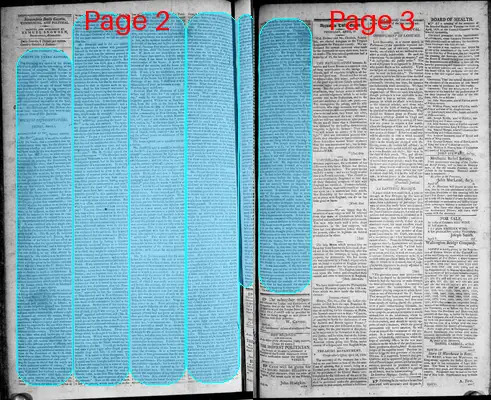
Alexandria Daily Gazette, Commercial & Political
Alexandria, Virginia
What is this article about?
In the U.S. House of Representatives on March 3, Mr. Randolph proposed a resolution declaring illegal extra rations and quarters allowances to Brig. Gen. Wilkinson, citing the 1802 act. Debate ensued with Mr. Jackson defending based on Attorney General's opinion and separation of powers; Mr. Rowan supported inquiry into expenditures.
Merged-components note: This is a continuation of the debate on extra rations from page 2 to page 3, as the text flows directly from the resolution discussion.
Clippings
1 of 2
OCR Quality
Full Text
DEBATE ON EXTRA RATIONS:
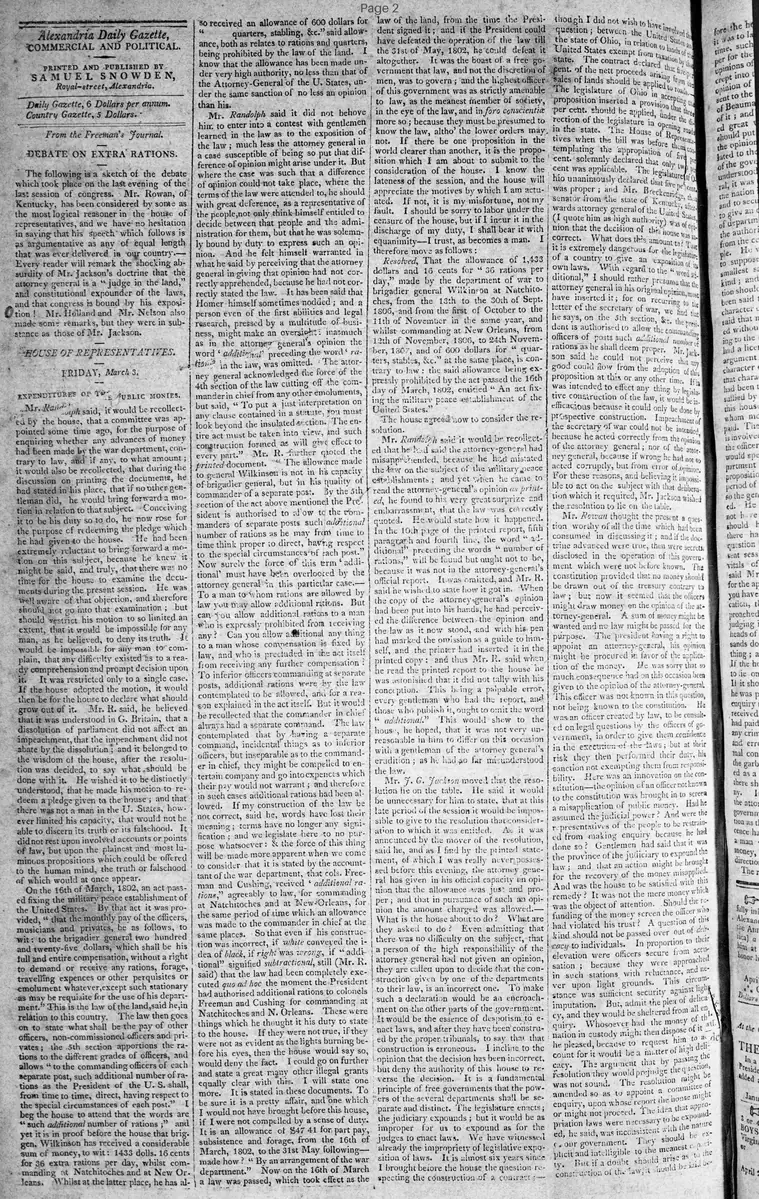
The following is a sketch of the debate which took place on the last evening of the last session of congress. Mr. Rowan, of Kentucky, has been considered by some as the most logical reasoner in the house of representatives, and we have no hesitation in saying that his speech which follows is as argumentative as any of equal length that was ever delivered in our country.-- Every reader will remark the shocking absurdity of Mr Jackson's doctrine that the attorney general is a "judge in the land," and constitutional expounder of the laws, and that congress is bound by his exposition! Mr. Holland and Mr. Nelson also made some remarks, but they were in substance as those of Mr. Jackson.
HOUSE OF REPRESENTATIVES.
FRIDAY, March 3.
EXPENDITURES OF THE PUBLIC MONIES.
Mr. Randolph said; it would be recollected by the house, that a committee was appointed some time ago, for the purpose of enquiring whether any advances of money had been made by the war department, contrary to law, and if any, to what amount; it would also be recollected, that during the discussion on printing the documents, he had stated in his place, that if no other gentleman did, he would bring forward a motion in relation to that subject. Conceiving it to be his duty so to do, he now rose for the purpose of redeeming the pledge which he had given to the house. He had been extremely reluctant to bring forward a motion on this subject, because he knew it might be said, and truly, that there was no time for the house to examine the documents during the present session. He was well aware of that objection, and therefore should not go into that examination; but should restrict his motion to so limited an extent, that it would be impossible for any man, as he believed, to deny its truth. It would be impossible for any man to complain, that any difficulty existed as to a ready comprehension and prompt decision upon it. - It was restricted only to a single case. If the house adopted the motion, it would then be for the house to declare what should grow out of it. Mr. R. said, he believed that it was understood in G. Britain, that a dissolution of parliament did not affect an impeachment, that the impeachment did not abate by the dissolution; and it belonged to the wisdom of the house, after the resolution was decided, to say what should be done with it. He wished it to be distinctly understood, that he made his motion to redeem a pledge given to the house; and that there was not a man in the U. States, however limited his capacity, that would not be able to discern its truth or its falsehood. It did not rest upon involved accounts or points of law, but upon the plainest and most lucid propositions which could be offered to the human mind, the truth or falsehood of which would at once appear.
On the 16th of March, 1802, an act passed fixing the military peace establishment of the United States. By that act it was provided, "that the monthly pay of the officers, musicians and privates, be as follows, to wit: to the brigadier general two hundred and twenty-five dollars, which shall be his full and entire compensation, without a right to demand or receive any rations, forage, travelling expenses or other perquisites or emolument whatever, except such stationery as may be requisite for the use of his department." This is the law of the land, said he, in relation to this country. The law then goes on to state what shall be the pay of other officers, non-commissioned officers and privates; the 5th section apportions the rations to the different grades of officers, and allows "to the commanding officers of each separate post, such additional number of rations as the President of the U. S. shall, from time to time, direct, having respect to the special circumstances of each post." I beg the house to attend that the words are "such additional number of rations;" and yet it is in proof before the house that brig. gen. Wilkinson has received a considerable sum of money, to wit: 1433 dolls. 16 cents for 36 extra rations per day, whilst commanding at Natchitoches and at New Orleans. Whilst at the latter place, he has also received an allowance of 600 dollars for quarters, stabling, &c." said allowance, both as relates to rations and quarters, being prohibited by the law of the land. I know that the allowance has been made under very high authority, no less than that of the Attorney-General of the U. States, under the same sanction of no less an opinion than his.
Mr. Randolph said it did not behove him, to enter into a contest with gentlemen learned in the law as to the exposition of the law; much less the attorney general in a case susceptible of being so put that difference of opinion might arise under it. But where the case was such that a difference of opinion could not take place, where the terms of the law were attended to, he should with great deference, as a representative of the people, not only think himself entitled to decide between that people and the administration for them, but that he was solemnly bound by duty to express such an opinion. -And he felt himself warranted in what he said by perceiving that the attorney general in giving that opinion had not correctly apprehended, because he had not correctly stated the law. -It has been said that Homer-himself sometimes nodded; and a person even of the first abilities and legal research, pressed by a multitude of business, might make an oversight: inasmuch as in the attorney general's opinion the word 'additional' preceding the word 'ration' in the law, was omitted. - The attorney general acknowledged the force of the 4th section of the law cutting off the commander in chief from any other emoluments, but said, "To put a just interpretation on any clause contained in a statute, you must look beyond the insulated section. The entire act must be taken into view, and such construction formed as will give effect to every part." Mr. R. further quoted the printed-document. The allowance made to general Wilkinson is not in his capacity of brigadier general, but in his quality of commander of a separate post. By the 5th section of the act above mentioned the President is authorised to allow to the commanders of separate posts such additional number of rations as he may from time to time think proper to direct, having respect to the special circumstances of each post." Now surely the force of this term 'additional' must have been overlooked by the attorney general in this particular case.-- To a man to whom rations are allowed by law you may allow additional rations. But can you allow additional rations to a man who is expressly prohibited from receiving any? Can you allow additional any thing to a man whose compensation is fixed by law, and who is precluded in the act itself from receiving any further compensation? To inferior officers commanding at separate posts, additional rations were by the law contemplated to be allowed, and for a reason explained in the act itself. But it would be recollected that the commander in chief always had a separate command. The law contemplated that by having a separate command, incidental things as to inferior officers, but inseparable as to the commander in chief, they might be compelled to entertain company and go into expenses which their pay would not warrant; and therefore in such cases additional rations had been allowed. If my construction of the law be not correct, said he, words have lost their meaning; terms have no longer any signification; and we legislate here to no purpose whatsoever: & the force of this thing will be made more apparent when we come to consider that it is stated by the accountant of the war department, that cols. Freeman and Cushing, received 'additional rations,' agreeably to law, for commanding at Natchitoches and at New-Orleans, for the same period of time which an allowance was made to the commander in chief at the same places. So that even if his construction was incorrect, if white conveyed the idea of black, if right was wrong, if "additional" signified subtractional, still (Mr. R. said) that the law had been completely executed quo ad hoc the moment the President had authorised additional rations to colonels Freeman and Cushing for commanding at Natchitoches and N. Orleans. These were things which he thought it his duty to state to the house. If they were not true, if they were not as evident as the lights burning before his eyes, then the house would say so, would deny the fact. I could go on further and state a great many other illegal grants equally clear with this. I will state one more. It is stated in these documents. To be sure it is a pretty affair, and one which I would not have brought before this house, if I were not compelled by a sense of duty. It is an allowance of $47 41 for part pay, subsistence and forage, from the 16th of March, 1802, to the 31st May following- made how ? "By an arrangement of the war department." Now on the 16th of March a law was passed, which took effect as the law of the land from the time the President signed it; and if the President could have defeated the operation of the law till the 31st of May, 1802, he could defeat it altogether. It was the boast of a free government that law, and not the discretion of men, was to govern; and the highest officer of this government was as strictly amenable to law, as the meanest member of society, in the eye of the law, and in foro conscientiae more so; because they must be presumed to know the law, altho' the lower orders may not. If there be one proposition in the world clearer than another, it is the proposition which I am about to submit to the consideration of the house. I know the lateness of the session, and the house will appreciate the motives by which I am actuated. If not, it is my misfortune, not my fault. I should be sorry to labor under the censure of the house, but if I incur it in the discharge of my duty, I shall bear it with equanimity--I trust, as becomes a man. I therefore move as follows :
Resolved, That the allowance of 1,433 dollars and 16 cents for "36 rations per day." made by the department of war to brigadier general Wilkinson at Natchitoches, from the 13th to the 30th of Sept. 1806, and from the first of October to the 11th of November in the same year, and whilst commanding at New Orleans, from 12th of November, 1806, to 24th November, 1807, and of 600 dollars for "quarters, stables, &c." at the same place, is contrary to law : the said allowance being expressly prohibited by the act passed the 16th day of March, 1802, entitled "An act fixing the military peace establishment of the United States."
The house agreed now to consider the resolution.
Mr. Randolph said it would be recollected that he had said the attorney-general had misapprehended, because he had misstated the law on the subject of the military peace establishments; and yet when he came to read the attorney-general's opinion as printed, he found to his very great surprise and embarrassment, that the law was correctly quoted. He would state how it happened. In the 10th page of the printed report, fifth paragraph and fourth line, the word "additional" preceding the words "number of rations," will be found but ought not to be, because it was not in the attorney-general's official report. It was omitted, and Mr. R. said he wished to state how it got in. When the copy of the attorney-general's opinion had been put into his hands, he had perceived the difference between the opinion and the law as it now stood, and with his pen had marked the omission as a guide to himself, and the printer had inserted it in the printed copy: and thus Mr. R. said when he read the printed report to the house he was astonished that it did not tally with his conception. This being a palpable error, every gentleman who had the report, and those who publish it, ought to omit the word "additional." This would shew to the house, he hoped, that it was not very unreasonable in him to differ on this occasion with a gentleman of the attorney general's erudition; as he had so far misunderstood the law.
Mr. J. G. Jackson moved that the resolution lie on the table. He said it would be unnecessary for him to state, that at this late period of the session it would be impossible to give to the resolution that consideration to which it was entitled. As it was announced by the mover of the resolution, said he, and as I find by the printed statement, of which I was really never possessed before this evening, the attorney general has given in his official capacity an opinion that the allowance was just and proper; and that in pursuance of such an opinion the amount charged was allowed.-- What is the house about to do? What are they asked to do? Even admitting that there was no difficulty on the subject, -that a person of the high responsibility of the attorney general had not given an opinion, they are called upon to decide that the construction given by one of the departments to their law, is an incorrect one. To make such a declaration would be an encroachment on the other parts of the government. It would be the essence of despotism. to enact laws, and after they have been construed by the proper tribunals, to say that that construction is erroneous. I incline to the opinion that the decision has been incorrect, but deny the authority of this house to reverse the decision. It is a fundamental principle of free governments that the powers of the several departments shall be separate and distinct. The legislature enacts; the judiciary expounds; but it would be as improper for us to expound as for the judges to enact laws. We have witnessed already the impropriety of legislative exposition of laws. It is almost six years since I brought before the house the question respecting the construction of a contract -- though I did it of Ohio. in relation to land United States an contract declared that five per cent. of the nett proceeds arising from the sales of lands should be applied under the direction of the legislature in opening roads in the state. The House of Representatives contemplating the appropriation of five per cent. when the bill was before them COn. cent. solemnly declared that only two cent was applicable The legislature of Ohio naiousy eca that was proper ; and Mr. senator from the state of Breckenridge Kentucky after- then attorney general of the United States I quote him as high authority was of opj- correct nion that the decision of this house to fie or in- What decision does this of this amount house to was Tuat it is extremely dangerous for the legislature of a country to give an exposition of its own laws. With regard to the "word ad. ditional," I should rather presume that the attorney general in his original opinion, must have inserted it; for on recurring to the letter of the secretary of war, we find that he says, on the 5th section, &c. the president is authorised to allow the commanding officers of posts such additional number of rations as he shall deem proper. Mr. Jackson said he could not perceive that any good could flow from the adoption of this proposition at this or any other time. If it was intended to effect any thing by legislative construction of the law, it would be inefficacious because it could only be done by prospective construction. Impeachment of the secretary of war could not be intended, because he acted correctly from the opinion of the attorney general; nor of the attorney general, because if wrong he had not so acted corruptly, but from error of opinion For these reasons, and believing it impossible to act on the subject with that deliberation which it required, Mr. Jackson wished the resolution to lie on the table.
Mr. Rowan thought the present a question worthy of all the time which had been consumed in discussing it; and if the doctrine advanced were true, then were secrets disclosed in the operation of this government which were not before known. The constitution provided that no money should be drawn out of the treasury contrary to law: but now it seemed that the officers might draw money on the opinion of the attorney-general. A sum of money might be wanted and no law might be passed for the purpose. The president having a right to appoint an attorney-general, his opinion might be procured in favor of the application of the money. He was sorry that so much consequence had on this occasion been given to the opinion of the attorney-general This officer was not known in this question not being known to the constitution. He was an officer created by law, to be consulted on legal questions by the officers of government, in order to give them confidence in the execution of the laws; but at their risk they then performed their duty, his sanction not exempting them from responsibility. Here was an innovation on the constitution--the opinion of an officer not known to the constitution was brought in to screen a misapplication of public money. Had he assumed the judicial power? And were the representatives of the people to be restrained from making enquiry because he had done so? Gentlemen had said that it was law; and that an action might be brought for the recovery of the money misapplied. And was the house to be satisfied with this remedy ? It was not the mere money which was the object of attention. Should the refunding of the money screen the officer who had violated his trust ? A question of this kind should not be passed over out of delicacy to individuals. "In proportion to their elevation were officers secure from accusation upon light grounds. This circumstance was sufficient security against light enquiry. Whosoever had the money of the country, and they would be sheltered from all imputation. But, admit the plea of delicacy. The argument that by passing the resolution they would prejudge the question, was not sound. The resolution might be amended so as to appoint t a committee of enquiry, upon whose report the house might or might not proceed. The idea that appropriation laws were necessary to be expounded, he said, was inconsistent with the nature of our government. They should be explicit and intelligible to the meanest capacity. But if a doubt should arise as to the construction of the law, it should be laid before the house for the time. such opinions of crept into the opinion of sent to the of Beauma of it ; and ed great should put jated to the the opinion of the gove understood ral, it was the nation and to secu to give an of deparim the authori ple. He from the ce to suppose smallest s kind; and tion shoul been said character : said that n ed withou ing to the had a lice argument character that chara had been sullied by this hous whom mc paid. The is involve the officer would spe partment propositic period of so the gen ed. He not have should there ha question Sent sess vitals of said Mr for the ap you have caticn, t proached judging heads of sands do thing ; a If the ho to fie or If it sho he was p enquiry received had paid any crim and err mal con the garb ed as a there sh ny. I the attoy governm tion as t cenceha a man money, directio The r
The House, the President, whose duty was to lay before congress from time to time, for their consideration. Three or four subjects as he should deem... opinions of the attorney general had lately... opinion of the attorney general had been history of this country. The... of Beaumarchais, without their requisition house the subject the claim... ed great weight. He thought the nation of it; and in other cases it had been allow- sould put their veto upon the influence of hated to the duties of the great departments the opinions of the attorney general, as re- understood the duties of the attorney gene- of the government. Mr. Rowan said, if he ral, it was to prosecute suits in the courts of the nation in behalf of the United States, to give an opinion on points which the heads and to secure their great interests; but not of departments should propose, and under ple. He would not give the nation reason from the censure and scrutiny of the peo- the authority of his opinion to screen them to suppose that the legislature lent the smailest sanction to a proceeding of this tion should immediately be acted on. It had lind; and therefore he thought the resolu- been said that this proposition involved the character of the persons concerned. Mr. R. said that malfaisance would never be alledg- ed without involving character; & accordl. ing to the doctrine laid down, public officers had a licence to do what they pleased. The argument that the resolution involwed the character of general Wilkinson was nothing. that character was out of the question; it had been too long in the public reach to be sullied by any thing which could be done in this house. The people never looked ro whom money is p il, bu. BY whom' it is paid. The responsibility of the department is involved. If they would give money to the officer, it was well understood that he would spend it. It was an error of ihe de- partment of war. He regretted that this proposition had come forward at so late a period of the session; but why it had done so the gentleman from Virginia had explain- ed. - He had rather that the subject should not h ve come before the house than it should have been dismissed lightly, for there-had scarcely been so important a question before the house during the pre- sent session. It connected itself with the vitals of the government. Say at once, said Mr. Rowan, when you make a law for the appropriation of public money, that vou have no power to enquire into its appli. caticu, that the subject shall not be ap- proached from delicacy or the fear of pre- judging it, and you immediately make the heads of departments despots. A few thou- sands dollars compared with principle is no- thing : a correct decision is worth millions. If the house were to permit the resolution to lie on the table, it might be amended. If it should be thought proper, Mr. R. said he was prepared to vote for a committee of enquiry not as to the man or men who had received the money, but as to those 'who had paid it. He did not say that there was any criminality in this ease, but malignity and error in this case were the same; for mal conduct would always elothe itself in the garb of the latter, were it to be admitt- ed as a plea in excuse. Upon this subject there should be the utmost rigor of scruti- ny. It was lamentable, if the opinion of the attorney general was to rule the whole government, that from so young an institu- tion as this government so perfect an exeres- cence had grown out. It was no excuse for a man who had the custody of the public money, that he had obeyed the executive direction in applying it improperly. The resolution received the go-by.
What sub-type of article is it?
What themes does it cover?
What keywords are associated?
What entities or persons were involved?
Where did it happen?
Story Details
Key Persons
Location
House Of Representatives
Event Date
March 3
Story Details
Debate on whether allowances of extra rations and quarters to Brig. Gen. Wilkinson were contrary to the 1802 military peace establishment act, with Mr. Randolph moving a resolution declaring them illegal, opposed by Mr. Jackson on grounds of separation of powers and Attorney General's opinion.