Thank you for visiting SNEWPapers!
Sign up free
The New Hampshire Gazette
Portsmouth, Rockingham County, New Hampshire
What is this article about?
Mr. Dexter argues before the New Hampshire General Assembly for indemnity to petitioners who suffered due to a state law conflicting with a U.S. Supreme Court decision on the capture of the Lufanna by the privateer brig M'Clary during the war. He emphasizes justice, the impossibility of abandoning the prize claim, and historical precedents for compensation.
Clipping
OCR Quality
Full Text
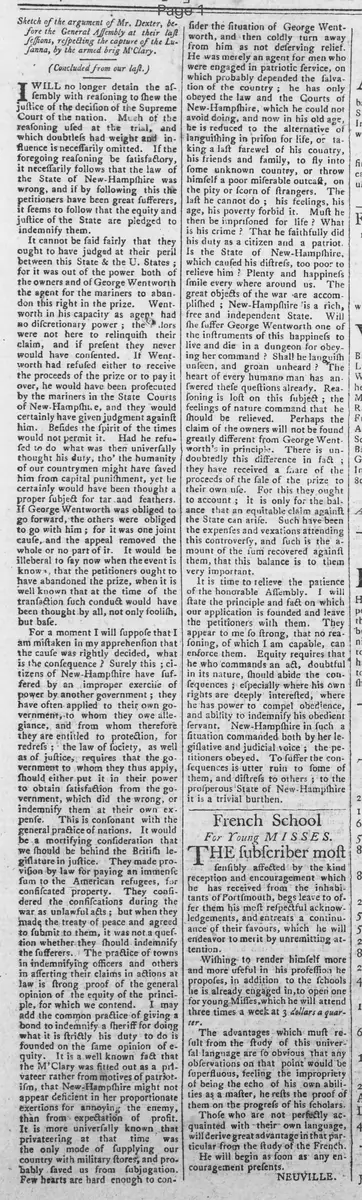
(Concluded from our last.)
WILL no longer detain the assembly with reasoning to shew the justice of the decision of the Supreme Court of the nation. Much of the reasoning used at the trial, and which doubtless had weight and influence is necessarily omitted. If the foregoing reasoning be satisfactory, it necessarily follows that the law of the State of New-Hampshire was wrong, and if by following this the petitioners have been great sufferers, it seems to follow that the equity and justice of the State are pledged to indemnify them.
It cannot be said fairly that they ought to have judged at their peril between this State & the U. States; for it was out of the power both of the owners and of George Wentworth the agent for the mariners to abandon this right in the prize. Wentworth in his capacity as agent had no discretionary power; the sailors were not here to relinquish their claim, and if present they never would have consented. If Wentworth had refused either to receive the proceeds of the prize or to pay it over, he would have been prosecuted by the mariners in the State Courts of New-Hampshire, and they would certainly have given judgment against him. Besides the spirit of the times would not permit it. Had he refused to do what was then universally thought his duty, tho' the humanity of our countrymen might have saved him from capital punishment, yet he certainly would have been thought a proper subject for tar and feathers.
If George Wentworth was obliged to go forward, the others were obliged to go with him; for it was one joint cause, and the appeal removed the whole or no part of it. It would be illiberal to say now when the event is known, that the petitioners ought to have abandoned the prize, when it is well known that at the time of the transaction such conduct would have been thought by all, not only foolish, but base.
For a moment I will suppose that I am mistaken in my apprehension that the cause was rightly decided, what is the consequence? Surely this; citizens of New-Hampshire have suffered by an improper exercise of power by another government; they have often applied to their own government to whom they owe allegiance, and from whom therefore they are entitled to protection, for redress; the law of society, as well as of justice, requires that the government to whom they thus apply, should either put it in their power to obtain satisfaction from the government, which did the wrong, or indemnify them at their own expense. This is consonant with the general practice of nations. It would be a mortifying consideration that we should be behind the British legislature in justice. They made provision by law for paying an immense sum to the American refugees, for confiscated property. They considered the confiscations during the war as unlawful acts; but when they made the treaty of peace and agreed to submit to them, it was not a question whether they should indemnify the sufferers. The practice of towns in indemnifying officers and others in asserting their claims in actions at law is strong proof of the general opinion of the equity of the principle, for which we contend. I may add the common practice of giving a bond to indemnify a sheriff for doing what it is strictly his duty to do is founded on the same opinion of equity. It is a well known fact that the M'Clary was fitted out as a privateer rather from motives of patriotism, that New-Hampshire might not appear deficient in her proportionate exertions for annoying the enemy, than from expectation of profit.
It is more universally known that privateering at that time was the only mode of supplying our country with military stores, and probably saved us from subjugation.
Few hearts are hard enough to consider the situation of George Wentworth, and then coldly turn away from him as not deserving relief.
What sub-type of article is it?
What themes does it cover?
What keywords are associated?
What entities or persons were involved?
Where did it happen?
Story Details
Key Persons
Location
New Hampshire
Story Details
Mr. Dexter argues that the New Hampshire law conflicting with the U.S. Supreme Court decision on the Lufanna prize capture was wrong, obligating the state to indemnify sufferers like agent George Wentworth, who had no choice but to proceed amid wartime patriotism and legal pressures.