Thank you for visiting SNEWPapers!
Sign up free
The Litchfield County Post
Litchfield, Litchfield County, Connecticut
What is this article about?
Governor Gideon Tomlinson's May 1827 address to the Connecticut General Assembly, thanking divine providence and voters, honoring revolutionary veterans, reviewing law revisions, proposing constitutional amendments for senate elections, advocating education improvements, addressing emigration and manufacturing, prison reform, and militia efficiency.
Merged-components note: These components form the complete Governor's Message, which continues across page 1 and page 2. The label is corrected to 'editorial' as it is an official address with opinion and policy discussion.
Clippings
1 of 2
OCR Quality
Full Text
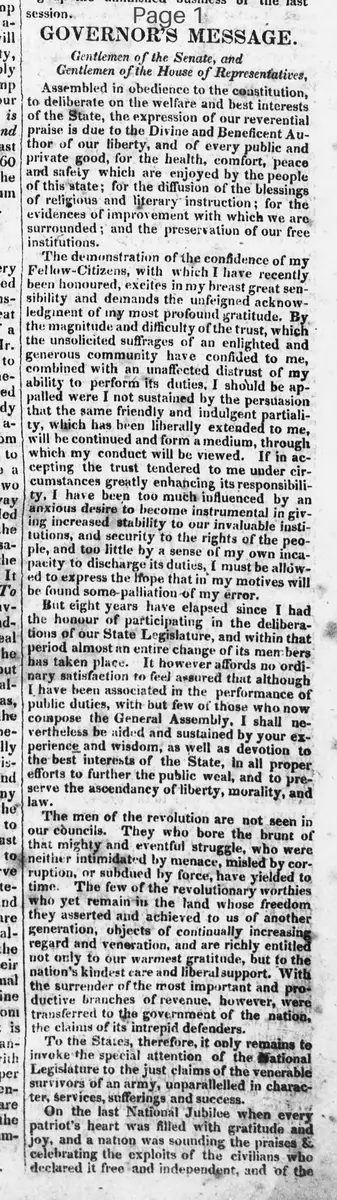
Gentlemen of the Senate, and Gentlemen of the House of Representatives,
Assembled in obedience to the constitution, to deliberate on the welfare and best interests of the State, the expression of our reverential praise is due to the Divine and Beneficent Author of our liberty, and of every public and private good, for the health, comfort, peace and safety which are enjoyed by the people of this state; for the diffusion of the blessings of religious and literary instruction; for the evidence of improvement with which we are surrounded; and the preservation of our free institutions.
The demonstration of the confidence of my Fellow-Citizens, with which I have recently been honoured, excites in my breast great sensibility and demands the unfeigned acknowledgment of my most profound gratitude. By the magnitude and difficulty of the trust, which the unsolicited suffrages of an enlightened and generous community have confided to me, combined with an unaffected distrust of my ability to perform its duties, I should be appalled were I not sustained by the persuasion that the same friendly and indulgent partiality, which has been liberally extended to me, will be continued and form a medium, through which my conduct will be viewed. If in accepting the trust tendered to me under circumstances greatly enhancing its responsibility, I have been too much influenced by an anxious desire to become instrumental in giving increased stability to our invaluable institutions, and security to the rights of the people, and too little by a sense of my own incapacity to discharge its duties, I must be allowed to express the hope that in my motives will be found some palliation of my error.
But eight years have elapsed since I had the honour of participating in the deliberations of our State Legislature, and within that period almost an entire change of its members has taken place. It however affords no ordinary satisfaction to feel assured that although I have been associated in the performance of public duties, with but few of those who now compose the General Assembly. I shall nevertheless be aided and sustained by your experience and wisdom, as well as devotion to the best interests of the State, in all proper efforts to further the public weal, and to preserve the ascendancy of liberty, morality, and law.
The men of the revolution are not seen in our councils. They who bore the brunt of that mighty and eventful struggle, who were neither intimidated by menace, misled by corruption, or subdued by force, have yielded to time. The few of the revolutionary worthies who yet remain in the land whose freedom they asserted and achieved to us of another generation, objects of continually increasing regard and veneration, and are richly entitled not only to our warmest gratitude, but to the nation's kindest care and liberal support. With the surrender of the most important and productive branches of revenue, however, were transferred to the government of the nation. the claims of its intrepid defenders.
To the States, therefore, it only remains to invoke the special attention of the national Legislature to the just claims of the venerable survivors of an army, unparalleled in character, services, sufferings and success.
On the last National Jubilee when every patriot's heart was filled with gratitude and joy, and a nation was sounding the praises & celebrating the exploits of the civilians who declared it free and independent, and of the warriors who maintained that declaration. the disembodied spirits of two of the most prominent and efficient actors in that assemblage, where all were great, patriotic and virtuous, were summoned before the Supreme Judge of the world, to whom they had appealed "for the rectitude of their intentions."
To us they have left a rich legacy, in the power of their example, and the wisdom of their precepts, which have emancipated the new world and thrown back a blaze of light upon the old.
The recent revision of the Statute laws of this State, performed with great industry and ability, and submitted to the deliberate and careful examination of the General Assembly by which our laws have been adapted to the provisions of the Constitution and to the present condition and circumstances of the State, will abridge your labors. The uniformity and certainty of the law, contributes to the convenience and safety of the people, prevent litigation and promote the peace of the community. Alterations of that code therefore ought not to be made without the most deliberate consideration.
In discharging the duties enjoined on the Executive by the Constitution, of giving to the General Assembly information of the state of the Government, and recommending to their consideration such measures as he may deem expedient, the attention is naturally drawn to the instrument prescribing it.
Notwithstanding the constitution was strongly opposed in its reception, and the necessity of its rejection earnestly urged, when it was submitted to the immediate consideration of the people, for their approbation, it will now, it is presumed, be generally admitted that it has, not only better defined our civil and religious rights, but more effectually secured those rights, by establishing and perpetuating the republican principles, transmitted to us from our ancestors. But being the production of human councils, in which a diversity of views, not unfrequently renders necessary a compromise and yielding of opinions, its framers anticipated that experience might prove it to be like all other institutions of man, in some respects, imperfect. Accordingly among the powers delegated by the constitution, is that of proposing to alter or amend it. This is an important power, and in its exercise, great caution should be observed. A change of the supreme law of a state should not be made except for the most weighty reasons.
On the stability of that law in a great degree depends its utility. Propositions of a mere speculative character, tending to produce excitement in the public mind, ought to be discountenanced.
The power to propose alterations of the fundamental law of the State, is committed exclusively to the House of Representatives.
To the mode of electing Senators prescribed by the constitution, objections were urged before its ratification, which, being continued, and having considerably agitated the public mind, are entitled to deliberate, careful and dispassionate consideration.
In approaching this subject, involved as it unquestionably is, in real difficulties, resulting from the civil divisions and long established usages of the state, the most solicitous and faithful respect and regard, should be paid to the rights and liberties of the people, who are the only legitimate source of political power, and for whose benefit civil governments are instituted, and ought invariably to be administered.
It has been objected that in voting for the entire senate, according to the provisions of the constitution, the Electors, in order to secure an equal apportionment of the members of that body, among the several counties in the state, are often obliged to act with an imperfect knowledge of the talents, qualifications and characters of some of the persons to whom they entrust the exercise of the high authority and important powers delegated to that body, and are exposed to be deceived by misrepresentation; that the value and power of the right of suffrage are thereby diminished; that the difficulty of exercising the elective franchise correctly and satisfactorily to the conscience of the electors, may lead to its disuse, and that the fundamental principles of a representative government, are thus infringed, and our republican institutions endangered.
These objections to the constitutional mode of electing senators, are entitled to grave consideration. Whether any or all the evils alleged have in fact been produced by the provisions of the constitution in relation to the election of senators, the House to whom the subject is delegated, will judge. The admission that such results have arisen, from the existing mode of electing the senate, would prove the constitution in this particular defective, and form a powerful reason for its amendment, and a departure from a system long established.
The evils complained of may be to a considerable extent prevented by an amendment of the constitution, which shall establish the numbers of which the senate shall consist, and provide that the General Assembly, by a law, to be passed for that purpose, shall divide the State, as soon as may be, after the adoption of the amendment by the Electors, into such number of districts, for the purpose of electing senators as may be deemed expedient; that the districts so to be constituted, shall be composed of contiguous territory, and that in each district there shall be chosen a number of senators, bearing as nearly as may be practicable, the same proportion to the number of which the senate may consist, as the population of such district shall bear to the aggregate population of the State. By such an amendment an equal representation of every section of the State in the senate will be secured, the feelings and interests of each section in that body understood, and the rights of the whole State maintained. The amendment ought, in my opinion, to provide further, that the districts may be altered, and the senators apportioned among the several districts, by law, after each successive census, taken under the authority of the United States, if it shall be deemed necessary. The expediency of proposing to the Electors an amendment of the constitution embracing these principles, is submitted to the consideration of their immediate Representatives. They well understand the public sentiment, and are competent to decide, whether the measure be necessary to preserve to full, free, and correct exercise of the elective franchise, the equal representation of every section of the State in the senate, and whether it be required by the Electors, on whose ultimate determination depends its adoption.
No duty imposed upon a free government is more important than the diffusion of knowledge among the people; whether we regard its influence upon the human happiness or our republican institutions. The appropriation by the constitution of the School Fund, for the perpetual support and encouragement of public or common schools, was the result of enlightened benevolence, and profound wisdom.
The fund amounts to more than one million seven hundred thousand dollars. The income of the fund, it is believed, under the management of the Commissioner, may, by its judicious investment, be considerably augmented.
The proper and faithful application of the interest of this fund to the encouragement of education, will materially affect the character and happiness of all successive generations.
The system of Common Schools established by our ancestors, widely diffuse the intellectual attainments and moral principles, indispensable to the perpetuity of republican government. The division of the State into school societies and districts, affords peculiar facilities for extending the benefits of education, while the distribution of the interest of the School Fund, among the several school districts according to the number of persons in each, between the ages of four and sixteen years, under the existing laws, secures to every youth in the State, the privilege of acquiring a common education. If the results of our system, improved as it has been, by the lights of experience, are not such as entirely to fulfill the anticipations of its founders, and the wishes of the philanthropist, it is not perceived to be attributed as much to any radical defect in the system, as to remissness in its execution on the part of those who have the immediate superintendence of the primary schools. Every effort should be made to impress upon their minds a deep sense of the responsibility resting upon them, and of the blessings resulting from literary and moral instruction.
To elevate the character of our common schools, and to cause the utility to correspond with the munificent means which are pledged for their support, instructors distinguished for learning, sobriety and virtue, must be employed, and the schools, as well as the instructors, subjected to a rigid examination and inspection.
The duties of the visitors of schools, as prescribed by law, are highly important; and on their faithful and thorough performance, the intellectual and moral improvement of our youth greatly depends. Your information and experience will enable you to determine, whether any further legal provision be necessary to insure such performance. The improvement of a system which has been admired and imitated in other States, is worthy of your deliberate and careful attention. To neglect it would be a contempt of those from whom it has been derived, and a wrong to posterity.
The emigration of our citizens has arrested the progress of the population of this state, and diminished our political power in the Union. To retain our youthful, intelligent and enterprising citizens within the State, their attachment to their native soil, always strong, must be strengthened, by offering them combined advantages which they will not easily find elsewhere. They must see our colleges, and other seminaries of learning patronized: the public burdens made equal and light; rigid economy practiced in the various departments of the government; justice speedily and impartially administered: agriculture, manufactures, commerce and the arts encouraged: and the condition of the State generally improved.
Our large manufacturing establishments, and the various mechanic arts, by furnishing lucrative employment, have kept in the state many valuable citizens: and stimulated agriculture, navigation, and commerce. But the manufacture of woolen cloths needs encouragement.
The large importation of wool and woolen goods have injured both the grower and the manufacturer of wool; and by depressing those interests, may reduce us to a dependence on a foreign supply, for an article of prime necessity.
These evils can only effectually be removed by the National Government, in which is deposited the power to levy duties on imports; and it is to be regretted, that a measure thoroughly matured for that purpose, and intended to protect and sustain the agricultural and manufacturing interests, after having been passed by the immediate representatives of the people, was finally defeated in the other branch of Congress. Correct information, however, regarding the true interests and policy of our country, and steadiness of purpose, and an effort in maintaining them, may, at a future day, produce a different result.
The object of punishment is to prevent the commission of crimes, either by destroying the power, or removing the disposition to commit them. The former can only be accomplished by capital punishment, or the perpetual seclusion of the criminal from society; and the latter by his reformation.
In effecting the reformation of the criminal, (an object of high moment, and uniformly sought by the benevolent and good,) his confinement to hard labour, with strict silence, while engaged in work, and absolute seclusion from the society of man, in solitary cells, during the hours of rest, has a powerful influence.
Such confinement has a strong tendency to destroy the habits of idleness, intemperance, and dissoluteness, which are the most fruitful sources of crimes. By removing the criminal from all vicious associations, and from the contagion of evil example, and the moral poison of intercourse and conversation with his fellow prisoners, hardened in guilt, and skilled in the commission of crimes; and placing him in solitude, to commune with his own heart, and to meditate on his past life, his present condition and his future destiny, deep penitence may with reason be expected—and the criminal, especially if he be a young offender, may be restored to usefulness, in that community, whose laws he may have violated.
The punishment of offenses in all cases, and especially the length of time for which the criminal shall be confined to hard labor, ought to be regulated by the nature and aggravation of the offense, and the previous conduct and hardened character of the criminal; and to be so moderate as to secure the decided sanction and support of public opinion, and humanity itself, in its prompt and rigid execution. Experience demonstrates that the severity of punishment does not as much deter men from perpetrating crimes, as the certainty of it.
Crimes will not be committed with the expectation of enduring the punishment, but in the hope of escaping detection.
The results which have attended the penitentiary system in other States, have satisfactorily proved, that a system of criminal law may not only be executed without expense, but so as to yield a considerable income to the state. No reason is discovered why our State Prison, instead of occasioning an annual expense of several thousand dollars, by an improvement of its police, may not be made a source of actual profit to the state, while all the objects of punishment will be more effectually accomplished. This interesting and important subject, occupied the deliberate attention of the General Assembly at the last session, and the erection of a new State Prison was directed.
The building of the edifice has been commenced, under the direction of the commissioners appointed to superintend it, whose report will be duly laid before you. As the building will probably be completed before the termination of the current year, the expediency of establishing, during the present session, a system for the regulation and government of the prison, is presented to your consideration.
To the National Government is committed the power to provide for organizing, arming, and disciplining the militia. Scarcely any difference of opinion has existed among the most enlightened and patriotic statesmen, as to the necessity of giving all possible efficiency to this powerful arm of our defence; and this subject has recently attracted the special attention of the National Government. During the past year, a Board of Officers was convened at Washington, to take into consideration the present organization of the militia system, and to propose such alterations as their skill and experience might enable them to suggest, and their judgment should approve. Their report was laid before Congress, at its late session, but the principles it expressed were not made the subject of definitive action. The report presents the excess of the number of men which the law of Congress requires to be enrolled in the militia, as the primary defect of the system; and proposes so to alter the existing law, that no person shall be enrolled in the militia who shall not have arrived at the age of twenty-one years: it being considered by the Board, that the public interest and safety in time of peace, do not require an enrolment in the militia at an earlier age. The proposed exemption would preserve the rightful control of masters, parents, and guardians, over their apprentices, wards, and children; the due exercise of which, is at all times important to the best interests of society. The opinion has also been expressed, by a committee in one branch of Congress, in accordance with the principles sanctioned by the board of officers, that it is expedient to exempt all persons above the age of thirty-five years, from the performance of service in the militia. A modification of the militia system, which should limit the liability to enrolment in the militia, to the period of life between the ages of twenty-one and thirty-five years, will considerably reduce the number of the militia, but it will increase its efficiency. It is not deemed necessary to hold our citizens enrolled for a longer period, to accomplish any of the purposes for which the militia may be called into the service of the United States. The necessity which demanded the enrolment that was required, when the population of the U. States did not exceed four millions, no longer exists, when their population is augmented to more than ten millions; and their maritime frontier will be defended by a powerful navy, and by formidable fortifications.
No public exigency is discovered, which now demands that masters shall be placed in the ranks with their apprentices, and that fathers advanced to the meridian of life, shall be trained by the side of their sons, or under their command. The expediency of shortening the period during which the citizens of the respective states shall be enrolled in the militia, must be apparent, and it is hoped the measure will soon be adopted by the National Government.
The states have reserved to themselves the appointment of the officers, and the authority of training the militia, according to the discipline prescribed by Congress, and on the Legislatures of the respective states, devolves the duty of passing laws to effect these objects.
The Militia of this state may be safely pronounced to be equal in organization, equipment, discipline, and efficiency, to the militia of any state in the Union.
The exemption of such of our citizens as perform military service, and are armed, equipped, and dressed in uniform, according to law, from the poll tax, has had a powerful tendency to improve the militia, and has been followed by results demonstrative of the correctness of that policy. The reduction of the tax, by diminishing the inducement to a complete equipment, and a full compliance with the law, may impair the efficiency, and repress the spirit and ardor of the militia. It is therefore worthy of consideration, whether the burdens of that class in the community ought not to be diminished.
In my judgment, frequent musters of the militia, as they are generally, and perhaps necessarily conducted, produce no considerable advantage. They are onerous to the militia, by calling them from their homes, and their customary employments; occasion a considerable expense, and a loss of time, and undoubtedly have a pernicious influence upon the public morals. If the musters or training do not increase the efficiency of the militia, which is the opinion of experienced military men, the expediency of providing that these musters shall be less frequent seems to result. The militia are the natural defenders of the country. They will never be dangerous to its liberty. Attached to the soil, and intelligent, they can never be seduced by flattery, nor made subservient to ambition. A band of freemen, exercising the privileges and immunities of freemen, with their own arms in their own hands, they may be pronounced, on high authority, to be "the army of the constitution." If their services be diminished and made light in time of peace, it may be reasonably and rightfully expected, that they will, with the more alacrity, repair to the post of danger in time of war.
The lenity and justice of our laws, the peaceable and regular habits of the people, and their strong attachment to our confederated and state governments, afford good ground of confidence, that our militia will not be called into the service of the United States, for any other purpose than national defence.
The resources of the nation have been applied, by the permanent annual appropriation of two hundred thousand dollars, to procure arms to be distributed among the several states, in proportion to the number of militia enrolled, in each state, for the purpose of arming the great body of the militia, in case of any emergency requiring it. The arms delivered to this state have been deposited in the public arsenal, from which our militia will be furnished when necessary. The frontier which the militia of this state may be called to defend, renders highly important the equipment of the artillery, as reliance must be placed on heavy ordnance, to prevent an enemy from placing his foot on our shores.
An adequate supply of this species of ordnance, has not been furnished to this state, but it is expected that an arrangement may be made with the ordnance department of the United States, by which a quantity of cannon will be obtained, as a part of the quota of arms to which this state is entitled, under the act of Congress to provide for arming the Militia.
Having solemnly bound myself faithfully to discharge the duties of the office to which my fellow citizens have called me, I fervently supplicate, in the performance of these duties, the guidance of the God of our Fathers, and humbly implore that His blessing may be conspicuously displayed, alike in the spirit with which our mutual consultations shall be conducted; in the wisdom of our measures: in their influence and effect upon the liberty, prosperity, and happiness of those, by whom we are entrusted with authority; and in the perpetuation of the rich inheritance which we have derived from our ancestors, to the latest generations.
General Assembly,
May Session, A.D. 1827.
GIDEON TOMLINSON.
What sub-type of article is it?
What keywords are associated?
What entities or persons were involved?
Editorial Details
Primary Topic
Governor's Address Recommending Improvements To State Institutions And Policies
Stance / Tone
Official And Advisory, Supportive Of Republican Principles And Reforms
Key Figures
Key Arguments