Thank you for visiting SNEWPapers!
Sign up free
The New Hampshire Gazette And General Advertiser
Portsmouth, Rockingham County, New Hampshire
What is this article about?
Proceedings in the U.S. House of Representatives from June 18-26, debating and amending bills to establish the Departments of Foreign Affairs, War, and Treasury; discussing tonnage and impost bills; handling petitions and appropriations for Federal Hall rooms. Key votes retained presidential removal powers and maintained import duty discriminations.
Clipping
OCR Quality
Full Text
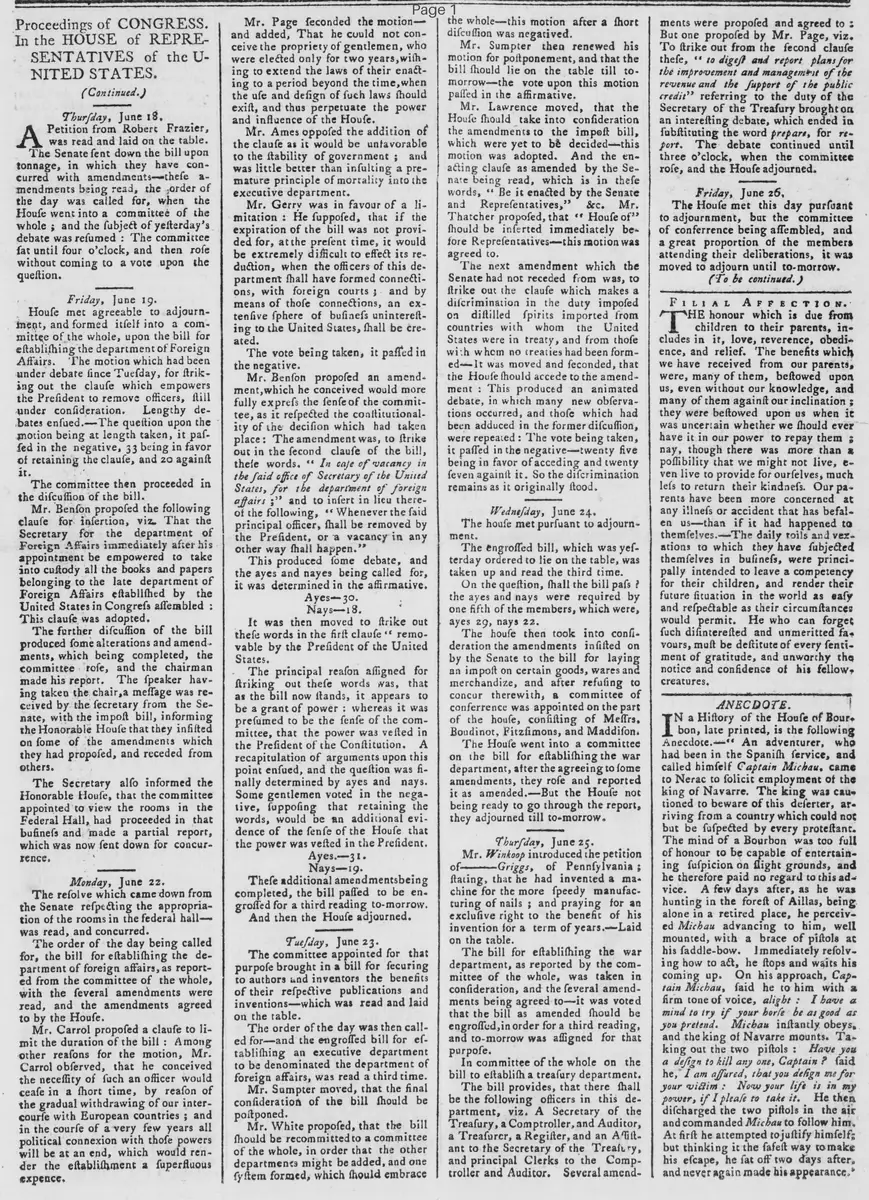
In the HOUSE of REPRESENTATIVES of the UNITED STATES.
(Continued.)
Thursday, June 18.
Petition from Robert Frazier,
was read and laid on the table.
The Senate sent down the bill upon tonnage, in which they have concurred with amendments—these amendments being read, the order of the day was called for, when the House went into a committee of the whole: and the subject of yesterday's debate was resumed: The committee sat until four o'clock, and then rose without coming to a vote upon the question.
Friday, June 19.
House met agreeable to adjournment, and formed itself into a committee of the whole, upon the bill for establishing the department of Foreign Affairs. The motion which had been under debate since Tuesday, for striking out the clause which empowers the President to remove officers, still under consideration. Lengthy debates ensued.—The question upon the motion being at length taken, it passed in the negative, 33 being in favor of retaining the clause, and 20 against it.
The committee then proceeded in the discussion of the bill.
Mr. Benson proposed the following clause for insertion, viz. That the Secretary for the department of Foreign Affairs immediately after his appointment be empowered to take into custody all the books and papers belonging to the late department of Foreign Affairs established by the United States in Congress assembled:
This clause was adopted.
The further discussion of the bill produced some alterations and amendments, which being completed, the committee rose, and the chairman made his report. The Speaker having taken the chair, a message was received by the secretary from the Senate, with the impost bill, informing the Honorable House that they insisted on some of the amendments which they had proposed, and receded from others.
The Secretary also informed the Honorable House, that the committee appointed to view the rooms in the Federal Hall, had proceeded in that business and made a partial report, which was now sent down for concurrence.
Monday, June 22.
The resolve which came down from the Senate respecting the appropriation of the rooms in the federal hall—
was read, and concurred.
The order of the day being called for, the bill for establishing the department of foreign affairs, as reported from the committee of the whole, with the several amendments were read, and the amendments agreed to by the House.
Mr. Carroll proposed a clause to limit the duration of the bill: Among other reasons for the motion, Mr. Carroll observed, that he conceived the necessity of such an officer would cease in a short time, by reason of the gradual withdrawing of our intercourse with European countries; and in the course of a very few years all political connexion with those powers will be at an end, which would render the establishment a superfluous expense,
Mr. Page seconded the motion— and added, That he could not conceive the propriety of gentlemen, who were elected only for two years, wishing to extend the laws of their enacting to a period beyond the time, when the use and design of such laws should exist, and thus perpetuate the power and influence of the House.
Mr. Ames opposed the addition of the clause as it would be unfavorable to the stability of government: and was little better than insulting a premature principle of mortality into the executive department.
Mr. Gerry was in favour of a limitation: He supposed, that if the expiration of the bill was not provided for, at the present time, it would be extremely difficult to effect its reduction, when the officers of this department shall have formed connections, with foreign courts; and by means of those connections, an extensive sphere of business uninteresting to the United States, shall be created.
The vote being taken, it passed in the negative.
Mr. Benson proposed an amendment, which he conceived would more fully express the sense of the committee, as it respected the constitutionality of the decision which had taken place: The amendment was, to strike out in the second clause of the bill, these words, "In case of vacancy in the said office of Secretary of the United States, for the department of foreign affairs;" and to insert in lieu thereof the following, "Whenever the said principal officer, shall be removed by the President, or a vacancy in any other way shall happen."
This produced some debate, and the ayes and nays being called for, it was determined in the affirmative.
Ayes-30.
Nays-18.
It was then moved to strike out these words in the first clause "removable by the President of the United States."
The principal reason assigned for striking out these words was, that as the bill now stands, it appears to be a grant of power: whereas it was presumed to be the sense of the committee, that the power was vested in the President of the Constitution. A recapitulation of arguments upon this point ensued, and the question was finally determined by ayes and nays.
Some gentlemen voted in the negative, supposing that retaining the words, would be an additional evidence of the sense of the House that the power was vested in the President.
Ayes-31.
Nays-19.
These additional amendments being completed, the bill passed to be engrossed for a third reading to-morrow.
And then the House adjourned.
Tuesday, June 23.
The committee appointed for that purpose brought in a bill for securing to authors and inventors the benefits of their respective publications and inventions—which was read and laid on the table.
The order of the day was then called for—and the engrossed bill for establishing an executive department to be denominated the department of foreign affairs, was read a third time.
Mr. Sumter moved, that the final consideration of the bill should be postponed.
Mr. White proposed, that the bill should be recommitted to a committee of the whole, in order that the other departments might be added, and one system formed, which should embrace
the whole—this motion after a short discussion was negatived.
Mr. Sumter then renewed his motion for postponement, and that the bill should lie on the table till to-morrow—the vote upon this motion passed in the affirmative.
Mr. Lawrence moved, that the House should take into consideration the amendments to the impost bill, which were yet to be decided—this motion was adopted. And the enacting clause as amended by the Senate being read, which is in these words, "Be it enacted by the Senate and Representatives,"&c. Mr. Thatcher proposed, that "House of" should be inserted immediately before Representatives—this motion was agreed to.
The next amendment which the Senate had not receded from was, to strike out the clause which makes a discrimination in the duty imposed on distilled spirits imported from countries with whom the United States were in treaty, and from those with whom no treaties had been formed—It was moved and seconded, that the House should accede to the amendment: This produced an animated debate, in which many new observations occurred, and those which had been adduced in the former discussion, were repeated: The vote being taken, it passed in the negative—twenty five being in favor of acceding and twenty seven against it. So the discrimination remains as it originally stood.
Wednesday, June 24.
The house met pursuant to adjournment.
The engrossed bill, which was yesterday ordered to lie on the table, was taken up and read the third time.
On the question, shall the bill pass? the ayes and nays were required by one fifth of the members, which were, ayes 29, nays 22.
The house then took into consideration the amendments insisted on by the Senate to the bill for laying an impost on certain goods, wares and merchandize, and after refusing to concur therewith, a committee of conference was appointed on the part of the house, consisting of Messrs. Boudinot, Fitzsimons, and Madison.
The House went into a committee on the bill for establishing the war department, after the agreeing to some amendments, they rose and reported it as amended.—But the House not being ready to go through the report, they adjourned till to-morrow.
Thursday, June 25.
Mr. Wynkoop introduced the petition of J. Griggs, of Pennsylvania; stating, that he had invented a machine for the more speedy manufacturing of nails; and praying for an exclusive right to the benefit of his invention for a term of years.—Laid on the table.
The bill for establishing the war department, as reported by the committee of the whole, was taken in consideration, and the several amendments being agreed to—it was voted that the bill as amended should be engrossed, in order for a third reading, and to-morrow was assigned for that purpose.
In committee of the whole on the bill to establish a treasury department.
The bill provides, that there shall be the following officers in this department, viz. A Secretary of the Treasury, a Comptroller, and Auditor, a Treasurer, a Register, and an Assistant to the Secretary of the Treasury, and principal Clerks to the Comptroller and Auditor. Several amendments
ments were proposed and agreed to: But one proposed by Mr. Page, viz. To strike out from the second clause these, "to digest and report plans for the improvement and management of the revenue and the support of the public credit" referring to the duty of the Secretary of the Treasury brought on an interesting debate, which ended in substituting the word prepare, for report. The debate continued until three o'clock, when the committee rose, and the House adjourned.
Friday, June 26,
The House met this day pursuant to adjournment, but the committee of conference being assembled, and a great proportion of the members attending their deliberations, it was moved to adjourn until to-morrow.
(To be continued.)
What sub-type of article is it?
What keywords are associated?
What entities or persons were involved?
Where did it happen?
Domestic News Details
Primary Location
Federal Hall
Event Date
June 18 To June 26
Key Persons
Outcome
bills for departments of foreign affairs, war, and treasury advanced with amendments; presidential removal powers retained (votes: 33-20, 30-18, 31-19, 29-22); impost bill discrimination upheld (27-25); conference committee appointed; petitions tabled.
Event Details
The House debated and amended bills establishing executive departments, including Foreign Affairs (retaining presidential removal clause, adopting custody clause, rejecting duration limit), impost and tonnage bills (Senate amendments discussed, discrimination retained), War Department (amendments agreed), and Treasury Department (officers defined, duties amended from 'report' to 'prepare' plans); handled Federal Hall rooms appropriation, inventor petitions, and author/inventor rights bill introduction.