Thank you for visiting SNEWPapers!
Sign up free
The Topeka State Journal
Topeka, Shawnee County, Kansas
What is this article about?
At the University of Kansas in Lawrence, Kan., a special class in food conservation discussed the significance of food elements necessary for life, emphasizing balanced diets like milk and whole wheat over sugar, with instructor Miss Gertrude Hazen highlighting nutrition facts including iron's importance.
Clipping
OCR Quality
Full Text
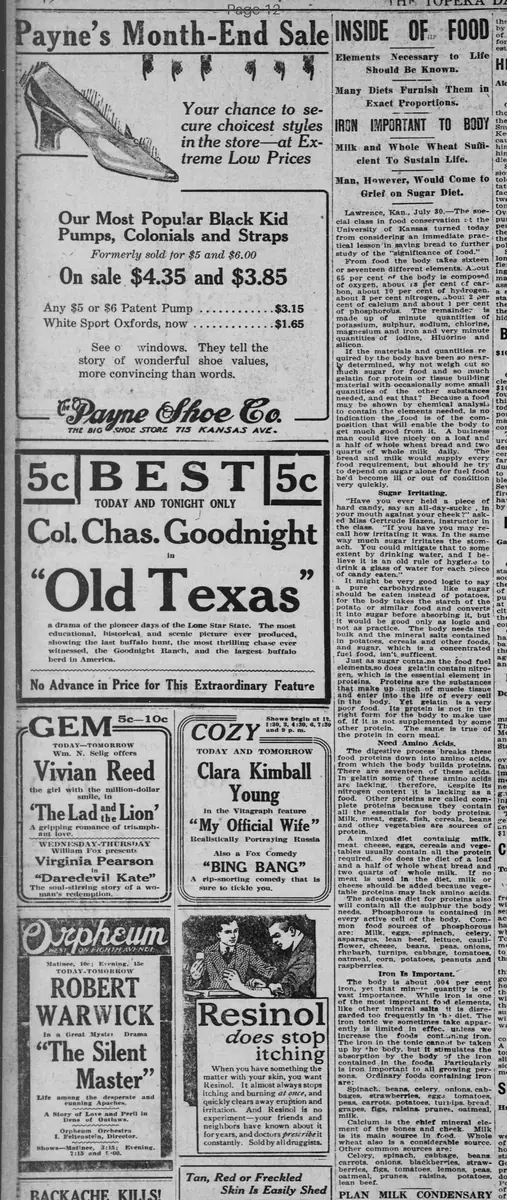
Elements Necessary to Life
Should Be Known.
Many Diets Furnish Them in
Exact Proportions.
IRON IMPORTANT
TO BODY
Milk and Whole Wheat Suffi-
ient To Sustain Life.
Man, However, Would Come to
Grief on Sugar Diet.
Lawrence, Kan., July 30.--The spe-
cial class in food conservation at the
University of Kansas turned today
from considering an immediate prac-
tical lesson in saving bread to further
study of the "significance of food."
From food the body takes sixteen
or seventeen different elements. About
65 per cent of the body is composed
of oxygen, about 18 per cent of car-
bon, about 10 per cent of hydrogen.
about 3 per cent nitrogen, about 2 per
cent of calcium and about 1 per cent
of phosphorous. The remainder is
made up of minute quantities of
potassium, sulphur, sodium, chlorine,
magnesium and iron and very minute
quantities of iodine, fluorine and
silicon.
If the materials and quantities re-
quired by the body have been so near-
ly determined, why not weigh out so
much sugar for food and so much
gelatin for protein or tissue building
material with occasionally some small
quantities of the other substances
needed, and eat that? Because a food
may be shown by chemical analysis
to contain the elements needed, is no
indication the food is of the com-
position that will enable the body to
get much good from it. A business
man could live nicely on a loaf and
a half of whole wheat bread and two
quarts of whole milk daily.
The
bread and milk would supply every
food requirement, but should he try
to depend on sugar alone for fuel food
he'd become ill or out of condition
very quickly.
Sugar Irritating.
"Have you ever held a piece of
hard candy, say an all-day-sucker, in
your mouth against your cheek?" ask-
ed Miss Gertrude Hazen, instructor in
the class. "If you have you may re-
call how irritating it was. In the same
way much sugar irritates the stom-
ach. You could mitigate that to some
extent by drinking water, and I be-
lieve it is an old rule of hygiene to
drink a glass of water for each piece
of candy eaten."
It might be very good logic to say
a pure carbohydrate like sugar
should be eaten instead of potatoes,
for the body takes the starch of the
potato or similar food and converts
it into sugar before absorbing it, but
it would be good only as logic and
not as practice. The body needs the
bulk and the mineral salts contained
in potatoes, cereals and other foods,
and sugar, which is a concentrated
fuel food, isn't sufficient.
Just as sugar contains the food fuel
elements, so does gelatin contain nitro-
gen, which is the essential element in
proteins. Proteins are the substances
that make up much of muscle tissue
and enter into the life of every cell
in the body. Yet gelatin is a very
poor food. Its protein is not in the
right form for the body to make use
of, if it is not supplemented by some
other protein. The same is true of
the protein in corn meal.
Need Amino Acids.
The digestive process breaks these
food proteins down into amino acids,
from which the body builds proteins.
There are seventeen of these acids.
In gelatin some of these amino acids
are lacking, therefore, despite its
nitrogen content it is lacking as a
food. Other proteins are called com-
plete proteins because they contain
all the essentials for body proteins.
Milk, meat, eggs, fish, cereals, beans
and other vegetables are sources of
protein.
A mixed diet
containing milk,
meat, cheese, eggs, cereals and vege-
tables usually contain all the protein
required. So does the diet of a loaf
and a half of whole wheat bread and
two quarts of whole milk. If no
meat is used in the diet, milk or
cheese should be added because vege-
table proteins may lack amino acids.
The adequate diet for proteins also
will contain all the sulphur the body
needs. Phosphorous is contained in
every active cell of the body. Com-
mon food sources of phosphorous
are: Milk, eggs, spinach, celery,
asparagus, lean beef, lettuce, cauli-
flower, cheese, beans, peas, onions,
rhubarb, turnips, cabbage, tomatoes,
oatmeal, corn, potatoes, peanuts and
raspberries.
Iron Is Important.
The body is about .004 per cent
iron, yet that minute quantity is of
vast importance. While iron is one
of the most important food elements,
like other mineral salts it is disre-
garded too frequently in a diet. The
iron tonic we sometimes take appar-
ently is limited in effect unless we
increase the foods containing iron.
The iron in the tonic cannot be taken
up by the body, but it stimulates the
absorption by the body of the iron
contained in the foods. Particularly
is iron important to all growing per-
sons. Ordinary foods containing iron
are:
Spinach, beans, celery, onions, cab-
bages, strawberries, eggs, tomatoes,
peas, carrots, potatoes, turnips, bread,
grapes, figs, raisins, prunes, oatmeal,
milk.
Calcium is the chief mineral ele-
ment of the bones and teeth. Milk
is its main source in food. Whole
wheat also is a considerable source.
Other common sources are:
Celery, spinach, cabbage,
beans.
carrots, onions, blackberries, straw-
berries, figs, tomatoes, lemons, peas,
oatmeal, prunes,
raisins, potatoes,
lean beef.
What sub-type of article is it?
What keywords are associated?
What entities or persons were involved?
Where did it happen?
Domestic News Details
Primary Location
Lawrence, Kan.
Event Date
July 30
Key Persons
Event Details
The special class in food conservation at the University of Kansas turned from saving bread to studying the significance of food, discussing body composition elements, balanced diets like whole wheat bread and milk, dangers of sugar-only diets, protein needs including amino acids, and importance of iron, phosphorus, and calcium with listed food sources.