Thank you for visiting SNEWPapers!
Sign up free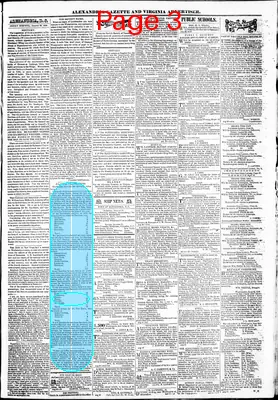
Alexandria Gazette
Alexandria, Alexandria County, District Of Columbia
What is this article about?
The Boston Atlas calculates that William Henry Harrison will win the 1840 U.S. presidential election by a large majority, citing 1836 results and recent state elections favoring Harrison and Tyler, projecting at least 187 electoral votes against Van Buren's 18.
Merged-components note: The table lists states with potential Whig support, integral to the political calculations article; merge table into domestic_news component.
Clipping
OCR Quality
Full Text
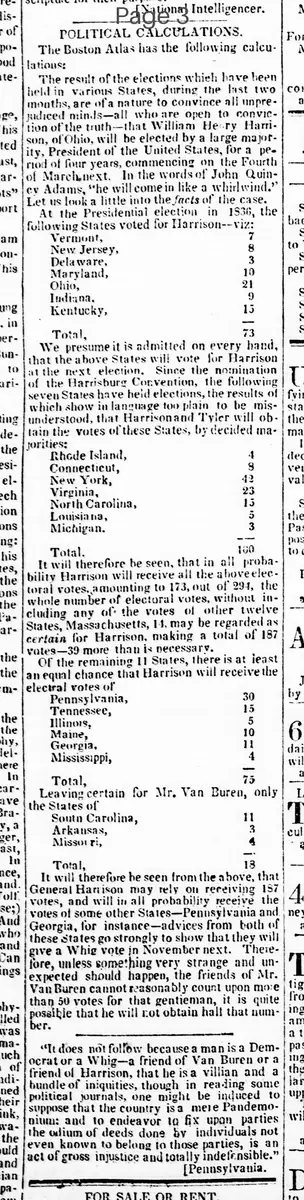
The Boston Atlas has the following calculations:
The result of the elections which have been held in various States, during the last two months, are of a nature to convince all unprejudiced minds—all who are open to conviction of the truth—that William Henry Harrison, of Ohio, will be elected by a large majority, President of the United States, for a period of four years, commencing on the Fourth of March next. In the words of John Quincy Adams, "he will come in like a whirlwind."
Let us look a little into the facts of the case. At the Presidential election in 1836, the following States voted for Harrison—viz:
Vermont, 7
New Jersey, 8
Delaware, 3
Maryland, 10
Ohio, 21
Indiana, 9
Kentucky, 15
Total, 73
We presume it is admitted on every hand, that the above States will vote for Harrison at the next election. Since the nomination of the Harrisburg Convention, the following seven States have held elections, the results of which show in language too plain to be misunderstood, that Harrison and Tyler will obtain the votes of these States, by decided majorities:
Total, 100
It will therefore be seen, that in all probability Harrison will receive all the above electoral votes, amounting to 173, out of 294, the whole number of electoral votes, without including any of the votes of other twelve States, Massachusetts, 14, may be regarded as certain for Harrison, making a total of 187 votes—39 more than is necessary.
Of the remaining 11 States, there is at least an equal chance that Harrison will receive the electoral votes of
Total, 75
Leaving certain for Mr. Van Buren, only the States of
South Carolina, 11
Arkansas, 3
Missouri, 4
Total, 18
It will therefore be seen from the above, that General Harrison may rely on receiving 187 votes, and will in all probability receive the votes of some other States—Pennsylvania and Georgia, for instance—advices from both of these states go strongly to show that they will give a Whig vote in November next. Therefore, unless something very strange and unexpected should happen, the friends of Mr. Van Buren cannot reasonably count upon more than 50 votes for that gentleman, it is quite possible that he will not obtain half that number.
"It does not follow because a man is a Democrat or a Whig—a friend of Van Buren or a friend of Harrison, that he is a villain and a bundle of iniquities, though in reading some political journals, one might be induced to suppose that the country is a mere Pandemonium: and to endeavor to fix upon parties the odium of deeds done by individuals not even known to belong to those parties, is an act of gross injustice and totally indefensible."
[Pennsylvania.]
| Pennsylvania, | 30 |
| Tennessee, | 15 |
| Illinois, | 5 |
| Maine, | 10 |
| Georgia, | 11 |
| Mississippi, | 4 |
What sub-type of article is it?
What keywords are associated?
What entities or persons were involved?
Where did it happen?
Domestic News Details
Primary Location
Boston
Event Date
Last Two Months
Key Persons
Event Details
The Boston Atlas calculates electoral votes from 1836 election and recent state elections, predicting Harrison will receive at least 187 votes out of 294, more than needed, while Van Buren gets only 18 certain votes.