Thank you for visiting SNEWPapers!
Sign up free
The National Intelligencer And Washington Advertiser
Washington, District Of Columbia
What is this article about?
Spanish Governor of Havana, Marquis of Someruelos, issues strict decree on February 17, 1803, regulating foreigners' embarkation, trade, and slave imports in Cuba, with fines and arrests; noted as generally friendly to the United States.
Merged-components note: Direct continuation of the Spanish order published at the Havannah regarding foreigners.
Clipping
OCR Quality
Full Text
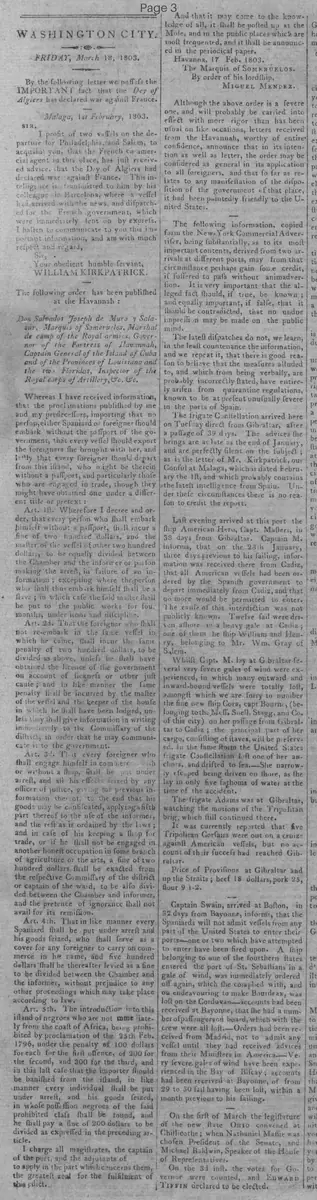
at the Havannah:
Don Salvador Joseph de Muro y Sala.
Sir, Marquis of Someruelos, Marshal
de camp of the Royal armies, Gover-
nor of the Fortress of Havannah,
Captain General of the Island of Cuba
and of the Provinces of Louisiana and
the two Floridas, Inspector of the
Royal corps of Artillery, &c. &c.
Whereas I have received information,
that the proclamations published by me
and my predecessors, importing that no
person, either Spaniard or foreigner should
embark without the passport of the go-
vernment, that every vessel should export
the foreigners she brought with her, and
that every foreigner should depart
from this island, who might be therein
without a passport, and particularly those
who are engaged in trade, though they
might have obtained one under a differ-
ent title or pretext:
Art. 1st. Wherefore I decree and or-
der, that every person who shall embark
himself without a passport, shall incur a
fine of two hundred dollars, and the
master of the vessel other two hundred
dollars, to be equally divided between
the Chamber and the informer or person
making the arrest, in failure of an in-
formation; excepting where the person
who shall thus embark himself shall be a
slave; in which case the said master shall
be put to the public works for four
months, under irons and discipline.
Art. 2d. That the foreigner who shall
not re-embark in the same vessel in
which he came, shall incur the same
penalty of two hundred dollars, to be
divided as above, unless he shall have
obtained the licence of the government
on account of sickness or other just
cause; and in like manner the same
penalty shall be incurred by the master
of the vessel and the keeper of the house
in which he shall have been lodged, un-
less they shall give information in writing
immediately to the Commissary of the
district, in order that he may communi-
cate it to the government.
Art. 3d. That every foreigner who
shall engage himself in commerce with
or without a shop, shall be put under
arrest, and all his effects seized by any
officer of justice, giving me previous in-
formation thereof, to the end that his
goods may be confiscated, applying one fifth
part thereof to the use of the informer,
and the rest as is ordained by the laws;
and in case of his keeping a shop for
trade, or if he shall not be engaged in
another honest occupation in some branch
of agriculture or the arts, a fine of two
hundred dollars shall be exacted from
the respective Commissary of the district
or captain of the ward, to be also divi-
ded between the Chamber and informer,
and the pretence of ignorance shall not
avail for its remission.
Art. 4th. That in like manner every
Spaniard shall be put under arrest and
his goods seized, who shall serve as a
cover for any foreigner to carry on com-
merce in his name, and five hundred
dollars shall be thereafter levied as a fine
to be divided between the Chamber and
the informer, without prejudice to any
other proceedings which may take place
according to law.
Art. 5th. The introduction into this
island of negroes who are not imme-
liately from the coast of Africa, being prohi-
bited by proclamation of the 25th Feb.
1796, under the penalty of 100 dollars
for each for the first offence, of 200 for
the second, and 300 for the third, and
in this last case that the importer should
be banished from the island, in like
manner every individual shall be put
under arrest, and his goods seized,
in whose possession negroes of the said
prohibited class shall be found, and
he shall pay a fine of 200 dollars to be
divided as expressed in the preceding ar-
ticle.
I charge all magistrates, the captain
of the port, and the adjutants of
to apply in the part which concerns them,
the greatest zeal for the fulfilment of
this edict.
And that it may come to the know-
ledge of all, it shall be posted up at the
Mole, and in the public places which are
most frequented, and it shall be announc-
ed in the periodical paper.
Havanna, 17 Feb. 1803.
The Marquis of SOMERUELOS.
By order of his lordship,
MIGUEL MENDEZ.
Although the above order is a severe
one, and will probably be carried into
effect with more rigor than has been
usual on like occasions, letters received
from the Havannah, worthy of entire
confidence, announce that in its inten-
tion as well as letter, the order may be
considered as general in its application
to all foreigners, and that so far as re-
lates to any manifestation of the disposi-
tion of the government at that place,
it had been pointedly friendly to the U-
nited States.
What sub-type of article is it?
What keywords are associated?
What entities or persons were involved?
Where did it happen?
Foreign News Details
Primary Location
Havannah
Event Date
17 Feb. 1803
Key Persons
Outcome
fines of 100-500 dollars, arrests, seizures of goods, confiscations, public works punishment, and banishment for violations of passport, trade, and slave import rules; one-fifth of confiscated goods to informer, rest per laws; decree enforced with rigor but friendly to united states.
Event Details
Governor Marquis of Someruelos decrees penalties for unauthorized embarkation without passports, failure of foreigners to re-embark, engaging in commerce, Spaniards covering for foreign trade, and possession of prohibited non-African-origin negroes; updates 1796 slave import proclamation; to be posted and announced publicly.