Thank you for visiting SNEWPapers!
Sign up free
The Virginia Gazette
Richmond, Williamsburg, Richmond County, Virginia
What is this article about?
Continuation of Dr. Herman Boerhaave's biography, covering his academic honors from Paris and Royal Society, succession to chemistry professorship in 1718, gout illness in 1722 with remarkable recovery, resignation in 1728, consultations with European patients, final illness, death on September 23, 1738, and tributes to his fortitude, piety, and scientific contributions.
Merged-components note: This is a single serialized literary biography of Dr. Boerhaave continued across pages 1-3; the second component was incorrectly labeled as obituary but is part of the same narrative essay.
Clippings
1 of 3
OCR Quality
Full Text
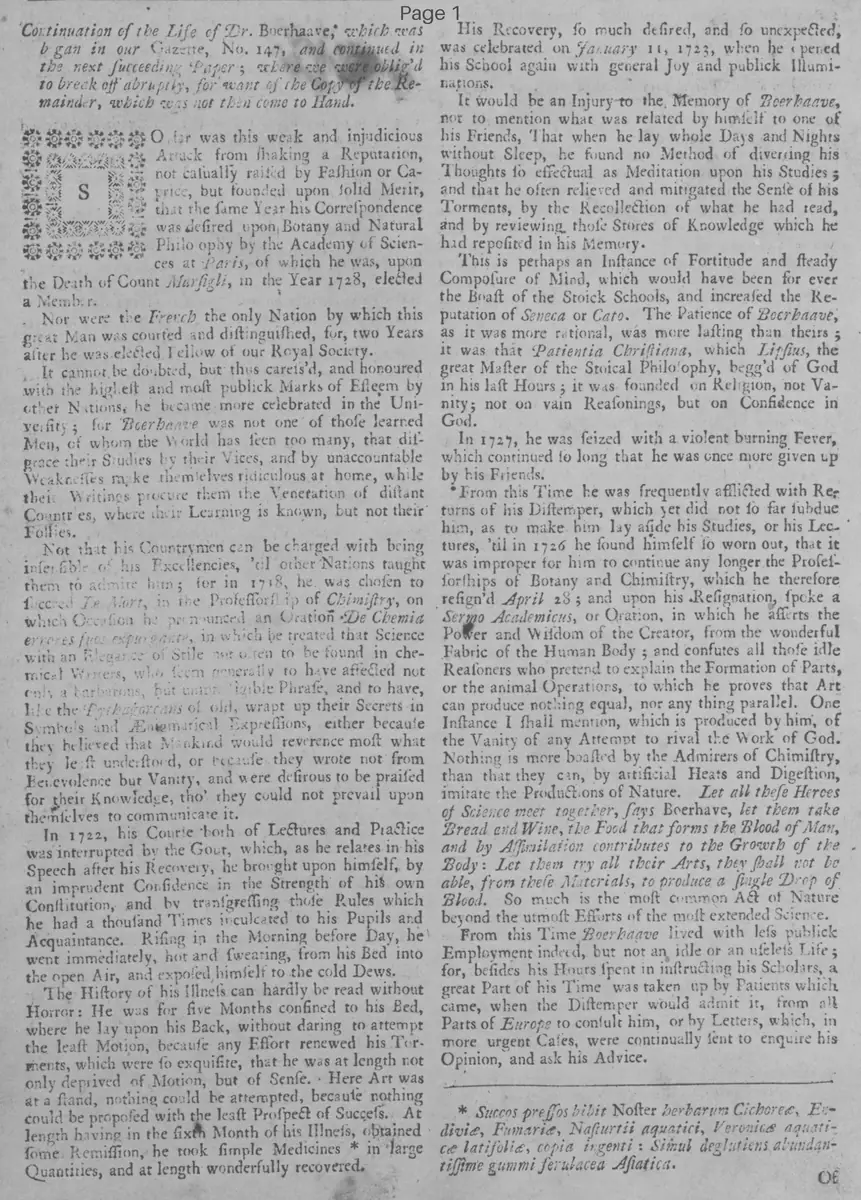
So far was this weak and injudicious Attack from making a Reputation, not casually raised by Fashion or Caprice, but founded upon solid Merit, that the same Year his Correspondence was desired upon, Botany and Natural Philosophy by the Academy of Sciences at Paris, of which he was, upon the Death of Count Marsigli, in the Year 1728, elected a Member.
Nor were the French the only Nation by which this great Man was courted and distinguished, for, two Years after he was elected Fellow of our Royal Society. It cannot be doubted, but thus caress'd, and honoured with the highest and most publick Marks of Esteem by other Nations, he became more celebrated in the University; for Boerhaave was not one of those learned Men, of whom the World has seen too many, that disgrace their Studies by their Vices, and by unaccountable Weaknesses make themselves ridiculous at home, while their Writings procure them the Veneration of distant Countries, where their Learning is known, but not their Follies.
Not that his Countrymen can be charged with being insensible of his Excellencies, 'till other Nations taught them to admire him; for in 1718. he was chosen to succeed J. Mort, in the Professorship of Chemistry, on which Occasion he pronounced an Oration De Chemia errores ince expurgante, in which he treated that Science with an Elegance of stile not often to be found in chemical Writers, who have generally affected not only a barbarous, but unintelligible Phrase, and to have, like the Pythagoreans of old, wrapt up their Secrets in Symbols and Enigmatical Expressions, either because they believed that Mankind would reverence most what they least understood, or because they wrote not from Benevolence but Vanity, and were desirous to be praised for their Knowledge, tho' they could not prevail upon themselves to communicate it.
In 1722, his Course both of Lectures and Practice was interrupted by the Gout, which, as he relates in his Speech after his Recovery, he brought upon himself, by an imprudent Confidence in the Strength of his own Constitution, and by transgressing those Rules which he had a thousand Times inculcated to his Pupils and Acquaintance. Rising in the Morning before Day, he went immediately, hot and sweating, from his Bed into the open Air, and exposed himself to the cold Dews.
The History of his Illness can hardly be read without Horror: He was for five Months confined to his Bed, where he lay upon his Back, without daring to attempt the least Motion, because any Effort renewed his Torments, which were so exquisite, that he was at length not only deprived of Motion, but of Sense. Here Art was at a stand, nothing could be attempted, because nothing could be proposed with the least Prospect of Success. At length having in the sixth Month of his Illness, obtained some Remission, he took simple Medicines* in large Quantities, and at length wonderfully recovered.
His Recovery, so much desired, and so unexpected, was celebrated on January 1st, 1723, when he opened his School again with general Joy and publick Illuminations.
It would be an Injury to the Memory of Boerhaave, not to mention what was related by himself to one of his Friends, That when he lay whole Days and Nights without Sleep, he found no Method of diverting his Thoughts so effectual as Meditation upon his Studies; and that he often relieved and mitigated the Sense of his Torments, by the Recollection of what he had read, and by reviewing those Stores of Knowledge which he had reposited in his Memory.
This is perhaps an Instance of Fortitude and steady Composure of Mind, which would have been for ever the Boast of the Stoick Schools, and increased the Reputation of Seneca or Cato. The Patience of Boerhaave, as it was more rational, was more lasting than theirs; it was that Patientia Christiana, which Lipsius, the great Master of the Stoical Philosophy, begg'd of God in his last Hours; it was founded on Religion, not Vanity; not on vain Reasonings, but on Confidence in God.
In 1727, he was seized with a violent burning Fever, which continued so long that he was once more given up by his Friends.
From this Time he was frequently afflicted with Returns of his Distemper, which yet did not so far subdue him, as to make him lay aside his Studies, or his Lectures, 'til in 1728 he found himself so worn out, that it was improper for him to continue any longer the Professorships of Botany and Chemistry, which he therefore resign'd April 28; and upon his Resignation, spoke a Sermon Academicus, or Oration, in which he asserts the Power and Wisdom of the Creator, from the wonderful Fabric of the Human Body; and confutes all those idle Reasoners who pretend to explain the Formation of Parts, or the animal Operations, to which he proves that Art can produce nothing equal, nor any thing parallel. One Instance I shall mention, which is produced by him, of the Vanity of any Attempt to rival the Work of God.
Nothing is more boasted by the Admirers of Chemistry, than that they can, by artificial Heats and Digestion, imitate the Productions of Nature. Let all these Heroes of Science meet together, Says Boerhaave, let them take Bread and Wine, the Food that forms the Blood of Man, and by Assimilation contributes to the Growth of the Body: Let them try all their Arts, they shall not be able, from these Materials, to produce a single Drop of Blood. So much is the most common Act of Nature beyond the utmost Efforts of the most extended Science.
From this Time Boerhaave lived with less publick Employment indeed, but not an idle or an useless Life; for, besides his Hours spent in instructing his Scholars, a great Part of his Time was taken up by Patients which came, when the Distemper would admit it, from all Parts of Europe to consult him, or by Letters, which, in more urgent Cases, were continually sent to enquire his Opinion, and ask his Advice.
* Successos præfos bibit Noster herbarum Cichorei, Endiviae, Fumarie, Natrutii aquatici, Veronicae aquaticae latifolia, copia ingenti: Simul deglutiens abundantissime gummi erubescens Asiatica.
Of his Sagacity, and the wonderful Penetration with which he often discover'd and detected, at the first Sight in a Parish, such Distempers as betray themselves by no Symptoms to common Eyes, such wonderful Relations have been spread over the World, as, though attested beyond doubt, can scarcely be credited. I mention none of them, because I have no Opportunity of collecting Testimonies, or distinguishing between those Accounts which are well proved, and those which owe their Rise to Fiction and Credulity.
Yet I cannot but implore, with the greatest Earnestness, such as have been conversant with this great Man, that they will not so far neglect the common Interest of Mankind, as to suffer any of these Circumstances to be lost to Posterity. Men are generally idle, and ready to satisfy themselves, and intimidate the Industry of others, by calling that impossible which is only difficult. The Skill to which Boerhaave attained, by a long and unwearied Observation of Nature, ought therefore to be transmitted in all its Particulars to future Ages, that his Successors may be ashamed to fall below him, and that none may hereafter excuse his Ignorance by pleading the Impossibility of clearer Knowledge.
Yet so far was this great Master from presumptuous Confidence in his Abilities, that in his Examination of the Sick, he was remarkably circumstantial and particular. He well knew that the Originals of Distempers are often at a Distance from their visible Effects, that to conjecture where Certainty may be obtained, is either Vanity or Negligence, and that Life is not to be sacrificed, either to an Affectation of quick Discernment, or of crowded Practice, but may be required, if trifled away at the Hand of the Physician.
About the Middle of the Year 1737, he felt the first Approaches of that fatal Illness that brought him to the Grave, of which we have inserted an Account written by himself Sept. 8, 1738, to a Friend at London* Aetatis, labor, corporisque opima firguetudo, effecit, ante annum, aut inertibus refertum, grave, belge, plenitudine turgens corpus, anhelum ad motus minimos, cum sensu fatigationis, pulsu mirifice anomale, ineptum ivaderi: ad ulbum motum. Urgebat praecipue Sufltens prorfus & interceptr a respiratione ad prima somni initia: Unde somnus prorfus prohibebatur, cum formidabili trangulationis molestia. Hinc Hydrops pedum, crurum, Semoium, Scrot i, preputii, & abdominis. ue tamen omnia luplata. Sed dolor manet in abdomine, cum anxie tate summa, anhelitu suffocante, & debilitate incredibili: Somno pauco, eoque vago, per somnia turbatissimo: Animus vero rebus agendis impar. Cum bis luctor fessus nec emergo: Patienter exspectans Dei jussa, quibus regno data, quae Sola amo, & bonoro unice. which deserves not only to be preserved as an Historical Relation of the Disease which deprived us of so great a Man, but as a Proof of his Piety and Resignation to the Divine Will.
In this last Illness, which was to the last degree lingering, painful, and afflictive, his Constancy and Firmness did not forsake him. He neither intermitted the necessary Cares of Life, nor forgot the proper Preparations for Death. Tho' Dejection and Lowness of Spirit was, as he himself tells us, Part of his Distemper, yet even this, in some measure, gave way to that Vigour which the Soul receives from a Consciousness of Innocence.
About three Weeks before his Death he received a Visit at his Country House from the Rev. Mr. Scultens, his intimate Friend, who found him sitting without Door, with his Wife, Sister, and Daughter: After the Compliments of Form, the Ladies withdrew, and left them to private Conversation; when Boerhaave took Occasion to tell him what had been, during his illness, the chief Subject of his Thoughts. He had never doubted of the spiritual and immaterial Nature of the Soul, but declared that he had lately had a kind of experimental Certainty of the Distinction between Corporeal and Thinking Substances, which mere Reason and Philosophy cannot afford, and Opportunities of contemplating the wonderful and inexplicable Union of Soul and Body, which nothing but long Sickness can give. This he illustrated by a Description of the Effects which the Infirmities of his Body had upon his Faculties; which yet they did not so oppress or vanquish, but his Soul was always Master of itself, and always resign'd to the Pleasure of its Maker.
He related, with great Concern, that once his Patience so far gave way to Extremity of Pain, that, after having lain fifteen Hours in exquisite Tortures, he prayed to God that he might be set free by Death. Mr. Scultens, by way of Consolation, answer'd, That he thought such Wishes, when forced by continued and excessive Torments, unavoidable in the present State of Human Nature; that the best of Men, even Job himself, were not able to refrain from such States of Impatience. This he did not deny, but said, "He that loves God, ought to think nothing desirable, but what is most pleasing to the Supreme Goodness."
Such were his Sentiments, and such his Conduct in this State of Weakness and Pain: As Death approached nearer, he was so far from Terror or Confusion, that he seemed even less sensible of Pain, and more cheerful under his Torments, which continued 'til the 23d Day of September, 1738, on which he died, between four and five in the Morning, in the 70th Year of his Age.
Thus died Boerhaave, a Man formed by Nature for great Designs, and guided by Religion in the Exertion of his Abilities. He was of a robust and athletic Constitution of Body, so hardened by early Severities, and wholesome Fatigue, that he was insensible of any Sharpness of Air, or Inclemency of Weather. He was tall, and remarkable for extraordinary Strength. There was in his Air and Motion something rough and artless, but so majestic and great at the Same Time, that no Man ever looked upon him without Veneration, and a kind of tacit Submission to the Superiority of his Genius.
The Vigour and Activity of his Mind sparkled visibly in his Eyes; nor was it ever observed, that any Change of his Fortune, or Alteration in his Affairs, whether happy or unfortunate, affected his Countenance. He was always cheerful, and desirous of promoting Mirth by a facetious and humorous Conversation; he was never soured by Calumny and Detraction, nor ever thought it necessary to confute them; for they are Sparks, said he, which, if you do not blow them, will go out of themselves.
Yet he took Care never to provoke Enemies by Severity of Censure, for he never dwelt on the Faults or Defects of others, and was so far from inflaming the Envy of his Rivals by dwelling on his own Excellencies, that he rarely mentioned himself or his Writings.
He was not to be over-aw'd or depress'd by the Presence, Frowns, or Insolence of Great Men, but persisted on all Occasions in the Right, with a Resolution always present and always calm. He was modest, but not timorous, and firm without Rudeness.
He could, with uncommon Readiness and Certainty, make a Conjecture of Mens Inclinations and Capacity by their Aspect.
His Method of Life was to study in the Morning and Evening, and to allot the middle of the Day to his publick Business. His usual Exercise was Riding, till in his latter Years, his Distempers made it more proper for him to walk; when he was weary, he amused himself with playing on the Violin.
His greatest Pleasure was to retire to his House in the Country, where he had a Garden stored with all the Herbs and Trees which the Climate would bear: here he used to enjoy his Hours unmolested, and prosecute his Studies without Interruption.
The Diligence with which he pursued his Studies, is sufficiently evident from his Success. Statesmen and Generals may grow great by unexpected Accidents, and a fortunate Concurrence of Circumstances, neither procured, nor foreseen by themselves: But Reputation in the learned World must be the Effect of Industry and Capacity. Boerhaave lost none of his Hours, but when he had at-
He attained one Science, attempted another: He added Physic to Divinity, Chemistry to the Mathematicks, and Anatomy to Botany. He examined Systems by Experiments, and formed Experiments into Systems. He neither neglected the Observation of others, nor blindly submitted to celebrated Names. He neither thought so highly of himself as to imagine he could receive no Light from Books, nor so meanly as to believe he could discover nothing but what was to be learned from them. He examined the Observations of other Men, but trusted only to his own.
Nor was he unacquainted with the Art of recommending Truth by Elegance, and embellishing the Philosopher with polite Literature; he knew that but a small Part of Mankind will sacrifice their Pleasure to their Improvement, and those Authors, who would find many Readers, must endeavour to please while they instruct. He knew the Importance of his own Writings to Mankind, and lest he might by a Roughness and Barbarity of Stile, too frequent among Men of great Learning, disappoint his own Intentions, and make his Labours less useful, he did not neglect the politer Arts of Eloquence and Poetry. Thus was his Learning at once various and exact, profound and agreeable.
[The Remainder in our next.]
What sub-type of article is it?
What themes does it cover?
What keywords are associated?
Literary Details
Title
Continuation Of The Life Of Dr. Boerhaave
Subject
Biography Of Dr. Boerhaave's Later Life, Illnesses, And Death
Form / Style
Biographical Prose Essay
Key Lines