Thank you for visiting SNEWPapers!
Sign up free
Virginia Free Press & Farmers' Repository
Charles Town, Jefferson County, West Virginia
What is this article about?
On August 11, 1830, The Free Press reports a lightning fire destroying Dr. John Briscoe's barn and 3,000 bushels of wheat near town, amid local drought scorching crops and pastures, contrasting Boston's abundant harvest; editorial urges gratitude to Providence over complaints.
Clipping
OCR Quality
Full Text
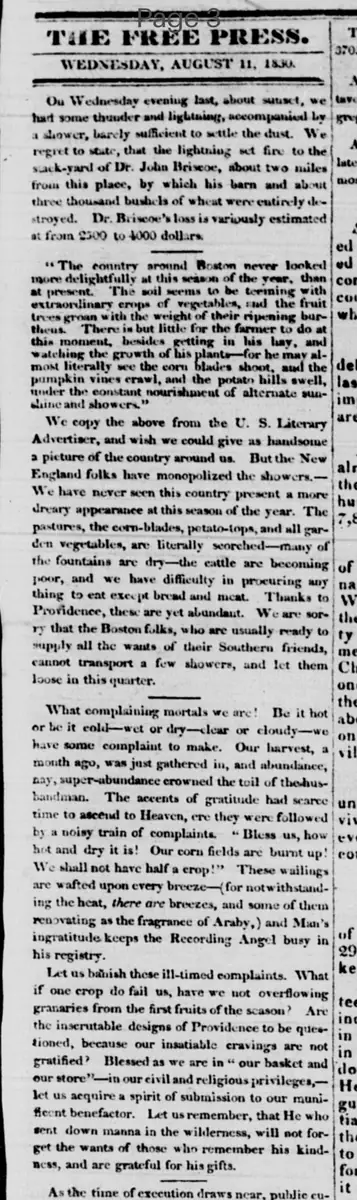
WEDNESDAY, AUGUST 11, 1830.
On Wednesday evening last, about sunset, we had some thunder and lightning, accompanied by a shower, barely sufficient to settle the dust. We regret to state, that the lightning set fire to the stack-yard of Dr. John Briscoe, about two miles from this place, by which his barn and about three thousand bushels of wheat were entirely destroyed. Dr. Briscoe's loss is variously estimated at from $500 to 4000 dollars.
"The country around Boston never looked more delightfully at this season of the year, than at present. The soil seems to be teeming with extraordinary crops of vegetables, and the fruit trees groan with the weight of their ripening burdens." There is but little for the farmer to do at this moment, besides getting in his hay, and watching the growth of his plants—for he may almost literally see the corn blades shoot, and the pumpkin vines crawl, and the potato hills swell, under the constant nourishment of alternate sunshine and showers."
We copy the above from the U. S. Literary Advertiser, and wish we could give as handsome a picture of the country around us. But the New England folks have monopolized the showers.—We have never seen this country present a more dreary appearance at this season of the year. The pastures, the corn-blades, potato-tops, and all garden vegetables, are literally scorched—many of the fountains are dry—the cattle are becoming poor, and we have difficulty in procuring any thing to eat except bread and meat. Thanks to Providence, these are yet abundant. We are sorry that the Boston folks, who are usually ready to supply all the wants of their Southern friends, cannot transport a few showers, and let them loose in this quarter.
What complaining mortals we are! Be it hot or be it cold—wet or dry—clear or cloudy—we have some complaint to make. Our harvest, a month ago, was just gathered in, and abundance, nay, super-abundance crowned the toil of the husbandman. The accents of gratitude had scarce time to ascend to Heaven, ere they were followed by a noisy train of complaints. "Bless us, how hot and dry it is! Our corn fields are burnt up! We shall not have half a crop!" These wailings are wafted upon every breeze—(for notwithstanding the heat, there are breezes, and some of them renovating as the fragrance of Araby,) and Man's ingratitude keeps the Recording Angel busy in his registry.
Let us banish these ill-timed complaints. What if one crop do fail us, have we not overflowing granaries from the first fruits of the season? Are the inscrutable designs of Providence to be questioned, because our insatiable cravings are not gratified? Blessed as we are in "our basket and our store" in our civil and religious privileges,—let us acquire a spirit of submission to our munificent benefactor. Let us remember, that He who sent down manna in the wilderness, will not forget the wants of those who remember his kindness, and are grateful for his gifts.
What sub-type of article is it?
What themes does it cover?
What keywords are associated?
What entities or persons were involved?
Where did it happen?
Story Details
Key Persons
Location
About Two Miles From This Place; Around Boston
Event Date
Wednesday Evening Last, August 1830
Story Details
Thunder and lightning with a minimal shower caused a fire that destroyed Dr. John Briscoe's barn and 3,000 bushels of wheat, estimated loss $500-4,000; local drought scorches crops and pastures contrasting Boston's bountiful vegetation; editorial reflects on human ingratitude and calls for submission to Providence amid recent abundant harvest.