Thank you for visiting SNEWPapers!
Sign up free
The Camden Journal
Camden, Kershaw County, South Carolina
What is this article about?
In 18--, a British lieutenant stationed in Oughterard, Ireland, leads a rainy night raid to suppress illicit distillation but spares a poor family's hidden still to avoid ruining them. Months later, the grateful family of Murphy O'Donnel presents gifts to the officer's wife, illustrating Irish generosity.
Clipping
OCR Quality
Full Text
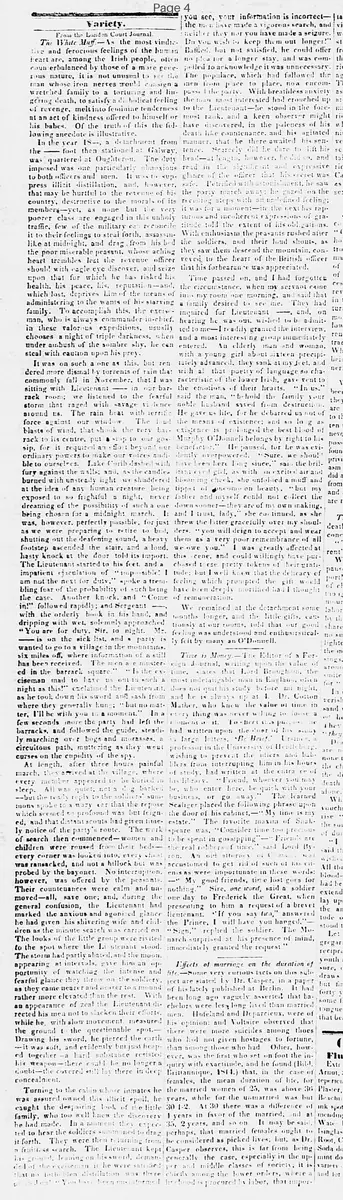
In the year 18—, a detachment from the — foot, then stationed at Galway, was quartered at Oughterard. The duty imposed was one particularly obnoxious to both officers and men. It was to suppress illicit distillation, and however that may be hurtful to the revenue of his country, destructive to the morals of its members—yet, as none but the very poorer class are engaged in this unholy traffic, few of the military can reconcile it to their feelings to steal forth, assassin-like, at midnight, and drag from his bed the poor miserable peasant, whose aching heart trembles lest the revenue officer should, with eagle eye, discover and seize upon that for which he has risked his health, his peace, his reputation, and which lost, deprives him of the means of administering to the wants of his starving family. To accomplish this, the exciseman, who is always commander-in-chief in these valorous expeditions, usually chooses a night of triple darkness, when under ambush of the sombre sky he can steal with caution upon his prey.
It was on such a one as this, but rendered more dismal by torrents of rain than commonly fall in November, that I was sitting with Lieutenant — in our barrack room; we listened to the fearful storm that raged with savage violence around us. The rain beat with terrific force against our windows. The furious blasts of wind that shook the barrack to its centre, put stop to our gossip, for it required an effort beyond our ordinary powers to make our voices audible to ourselves. Lightning flashed with fury against the walls: and, as the candle burned with unsteady light, we shuddered at the idea of any human creature being exposed to so frightful a night, never dreaming of the possibility of such a one being chosen for a midnight march. It was, however, perfectly possible, for just as we were preparing to retire to bed, shutting out the deafening sound, a heavy footstep ascended the stair, and a loud hasty knock at the door told its import. The Lieutenant started to his feet, and an impatient ejaculation of "impossible! I am not the next for duty," spoke a trembling fear of the probability of such being the case. Another knock, and "Come in!" followed rapidly: and Sergeant — with the orderly book in his hand, and dripping with wet, solemnly approached. "You are for duty, Sir, to night. Mr. — is on the sick list, and a party is wanted to go to a village in the mountains, six miles off, where information of a still has been received. The men are mustered in the barrack square." "Is the exciseman mad to lead us out in such a night as this?" exclaimed the Lieutenant, as he took down his sword and sash from where they generally hung; "but no matter, I'll be with you in a moment." In a few seconds more the party had left the barracks, and followed the guide, steadily marching over bogs and morasses, a circuitous path, muttering as they went curses on the cupidity of the spy. At length, after three hours painful march, they arrived at the village, where every inmate appeared to be buried in sleep. All was quiet: not a dog barked—but the ready reply to the soldiers' summons spoke to a wary ear that the repose which seemed so profound was but feigned, and that distant scouts had given timely notice of the party's route. The work of search then commenced—women and children were roused from their beds—every corner was looked into, chests searched, and not a hillock but was probed by the bayonet. No interruption, however, was offered by the peasants. Their countenances were calm and unmoved—all, save one; and, during the general confusion, the Lieutenant had marked the anxious and agonized glance he had given his shivering wife and children as the minute search was carried on. The looks of the little group were riveted to the spot where the Lieutenant stood. The storm had partly abated, and the moon, appearing at intervals, gave him an opportunity of watching the intense and fearful glance they threw on the soldiery, as they came nearer and nearer to a mound rather more elevated than the rest. With an appearance of zeal the Lieutenant directed his men not to slacken their efforts, while he, with slow movement, measured the ground to the questionable spot.—Drawing his sword, he pierced the earth—it was soft, and evidently but just heaped together—a hard substance resisted his weapon—there could no longer be a doubt—the covered still lay there in deep concealment.
Turning to the cabin whose inmates he was assured owned this illicit spoil, he caught the despairing look of the little family, who too well knew the discovery he had made. In a moment they expected to hear the soldiers summoned to drag it forth. They were then returning from a fruitless search. The Lieutenant kept his guard, leaning on his sword, demanding of the exciseman if he were satisfied that no further distillation was discovered. "You see, your information is incorrect—the men have made a vigorous search, and neither they nor you have made a seizure. Do you wish to keep them out longer?" Baffled, but not satisfied, he could offer no plea for a longer stay, and was compelled to acknowledge it was unnecessary. The populace, which had followed the men from place to place, now encompassed the party. With breathless anxiety the man most interested had crouched up to the Lieutenant—he stood in the fore-most rank, and a keen observer might have discovered, in the paleness of his countenance, and his agitated manner, that he there awaited his sentence. Scarcely did he dare to lift his head—at length, louder, he did so, and read in the significant and successive glance of the officer that his secret was safe. Petrified with astonishment, he saw the party march away: he gazed on the receding files with an undefined feeling: it was joy—in the next his rapid thousand incoherent expressions of gratitude told the extent of his obligations. With enthusiasm the peasants rushed after the soldiers, and their loud shouts, as they saw them descend the mountain, conveyed to the heart of the British officer that his forbearance was appreciated.
Time passed on, and I had forgotten the circumstance, when my servant came into my room one morning and said that a family desired to see me. They had inquired for Lieutenant —, and, on hearing he was out, wished to commit—to me—I readily granted the interview, and a most interesting group immediately entered. An elderly man and woman, with a young girl about sixteen, precipitately advanced, they sank at my feet, and with all that poetry of language so characteristic of the lower Irish, gave vent to the emotions of their hearts. "In us," said the man, "behold the family your noble husband saved from destruction. He gave us life, for he debarred us not of the means of existence: and so long as existence is prolonged the best blood of Murphy O'Donnel belongs by right to his benefactor." He paused, for he was evidently overpowered. "Sure, we shou'd have been here long since," said the bright-eyed girl, as with an excited air and blooming cheek, she unfolded a muff and tippet of uncommon beauty. "But father and myself could not effect the down sooner—they are of my own making, and I trust, lady," she continued, as she threw the latter gracefully over my shoulders, "you will deign to accept and wear them as a very poor remembrance of all we owe you." I was greatly affected at this scene, and could willingly have purchased these pretty tokens of their gratitude: but I well knew that the delicacy of feeling which prompted the gift would have been deeply mortified had I thought of remuneration. We remained at the detachment some months longer, and the little gifts constantly at our rooms, told that our good feeling was understood and enthusiastically reciprocated by many an O'Donnel.
What sub-type of article is it?
What themes does it cover?
What keywords are associated?
What entities or persons were involved?
Where did it happen?
Story Details
Key Persons
Location
Oughterard, Ireland
Event Date
In The Year 18—
Story Details
During a stormy November night raid to seize an illicit still in a mountain village near Oughterard, Lieutenant — discovers the hidden apparatus of Murphy O'Donnel's family but conceals the find from the exciseman, sparing them ruin. Months later, the grateful family visits the lieutenant's wife with handmade gifts expressing their profound thanks.