Thank you for visiting SNEWPapers!
Sign up free
Palladium Of Virginia And The Pacific Monitor
Lewisburg, Greenbrier County, West Virginia
What is this article about?
This continued editorial argues that Christ's kingdom is not of this world, prohibiting Christians from using carnal weapons, engaging in wars, or defensive violence, based on Jesus' teachings, life, and biblical precepts, contrasting with Mosaic allowances and refuting pro-war arguments.
Merged-components note: This is a single continued religious essay titled 'The Mediator's Kingdom' spanning three pages, arguing against the use of carnal weapons in Christianity; best classified as an opinion piece fitting 'editorial' rather than 'literary'.
Clippings
1 of 3
OCR Quality
Full Text
The Mediator's Kingdom, &c.
(Continued from our last.)
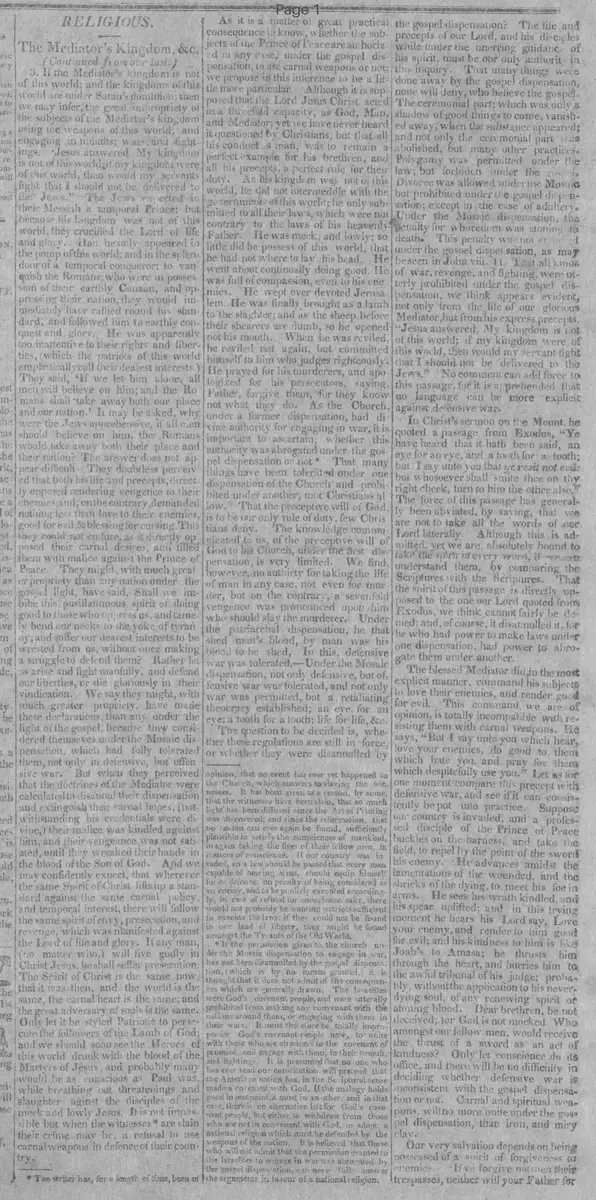
3. If the Mediator's kingdom is not of this world; and the kingdoms of this world are under Satan's dominion; then we may infer, the great impropriety of the subjects of the Mediator's Kingdom using the weapons of this world; and engaging in tumults; wars, and fightings. Jesus answered My kingdom is not of this world if my kingdom were of this world, then would my servants fight that I should not be delivered to the Jews. The Jews expected in their Messiah a temporal Prince; but because his kingdom was not of this world, they crucified the Lord of life and glory. Had he only appeared in the pomp of this world; and in the splendor of a temporal conqueror; to vanquish the Romans; who were in possession of their earthly Canaan, and oppressing their nation, they would immediately have rallied round his standard, and followed him to earthly conquest and glory. He was apparently too inattentive to their rights and liberties, (which the patriots of this world emphatically call their dearest interests.) They said. 'If we let him alone. all men will believe on him; and the Romans shall take away both our place and our nation.' It may be asked, why were the Jews apprehensive, if all even should believe on him, the Romans would take away both their place and their nation? The answer does not appear difficult They doubtless perceived that both his life and precepts, directly opposed rendering vengeance to their enemies, and, on the contrary, demanded nothing less than love to their enemies, good for evil, & blessing for cursing. This they could not endure. as it directly opposed their carnal desires. and filled them with malice against the Prince of Peace. They might, with much greater propriety than any nation under the gospel light, have said, Shall we imbibe this pusillanimous spirit of doing good to those who oppress us, and tamely bend our necks to the yoke of tyranny, and suffer our dearest interests to be wrested from us, without once making a struggle to defend them? Rather let us arise and fight manfully, and defend our liberties, or die gloriously in their vindication. We say they might, with much greater propriety. have made these declarations, than any under the light of the gospel, because they considered themselves under the Mosaic dispensation, which had fully tolerated them, not only in defensive, but offensive war. But when they perceived that the doctrines of the Mediator were calculated to disannul their dispensation and extinguish their carnal hopes, (notwithstanding his credentials were divine,) their malice was kindled against him, and their vengeance was not satiated, until they wreaked their hands in the blood of the Son of God. And we may confidently expect, that wherever the same Spirit of Christ lifts up a standard against the same carnal policy, and temporal interest. there will follow the same spirit of envy, persecution, and revenge, which was manifested against the Lord of life and glory. If any man. (no matter who.) will live godly in Christ Jesus. he shall suffer persecution. The Spirit of Christ is the same now, that it was then, and the world is the same, the carnal heart is the same; and the great adversary of souls is the same. Only let it be styled Patriotic to persecute the followers of the Lamb of God: and we should soon see the Heroes of this world drunk with the blood of the Martyrs of Jesus, and probably many would be as conscious as Paul was. while breathing out threatenings and slaughter against the disciples of the meek and lowly Jesus. It is not impossible but when the witnesses are slain their crime may be, a refusal to use carnal weapons in defence of their country.
, The writer has, for a length of time, been of
As it is a matter of great practical consequence to know, whether the subjects of the Prince of Peace are authorized in any case, under the gospel dispensation, to use carnal weapons or not; we propose in this inference to be a little more particular. Although it is supposed that the Lord Jesus Christ acted in a threefold capacity. as God, Man, and Mediator: yet we have never heard it questioned by Christians. but that all his conduct as man, was to remain a perfect example for his brethren, and all his precepts. a perfect rule for their duty. As his kingdom was not of this world, he did not intermeddle with the governments of this world; he only submitted to all their laws, which were not contrary to the laws of his heavenly Father. He was meek, and lowly; so little did he possess of this world. that he had not where to lay his head. He went about continually doing good. He was full of compassion, even to his enemies. He wept over devoted Jerusalem. He was finally brought as a lamb to the slaughter; and as the sheep before their shearers are dumb, so he opened not his mouth. When he was reviled. he reviled not again, but committed himself to him who judges righteously. He prayed for his murderers, and apologized for his persecutors, saying. Father, forgive them, for they know not what they do. As the Church. under a former dispensation, had divine authority for engaging in war. it is important to ascertain, whether this authority was abrogated under the gospel dispensation or not That many things have been tolerated under one dispensation of the Church and prohibited under another, most Christians allow, That the preceptive will of God. is to be our only rule of duty, few Christians deny. The knowledge communicated to us, of the preceptive will of God to his Church. under the first dispensation, is very limited. We find. however. no authority for taking the life of man in any case, not even for murder, but on the contrary, a sevenfold vengeance was pronounced upon him who should slay the murderer. Under the patriarchal dispensation, he that shed man's blood, by man was his blood to be shed, In this, defensive war was tolerated,--Under the Mosaic dispensation, not only defensive, but offensive war was tolerated, and not only war was permitted, but a retaliating theocracy established; an eye. for an eye; a tooth for a tooth; life for life, &c. The question to be decided is, whether these regulations are still in force. or whether they were disannulled by the gospel dispensation? The life and precepts of our Lord, and his disciples while under the unerring guidance of his spirit, must be our only authority in this inquiry. That many things were done away by the gospel dispensation, none will deny, who believe the gospel. The ceremonial part; which was only a shadow of good things to come, vanished away; when the substance appeared; and not only the ceremonial part was abolished, but many other practices. Polygamy was permitted under the law; but forbidden under the gospel. Divorce was allowed under the Mosaic but prohibited under the gospel dispensation; except in the case of adultery. Under the Mosaic dispensation. the penalty for whoredom was stoning to death. This penalty was not enforced under the gospel dispensation, as may be seen in John viii. It That all kinds of war, revenge, and fighting, were utterly prohibited under the gospel dispensation, we think appears evident. not only from the life of our glorious Mediator, but from his express precepts. "Jesus answered, My kingdom is not of this world; if my kingdom were of this world, then would my servants fight that I should not be delivered to the Jews." No comment can add force to this passage, for it is apprehended that no language can be more explicit against defensive war. In Christ's sermon on the Mount. he quoted a passage from Exodus, "Ye have heard that it hath been said, an eye for an eye, and a tooth for a tooth; but. I say unto you that ye resist not evil: but whosoever shall smite thee on thy right cheek, turn to him the other also." The force of this passage has generally been obviated, by saying, that we are not to take all the words of our Lord literally. Although this is admitted. yet we are absolutely bound to take the spirit of every word, if we understand them, by comparing the Scriptures with the Scriptures. That the spirit of this passage is directly opposed to the one our Lord quoted from Exodus. we think cannot fairly be denied; and, of course, it disannulled it, for he who had power to make laws under one dispensation, had power to abrogate them under another. The blessed Mediator did in the most explicit manner, command his subjects to love their enemies, and render good for evil. This command. we are of opinion, is totally incompatible with resisting them with carnal weapons. He says, But I say unto you which hear, love your enemies, do good to them which hate you, and pray for them which despitefully use you." Let us for one moment compare this precept with defensive war. and see if it can consistently be put into practice. Suppose our country is invaded, and a professed disciple of the Prince of Peace buckles on the harness, and takes the field, to repel by the point of the sword his enemy. He advances amidst the lamentations of the wounded. and the shrieks of the dying, to meet his foe in arms. He sees his wrath kindled, and his spear uplifted; and in this trying moment he hears his Lord say, Love your enemy, and render to him good for evil; and his kindness to him is like Joab's to Amasa; he thrusts him through the heart, and hurries him to the awful tribunal of his judge; probably, without the application to his never-dying soul, of any renewing spirit or atoning blood. Dear brethren. be not deceived, for God is not mocked Who amongst our fellow men. would receive the thrust of a sword as an act of kindness? Only let conscience do its office, and there will be no difficulty in deciding whether defensive war is inconsistent with the gospel dispensation or not. Carnal and spiritual weapons. will no more unite under the gospel dispensation, than iron, and miry clay. Our very salvation depends on being possessed of a spirit of forgiveness to enemies. If we forgive not men their trespasses, neither will your Father forgive your trespasses.
Forgive your trespasses. If men invade our rights, and trespass upon our privileges, is it forgiveness to repel them at the point of the bayonet? The honest Christian will find no difficulty in conscientiously deciding this question; notwithstanding he may be slow of heart in believing all that is written.
All the conduct of our Lord had meaning to it; and much of it was with an express view to teach his disciples by way of example. A little before he was betrayed, he ordered his disciples to take swords. The object of this must have been, either to use them for defence, or for some other purpose. The event proves, that they were not taken for self-defence. The question then is, for what were they taken? The event appears fully to answer the question; viz. To prohibit, by way of example, the use of them for self-defence, in the most trying situation possible. If any situation would justify self-defence with carnal weapons, it must have been the situation in which our Lord and his disciples were placed, at the time he was betrayed. They were in a public garden; and they were assaulted by a mob: contrary to the statutes of the Romans, and the laws of the Jews: and the object was, to take his life. This the disciples knew; and Peter judged it a proper time for defence, and drew his sword, and smote a servant of the High Priest, and cut off his ear. As our Lord's kingdom was not of this world, he would not suffer his subjects to use the weapons of this world in any situation. He therefore healed the wound they made, and rebuked Peter for his mistaken zeal. "Then said Jesus unto him, put up again thy sword into his place, for all they that take the sword, shall perish with the sword; thinkest thou that I cannot pray to my Father, and he would presently send me more than twelve legions of angels?" Here we see that our Lord not only forbade his disciples to use the sword in self-defence; but added a dreadful penalty to transgressors—"all they that take the sword shall perish with the sword."
The disciples did not then fully understand that his kingdom was not of this world. As soon as they were prohibited using the weapons of this world, they all forsook him and fled.*
The Apostle James in his epistle to the twelve tribes of Israel, which were scattered abroad, asks them this question: "From whence come wars and fightings among you? Come they not even of your lusts, that war in your members? Ye lust, and have not; ye kill, and desire to have, and cannot obtain; ye fight, and war, and yet ye have not." "Ye adulterers! know ye not that the friendship of the world is enmity with God? whosoever, therefore, will be a friend to the world, is an enemy of God." From this we think it evidently appears, that the warlike spirit of the world is directly opposed to God. The God of this world works effectually in the hearts of the children of disobedience, and stirs up their lusts, which war in their members, and hurries them on to acts of cruelty, revenge, & fighting.
This subject is of so much practical consequence, that it requires a few observations, in reply to some of the arguments of worldly and unenlightened Christians, in favour of using carnal weapons. It is said, that government is an ordinance of God, which exists throughout his vast dominion. In heaven above, there are angels and archangels; and upon earth, there are magistrates and powers; and in hell there is the prince of devils. That God, in his holy providence, has so disposed of events, that governments of some kind or other do exist in all parts of his dominion, none but sceptics will deny. But who would pretend that the governments in heaven and hell are not diametrically opposite? One is the spirit of peace and love; and the other, rebellion and war. Perhaps the manifestation of these different spirits, here on earth, may fairly be the dividing line amongst its inhabitants, and show to which kingdom they belong. They say all powers are ordained of God. Thus far they are correct; but it is apprehended that they do not make a proper distinction between the ordination of God, and his preceptive will for man. So far as the former agrees with the latter, it is a rule of duty, and cannot be any further. One is the rule of God's own procedure, (if the expression is proper,) and the other the rule of action for his creatures; but the counsel of God, and his laws for man, are often diametrically opposite. It is not improbable, that this is part of the mystery of God, which will, by and by, be finished.
The Lord Jesus Christ was delivered by the determinate counsel and foreknowledge of God; and yet by wicked hands, he was crucified and slain. Here, as in the case of Pharaoh, and many other instances recorded, the divine counsel and the duty of man were directly opposite. To ascertain our duty we must look at the preceptive will of God, and not to his eternal counsel. Although all powers are ordained of God, yet it must not be inferred, that all the laws of the heathen or civilized world, are to be a rule of duty for the Mediator's subjects, or that their Spirit is agreeable to the Spirit of the Gospel dispensation. It is said, We are commanded to obey magistrates, and every ordinance of man, for the Lord's sake. All this is admitted; but these injunctions are either limited by other precepts, or they are unlimited: if they are unlimited, then all who have died martyrs, fell a sacrifice to superstition, instead of duty. Notwithstanding these directions were intended as a rule for Christians in all ages, yet they were promulgated, while the disciples were under idolatrous governments, and were never intended to be binding upon them to worship idols.
These commands must, therefore, be limited. The question is, how are they limited? We apprehend, by the spirit, and other precepts of the gospel. We have already shown, we trust, that these absolutely prohibit war in every form. If so then none of these injunctions can counteract the position we are examining. They only enjoin strict obedience to all human laws under which we live, that do not contradict the spirit, or precepts of the Gospel: when they do, they are not binding, and must be resisted; not, however, with carnal, but spiritual weapons; we must take joyfully the spoiling of our goods, and count not our lives dear unto ourselves.
It has been often said, that he who refuses to comply with the commands of the magistrate, resists the powers that be; and, according to the apostle's reasoning, resists the ordinance of God, and will receive to himself damnation. And further, as all powers are the ordinance of God; they ought to be supported; and if they cannot without, they must be, even at the point of the sword. Here the subject of the Mediator must make a distinction between resisting the "Powers that be" by force of arms, and refusing to obey their unlawful commands. It is supposed, that in one case he would obey, and that in the other he would disobey the commands of his master. No martyr ever considered himself as violating this precept, in refusing to sacrifice to an idol, at the command of an earthly power: neither will any subject of the Mediator view himself as violating it by refusing to use carnal weapons, while he believes that his Lord has utterly forbidden his using them. It is apprehended that if this proves any thing upon the principles of war, that it will prove too much for its advocates. The command is to obey the powers that be, and not the powers that ought to be. If it is taken in an unlimited sense, it must prohibit resisting even tyrannical powers, and would of course condemn every Christian who engaged in the American revolution.
To say that all power is in the hands of the people, and of course it is the people who are the powers that be, is thought to be but a quibble. We will suppose a very possible case, that a foreign power completely overturns the government of the people, and disannuls their laws, and gives a new code, in that case, the command to obey the powers that be, would not be annihilated. The precept originally was given, while the disciples were in the midst of tyrannical governments. It is thought, that it is so far from tolerating defensive war, that it is opposed to it. The precepts of the gospel cannot be dependent upon the convulsions of the nations. If Christians are bound to aid with carnal weapons in suppressing a rebellion, then, if the opposing power gains the predominance, they must turn directly about, and fight the very power they were before supporting. Such conduct would not become the citizens of Zion. If it is said, the powers that be, are Christian rulers; then we say, let them govern only by the laws of the Mediator's kingdom, and we will bow with reverence before them: and not teach for commandments the doctrines of men; as we cannot receive human laws, for divine precepts.
It is stated that our Lord paid tribute, and that we are commanded to pay tribute to whom tribute is due, and that tribute supports the governments of this world. This is granted; but the Mediator's subjects are required also to lead peaceable and quiet lives; this is more promoted by paying tribute, than by the refusal. Our Lord directs Peter to pay the tribute, lest they should give offence. But paying tribute for the sake of preserving peace is a very different thing from actually engaging in war. Whenever the Christian is called upon to pay money, by way of taxes or tribute, he does not part with any spiritual treasure, but only earthly property; for which he has the example and precepts of his Lord. The currency of the world generally bears the ensign of the nation which made it. If it bears the image and superscription of Cæsar, then render to Cæsar, the things that are Cæsar's; and unto God, the things which are God's; Christians, however, whose hearts are upon this idol, will sooner give up their lives than their God. "The love of money is the root of all evil." The real Christian's treasure is in heaven, & beyond the reach of the powers of earth or hell. The things of this world are but privileges lent to him, to be resigned at the call of his Lord. Shall he then fear those who can only kill the body: and afterwards have no more power than they can do? Rather let him fear him, who has power to destroy both soul and body in hell for ever. It is better for him to suffer wrong, than to do wrong.
The permission granted to the Jewish church to wage war, has often been pleaded as authority for Christians. If this proves any thing, it proves too much; for not only defensive, but offensive war was permitted under the Mosaic dispensation. This, the Tyrants of the world have not generally contended was right, since the gospel dispensation. We think, however, that we have fully shown that this was abrogated under the gospel dispensation, and that all kinds of war were prohibited. If so, it has no weight on the subject.*
It has been said, that Christians, with a small exception, have never questioned the propriety of defensive war. As at regards nominal Christians, this statement is perhaps correct; but as it respects the real disciples of the Mediator it is to be questioned. We hear of no Christians in the first ages of the Church, engaged in carnal warfare; until we hear of great corruptions in the Church. Most protestants have been of opinion, that those precious disciples who inhabited the dark vallies of Piedmont; during the great corruptions of the nominal Church; were the Redeemer's true subjects. These disciples, of whom the world was not worthy, utterly refused to engage even in defensive war; notwithstanding they were hunted down by their bloody persecutors, the same as the Lamb is hunted down by the Wolf.
It has been often repeated that the Reformers who were good men, did not hesitate to engage in defensive war; and that the reformation was finally supported by the sword. That the Reformers were generally pious men, is readily admitted, and that the reformation under divine providence was a glorious event to the Church, is also granted. But the history of the Reformers, when written by their friends, abundantly manifests that they were men, subject to like passions, with other men; and that all the means they employed could not be justified, either by the Spirit, or the precepts of the gospel. Henry the Eighth was a vile man, but he was very active in protesting against the Pope, because his holiness would not grant him a divorce. God makes the wrath of man praise him. It will not probably be a great length of time, (in the opinion of the writer,) before those Churches which were defended with the sword, will be destroyed by the sword.
It has been further urged, that not only the Reformers, but most pious Protestants, have prayed for the prosperity of the arms of their country; and many have actually fought in the field of battle. All this is likewise admitted: but how many pious men have had a mistaken zeal? It is fully believed, that Protestants, generally, have been in the habit of considering the reformation so glorious an event, that they have very little inquired, whether the means by which it was finally defended, were agreeably to the spirit of the gospel or not. They have been taught, from their earliest years, to consider that the weapons of war as used by the Reformers were lawful, so that they have not hesitated to follow their example. That the example and prayers of pious people ought to have weight is readily granted; but to place a blind confidence in them, we apprehend, is criminal; or their example is to be imitated, no further, than it agrees with the spirit and precepts of the gospel. These must for ever remain a perfect standard of duty; whereas, the practice of real Christians, (owing to their imperfect state,) is constantly changing, and often contradictory. During the American revolution, doubtless, real Christians were praying and fighting for the success of the American arms; & real Christians in the British service, were praying and fighting for the success of his Majesty's arms. The truth is, they ought not to pray for war in any shape, but to pray that wars may cease from under heaven; and that God's kingdom may come; and his will be done on earth as it is done in heaven; and not only to pray, but endeavour to advance the kingdom of heaven, and put a stop to wars and bloodshed. The opinions of pious people often vary with the increase of light which shines upon the Church. One century ago most pious people believed in the propriety of the slave trade: but very few can now be found to advocate the abominable practice. The nature of the crime has not changed, nor the evidence against it; but the truth is, that the opinion of pious people has materially changed upon the subject. We ought always to remember that the example of pious people, is to be of no weight, any farther than it agrees with the example of our Lord. It is always unsafe to be looking too much to the fallible example of those whom we have esteemed pious, for a rule of duty, while we have the unerring word in our hands, to light our ways. When any one is depending upon the example of Christians, not under the immediate influence of divine inspiration, for evidence to support his hypothesis, it is strong presumptive evidence that he has not the word of God in his favour.
a Four things are noticeable from this history. First, That the subjects of the Mediator's kingdom have no right to use carnal weapons or defence, in the most trying situation possible. Secondly. The promulgation of a decree of heaven that all they, (whether states, churches, or kingdoms, who take the sword, shall perish with the sword—Every political or ecclesiastical body which is defended with the sword, will by the sword be destroyed in confirmation of this sentiment, we see while the great destroying powers were represented to St John in the symbols of ferocious beasts, it was added—If any man have an ear to hear, let him hear. He that leadeth into captivity shall go into captivity; he that killeth with the sword, must be killed with the sword:" but in opposition to this it is said "Here is the faith and the patience of the saints." We would inquire, how the faith and the patience of the saints appear, if they, like the nations of the earth, lead into captivity, and kill with the sword? Thirdly. The weapon, which the subjects of the Redeemer are to use for defence, is here brought into view, viz: Prayer. Nothing which appears prevented our Lord from using this weapon when he was betrayed, but the necessity of the Scriptures being fulfilled. Had he prayed to his Father, more than twelve legions of ministering spirits would have appeared swift as lightning to discharge his will. At the time he shall come in all the glory of his Father, the holy Angels will be with him. He will break through the heavens in flaming fire, and descend with the shout of the Archangel, and the trump of God; and cleave asunder the earth beneath: and send forth his angels, who will awake the sleeping millions from their tombs, and gather together his elect, and take them up into the air, to be ever with their Lord. Fourthly, we may expect that angels will be sent to deliver the saints in the times of trouble. Angels are ministering spirits, and are sent forth to minister to those who shall be the heirs of salvation. What a consolation it is, that the subjects of the Mediator can apply for help, in times of trouble, to him who has the hosts of heaven at his command; and who has said he will never leave nor forsake them! The Angel of the Lord encampeth round about them who fear him, to deliver them out of all their trouble. If God be for them who can be against them!
ought every controversy to be tried.
It is further argued, that we are commanded to pray for kings, and all in authority; it is true we must pray not only for kings, but all men, even enemies. This, however, does by no means imply, that we are commanded to pray for a blessing upon their unhallowed undertakings; but it only implies that we must pray that they may be translated out of nature's darkness into the light of the gospel; and from the power of Satan, unto the living God.
The great difficulty with the subjects of the Mediator ever has been, and still is, a want of faith in the promises of God. They are prone to be afraid of consequences. They look nearly as much at consequences as the children of Israel did, while journeying from Egypt to Canaan. The truth is, they ought to have nothing to do with consequences, but only duties. Thus, saith the Lord, should be their warrant and only guide. If they implicitly follow the command, consequences are all safe in God's hand. Had Abraham looked only at consequences, it is not probable he would ever have been styled the Father of the Faithful. It is not uncommon for timid and worldly Christians to be alarmed at consequences, and to argue in this manner: They say, shall we stand still and suffer an assassin to enter our houses, and take our lives and property, without ever attempting to resist him? All this must go upon the supposition, that he who has said he will never leave nor forsake his people, and is a very present help in every time of need, will take no care of them. No assassin could stand a moment before the prayer of faith, which would enter the heavens, and reach the ears of the Lord of Sabaoth. If faithless Christians cannot be persuaded to look at the precepts and the promises; but only at consequences, they ought to examine them well. Suppose God, in his holy providence, should permit an assassin to take the life of one of his dear children: the consequence would be, he would immediately be translated to glory; and possibly the assassin might become a penitent; but should he take the life of the assassin, in defending himself, the consequence then would be, he would hurry him into the abyss of the damned, where his probation would be eternally ended. He who puts his trust in the Lord shall not fear what man can do to him; he will be like Mount Zion, which cannot be moved.
(Concluded in our next.)
What sub-type of article is it?
What keywords are associated?
What entities or persons were involved?
Editorial Details
Primary Topic
Christian Non Resistance To Violence And Prohibition Of War Under The Gospel
Stance / Tone
Strongly Pacifist And Anti War Based On Christ's Teachings
Key Figures
Key Arguments