Thank you for visiting SNEWPapers!
Sign up free
The Lambertville Press
Lambertville, Hunterdon County, New Jersey
What is this article about?
Survivor Philip Berry's letter attributes the steamship Austria's mid-ocean fire, which killed around 400 people on September 13, 1858, to excessive furnace heat from the captain's bet to arrive in New York early, rather than just a tar bucket incident.
Clipping
OCR Quality
Full Text
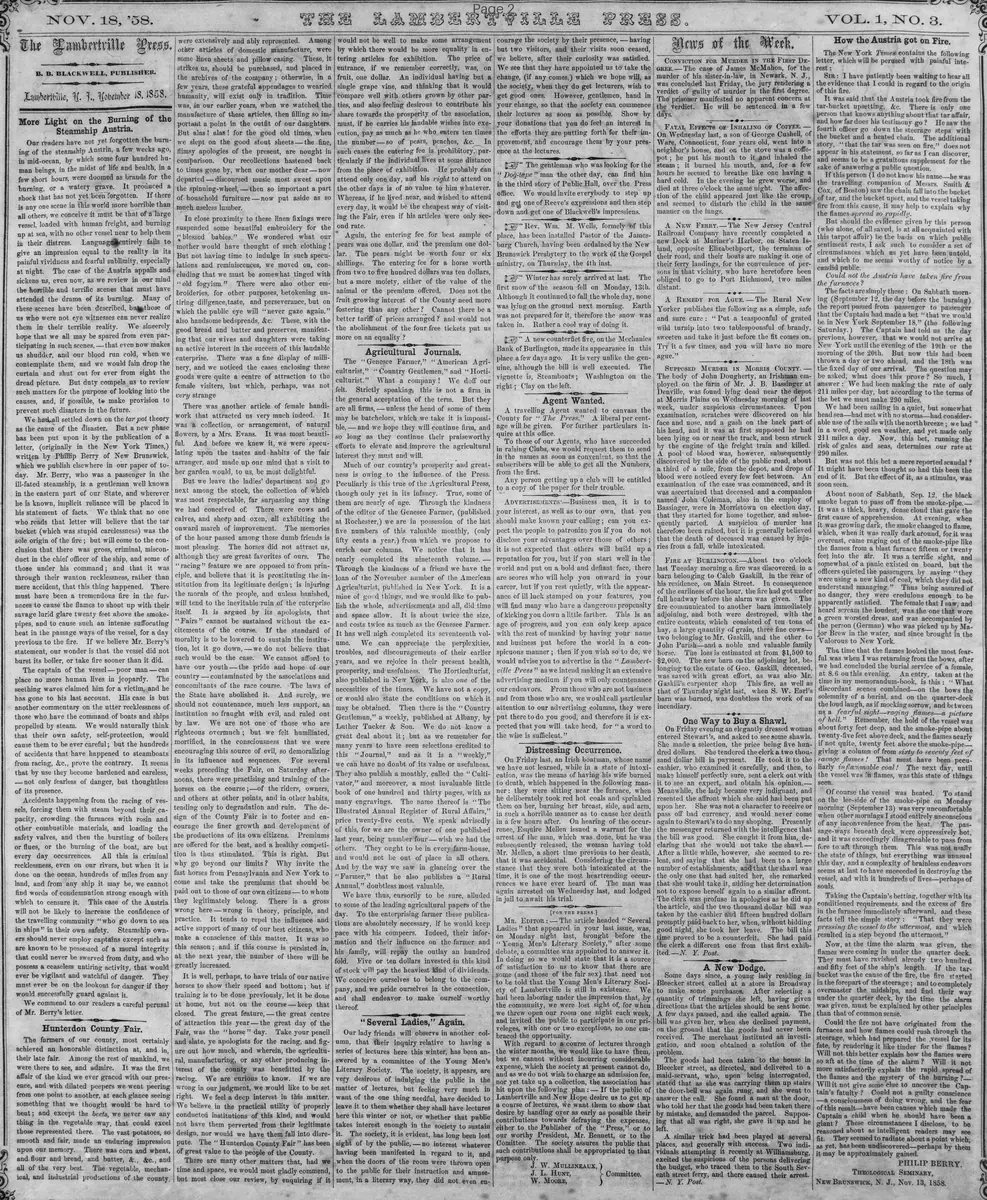
Our readers have not yet forgotten the burning of the steamship Austria, a few weeks ago, in mid-ocean, by which some four hundred human beings, in the midst of life and health, in a few short hours, were doomed as brands for the burning, or a watery grave. It produced a shock that has not yet been forgotten. If there is any one scene in this world more horrible than all others, we conceive it must be that of a large vessel, loaded with human freight, and burning up at sea, with no other vessel near to help them in their distress. Language entirely fails to give an impression equal to the reality in its painful vividness and fearful sublimity, especially at night. The case of the Austria appalls and sickens us, even now, as we review in our mind the horrible and terrific scenes that must have attended the drama of its burning. Many of these scenes have been described, but those of us who were not eye witnesses can never realize them in their terrible reality. We sincerely hope that we all may be spared from even participating in such scenes, -that even now makes us shudder, and our blood run cold, when we contemplate them, and we would fain drop the curtain and shut out for ever from sight the dread picture. But duty compels us to review such matters for the purpose of looking into the causes, and, if possible, to make provision to prevent such disasters in the future.
We had all settled down on the tar pot theory as the cause of the disaster. But a new phase has been put upon it by the publication of a letter, (originally in the New York Times,) written by Phillip Berry of New Brunswick, which we publish elsewhere in our paper of to-day. Mr. Berry, who was a passenger in the ill-fated steamship, is a gentleman well known in the eastern part of our State, and wherever he is known, implicit reliance will be placed in his statement of facts. We think that no one who reads that letter will believe that the tar bucket (which was stupid carelessness) was the sole origin of the fire; but will come to the conclusion that there was gross, criminal, misconduct in the chief officer of the ship, and some of those under his command; and that it was through their wanton recklessness, rather than mere accident, that this thing happened. There must have been a tremendous fire in the furnaces to cause the flames to shoot up with their savage lurid glare twenty feet above the smoke-pipes, and to cause such an intense suffocating heat in the passage ways of the vessel, for a day previous to the fire. If we believe Mr. Berry's statement, our wonder is that the vessel did not burst its boiler, or take fire sooner than it did.
The captain of the vessel-poor man-can place no more human lives in jeopardy. The seething waves claimed him for a victim, and he has gone to his last account. His case is but another commentary on the utter recklessness of those who have the command of boats and ships propelled by steam. We would naturally think that their own safety, self-protection, would cause them to be ever careful; but the hundreds of accidents that have happened to steamboats from racing, &c., prove the contrary. It seems that by use they become hardened and careless, -not only fearless of danger, but thoughtless of its presence.
Accidents happening from the racing of vessels, forcing them with steam beyond their capacity, crowding the furnaces with rosin and other combustible materials, and loading the safety valves, and then the bursting of boilers or flues, or the burning of the boat, are but every day occurrences. All this is criminal recklessness, even on our rivers, but when it is done on the ocean, hundreds of miles from any land, and from any ship it may be, we cannot find words of condemnation strong enough with which to censure it. This case of the Austria will not be likely to increase the confidence of the travelling community "who go down to sea in ships" in their own safety. Steamship owners should never employ captains except such as are known to be possessed of a moral integrity that could never be swerved from duty, and who possess a ceaseless untiring activity, that would ever be vigilant and watchful of danger. They must ever be on the lookout for danger if they would successfully guard against it.
We commend to our readers a careful perusal of Mr. Berry's letter.
VOL. 1, NO. 3.
How the Austria got on Fire.
The New York Times contains the following letter, which will be perused with painful interest:
SIR: I have patiently been waiting to hear all the evidence that I could in regard to the origin of this fire.
It was said that the Austria took fire from the tar-bucket upsetting, &c. There is only one person that knows anything about that tar affair, and how far does his testimony go? He saw the fourth officer go down the steerage steps with the bucket and a heated chain. The additional story, "that the tar was seen on fire," does not appear in his statement, so far as I can discover, and seems to be a gratuitous supplement for the sake of answering a public question.
If this person (I do not know his name—he was the travelling companion of Messrs. Smith & Cox, of Boston) saw the chain fall into the bucket of tar, and the bucket upset, and the vessel taking fire from this cause, it may help to explain why the flames spread so rapidly.
But should the evidence given by this person (who alone, of all saved, is at all acquainted with this tarpot affair be the basis on which public sentiment rests, I ask such to consider a set of circumstances which as yet have been untold. and which to me seems worthy of notice by a candid public.
Could not the Austria have taken fire from the furnaces ?
The facts are simply these : On Sabbath morning (September 12, the day before the burning) the report passed from passenger to passenger that the Captain had made a bet " that we would be, in New York September 18," (the following Saturday.) The Captain had told us the day previous, however, that we would not arrive at New York until the evening of the 19th or the morning of the 20th. But now this had been thrown a day or two ahead, and the 18th was the fixed day of our arrival. The question may be asked, what does this prove? So much, I answer : We had been making the rate of only 211 miles per day, but according to the terms of the bet we must make 290 miles.
We had been sailing in a quiet, but somewhat head sea —had met with no storms —had considerable use of the sails with the north breeze; we had in a word, good sea weather, and yet made only 211 miles a day. Now, this bet, running the risk of gales and seas, determines our rate at 290 miles.
But was not this bet a mere reported scandal? It might have been thought so had this been the end of it. But the effect of it, as a stimulus, was soon seen.
About noon of Sabbath, Sep. 12, the black smoke began to pass off from the smoke-pipe.- It was a thick, heavy, dense cloud that gave the first cause of apprehension. At evening, when it was growing dark, the smoke changed to flame, which, when it was really dark around, for it was overcast, came raging out of the smoke-pipe like the flames from a blast furnace fifteen or twenty feet into the air. It was a terrific sight, and somewhat of a panic existed on board, but the officers quieted the passengers. by saying "they were using a new kind of coal, which they did not understand managing." Thus being assured of no danger, they were credulous enough to be apparently satisfied. The female that I saw, and heard scream the loudest, was the one that wore a green worsted dress, and was accompanied by the person (German) who was picked up by Major Brew in the water, and since brought in the Valorous to New York.
The time that the flames looked the most fearful was when I was returning from the bows, after we had concluded the burial service of a female, at 8.6 on this evening. An entry, taken at the time in my memorandum-book, is this : " What discordant scenes combined-on the bows the solemnity of a burial, and on the quarter-deck the loud laugh, as if mocking sorrow, and between us a fearful sight raging flames-a picture of hell." Remember, the hold of the vessel was about forty feet deep, and the smoke-pipe about twenty-five feet above deck, and the flames nearly if not quite, twenty feet above the smoke-pipe- giving a column of from sixty to seventy feet of savage flames! That must have been peculiarly inflammable coal! The next day, until the vessel was in flames, was this state of things seen.
Of course the vessel was heated. To stand on the lee-side of the smoke-pipe on Monday morning (September 13) was very uncomfortable when other mornings I stood entirely unconscious of any inconvenience from the heat. The passage-ways beneath deck were oppressively hot, and it was exceedingly disagreeable to pass from fore to aft through them. This was not usually the state of things, but everything was unusual this day, and a complexity of brainless endeavors seems at last to have succeeded in destroying the vessel. and with it hundreds of lives-perhaps of souls.
Taking the Captain's betting, together with its conditioned requirements, and the excess of fire in the furnace immediately afterward, and these facts tell the simple story: "That they were pressing the vessel to the uttermost, and which resulted in a step beyond the uttermost."
Now, at the time the alarm was given. the flames were coming in under the quarter deck. They must have ravished already two hundred and fifty feet of the ship's length. If the tar- bucket was the cause of the fire, the fire started in the forepart of the steerage; and to completely overmaster the midships, and find their way under the quarter deck, by the time the alarm was given, must be explained by other principles than that of common sense.
Could the fire not have originated from the furnaces and how flames could rush through the steerage, which had prepared the vessel for its fate, by rendering it like tinder for the flames?
Will not this better explain how the flames were so aft at the time of the alarm? Will it not more satisfactorily explain the rapid spread of the flames and the mystery of the burning?-- Will it not give some clue to uncover the Captain's fatuity ? Could not a guilty conscience —a consciousness of doing wrong, and the fear of this result have been causes which made the Captain a child when be should have been a giant? These circumstances I disclose, to be reasoned about as intelligent readers may see fit. They seemed to radiate about a point which, as yet, has been undiscovered-perhaps by them it may be approximately gained.
PHILIP BERRY.
THEOLOGICAL SEMINARY,
New Brunswick, N. J., Nov. 13, 1858.
What sub-type of article is it?
What keywords are associated?
What entities or persons were involved?
Where did it happen?
Foreign News Details
Primary Location
Mid Ocean
Event Date
September 13, 1858
Key Persons
Outcome
approximately 400 deaths
Event Details
The steamship Austria caught fire in mid-ocean, leading to the deaths of around 400 passengers and crew. Survivor Philip Berry's letter suggests the fire originated from overfiring the furnaces to meet the captain's bet for early arrival in New York, creating intense heat and flames, rather than solely from a tar bucket upsetting. The flames spread rapidly under the quarter deck.