Thank you for visiting SNEWPapers!
Sign up free
The Enquirer
Richmond, Henrico County, Virginia
What is this article about?
Electors of Westminster celebrate Sir Francis Burdett's release from the Tower at Crown and Anchor Tavern dinner on Tuesday week before August 11. Speeches by Burdett, Wishart, and others advocate parliamentary reform, criticize House of Commons privileges, and reference Lord Grey's speech.
Clipping
OCR Quality
Full Text
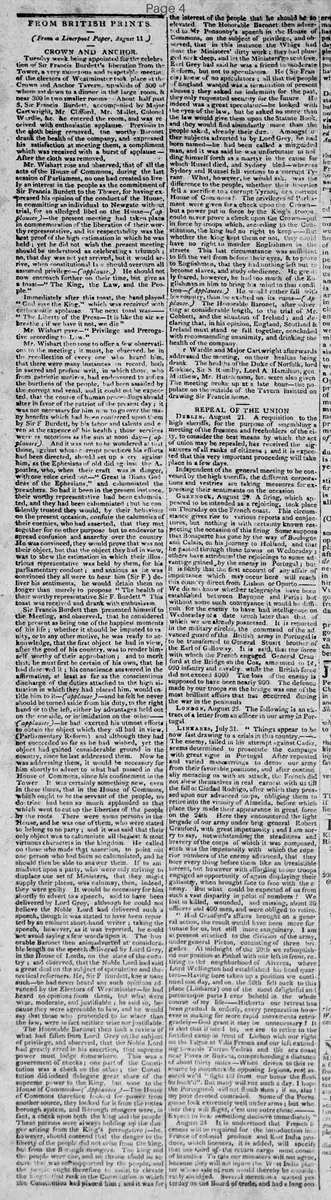
(From a Liverpool Paper, August 11)
CROWN AND ANCHOR.
Tuesday week being appointed for the celebration of Sir Francis Burdett's liberation from the Tower, a very numerous and respectable meeting of the electors of Westminster took place at the Crown and Anchor Tavern, upwards of 500 of whom sat down to a dinner in the large room, & near 300 in two smaller rooms. About half past 5, Sir Francis Burdett, accompanied by Major Cartwright, Mr. Clifford, Mr. Mallet, Colonel Wardle, &c. &c. entered the room, and was received with enthusiastic applause. Previous to the cloth being removed, the worthy Baronet drank the health of the company, and expressed his satisfaction at meeting them, a compliment which was received with a burst of applause.
After the cloth was removed, Mr. Wishart rose and observed, that of all the acts of the House of Commons, during the last session of Parliament, no one had created so lively an interest in the people as the commitment of Sir Francis Burdett to the Tower, for having expressed his opinion of the conduct of the House, in committing an individual to Newgate without trial, for an alleged libel on the House--(applause)--the present meeting had taken place in commemoration of the liberation of their worthy representative, and its respectability was the best proof of the high estimation in which he was held; yet he did not wish the present meeting should be understood as celebrating a triumph; no, that day was not yet arrived, but it would arrive, when constitutional law should overturn all assumed privilege--(applause.) He should not now encroach further on their time, but give as a toast--"The King, the Law, and the People."
Immediately after this toast, the band played "God save the King," which was received with enthusiastic applause. The next toast was--"The Liberty of the Press--It is like the air we breathe; if we have it not, we die."
Mr. Wishart gave--"Privilege and Prerogative according to Law."
Mr. Wishart then rose to offer a few observations to the meeting: it must, he observed, be in the recollection of every one who heard him, that there were many instances on record, both in sacred and profane writ, in which those, who from patriotic motives, had endeavored to soften the burthens of the people, had been assailed by the corrupt and venal, and it could not be expected, that the course of human proceedings should alter in favor of the patriot of the present day: it was not necessary for him now to go over the many benefits which had been conferred upon them by Sir F. Burdett, by his labor and talents and even at the expense of his health; those services were as notorious as the sun at noon day--(applause). And it was not to be wondered at that those, against whose corrupt practices his efforts had been directed, should set up a cry against him, as the Ephesians of old did against the Apostles, who, when their craft was in danger, with one voice cried out--"Great is Diana Goddess of the Ephesians," and calumniated the preachers. So had it been in the present instance, their worthy representative had been calumniated, and they had been calumniated; but he confidently trusted they would, by their behaviour on the present occasion, confute the calumnies of their enemies, who had asserted, that they met together for no other purpose but to endeavor to spread confusion and anarchy over the country. He was convinced, they would prove that was not their object, but that the object they had in view, was to shew the estimation in which their illustrious representative was held by them, for his parliamentary conduct; and anxious as he was convinced they all were to hear him (Sir F.) deliver his sentiments, he would detain them no longer than merely to propose "The health of their worthy representative Sir F. Burdett." This toast was received and drank with enthusiasm.
Sir Francis Burdett then presented himself to the Meeting, and observed, "that he considered the present as being one of the happiest moments of his life; whether it should be imputed to vanity, or to any other motive, he was ready to acknowledge, that the first object he had in view, after the good of his country, was to render himself worthy of their approbation; and to merit that, he must first be certain of his own, that he had deserved it; his conscience answered in the affirmative, at least as far as the conscientious discharge of the duties attached to the high situation in which they had placed him, would entitle him to it--(applause)--and he felt he never should be turned aside from his duty, to the right hand or to the left, either by advantages held out on the one side, or intimidation on the other--(applause)--he had exerted his utmost efforts to obtain the object which they all had in view, Parliamentary Reform) and although they had not succeeded so far as he had wished, yet the object had gained considerable ground in the country, since he last addressed them. Now he was addressing them, it would be necessary for him shortly to advert to what had passed in the House of Commons, since his confinement in the Tower. It was certainly something new, even in these times, that in the House of Commons, which ought to be the servant of the people, no doctrine had been so much applauded as that which went to cut up the liberties of the people by the roots. There were some persons in the House, and he was one of them, who were stated to belong to no party; and it was said that their only object was to calumniate all the best & most virtuous characters in the kingdom. He called on those who made that assertion, to point out one person who had been so calumniated, and he should then be able to answer them. If to animadvert upon a party, who were only striving to displace one set of Ministers, that they might supply their places, was calumny, then, indeed, they were guilty. It would be necessary for him shortly to advert to a speech, said to have been delivered by Lord Grey, although he could not believe the Noble Lord had delivered such a speech, though it was stated to have been reported by an eminent short-hand writer; taking the speech, however, as it was reported, he could not avoid saying a few words upon it. The honorable Baronet then animadverted at considerable length on the speech delivered by Lord Grey, in the House of Lords, on the state of the country: and observed, that the Noble Lord had said a great deal on the subject of speculative and theoretical reformers. He, Sir F. Burdett, knew none such--he had never heard any such opinions advanced by the Electors of Westminster--he had heard no opinions from them, but what were wise, moderate, and justifiable; he said so, because they were agreeable to law, and he would say that those who pretended to be wiser than the law, were in fact neither wise nor justifiable. The Honorable Baronet then took a review of what had fallen from Lord Grey on the subject of privilege, and observed, that the Noble Lord had greatly erred in his assertion, that supreme power must lodge somewhere. This was a government of checks; one part of the Constitution was a check on the other; the Constitution did indeed delegate great share of the supreme power to the King, but none to the House of Commons--(Applause)--The House of Commons therefore looked for power from another source, they looked for it from the rotten borough system, and Borough mongers were, in fact, a check upon both the king and the people. These persons were always holding up the danger arising from the King's prerogative;--he, however, should contend that the danger to the liberty of the people did not arise from the king, but from the Borough mongers. The king and the people were one, and no throne could be secure that was not supported by the people, and the people ought therefore to assist to elevate the king to that rank in the Constitution in which the Constitution had placed him; and it was for the interest of the people that he should be so elevated. The Honorable Baronet then adverted to Mr. Ponsonby's speech in the House of Commons, on the subject of privilege, and observed, that in this instance the Whigs had done the Ministers' dirty work: they had plunged neck deep, and let the Ministers go scot free. Earl Grey had said he was a friend to moderate Reform, but not to speculators. He (Sir Francis) knew of no speculators; all that the people of England wanted was a termination of present abuses; they asked no indemnity for the past, they only requested security for the future. He indeed was a great speculator--he looked with the eyes of the law, but he asked no more than the law would give them upon the Statute Book, and they would find abundantly more than the people asked, already their due. Amongst other subjects adverted to by Lord Grey, he had been named--he had been called a misguided man, and it was said he was unfortunate in holding himself forth as a martyr in the cause for which Russell died, and Sydney bled--whereas Sydney and Russell fell victims to a corrupt Tyrant: What, however, he would ask, was the difference to the people, whether their liberties fell a sacrifice to a corrupt Tyrant, or a corrupt House of Commons? The privileges of Parliament were given for a check upon the Crown--but a power put in force by the King's troops, could never prove a check upon the Crown--put in force by troops which, according to the Constitution, the king had no right to keep--But whether the king kept them or not, they could have no right to murder Englishmen in the streets. This last circumstance was sufficient to lift the veil from before their eyes, & to prove to Englishmen, that they had nothing left but to become slaves, and study obedience." He greatly feared, however, he had too much of the Englishman in him to bring his mind to that condition--(Applause.) He would rather fall with his country, than be exalted on its ruins--(applause.) The Honorable Baronet, after adverting at considerable length, to the trial of Mr. Cobbett, and the situation of Ireland; and declaring that, in his opinion, England, Scotland & Ireland must stand or fall together, concluded with recommending unanimity, and drinking the health of the company.
Col. Wardle and Major Cartwright afterwards addressed the meeting, on their healths being drank. The healths of the Duke of Norfolk, Lord Erskine, Sir S. Romilly, Lord A. Hamilton, Gen. Matthew, Mr. Hutchinson, &c. were also given. The meeting broke up at a late hour--the populace on the outside of the Tavern insisted on drawing Sir Francis home.
What sub-type of article is it?
What keywords are associated?
What entities or persons were involved?
Where did it happen?
Foreign News Details
Primary Location
Westminster
Event Date
Tuesday Week [Prior To August 11]
Key Persons
Outcome
meeting concluded late with toasts and addresses; populace drew sir francis burdett home.
Event Details
A large dinner at Crown and Anchor Tavern celebrated Sir Francis Burdett's liberation from the Tower. Over 800 electors attended. Speeches by Mr. Wishart praised Burdett and toasted constitutional principles. Sir Francis Burdett addressed the assembly on parliamentary reform, criticized House of Commons privileges, rotten boroughs, Lord Grey's speech, and Mr. Ponsonby's stance. He advocated for law-based reform and unity across Britain and Ireland. Colonel Wardle and Major Cartwright also spoke.