Thank you for visiting SNEWPapers!
Sign up free
Story
February 8, 1817
Alexandria Gazette, Commercial And Political
Alexandria, Virginia
What is this article about?
The U.S. Congress passes a resolution to employ Colonel John Trumbull to create four national historical paintings commemorating the Revolutionary War, highlighting his military service and artistic achievements in capturing key events and likenesses of patriots.
Clipping
OCR Quality
95%
Excellent
Full Text
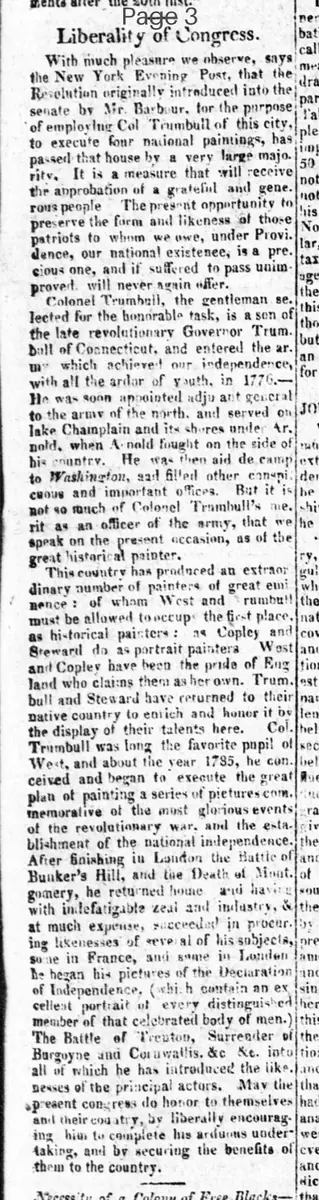
Liberality of Congress.
With much pleasure we observe, says the New York Evening Post, that the Resolution originally introduced into the senate by Mr. Barbour, for the purpose of employing Col. Trumbull of this city, to execute four national paintings, has passed that house by a very large majority. It is a measure that will receive the approbation of a grateful and generous people. The present opportunity to preserve the form and likeness of those patriots to whom we owe, under Providence, our national existence, is a precious one, and if suffered to pass unimproved, will never again offer.
Colonel Trumbull, the gentleman selected for the honorable task, is a son of the late revolutionary Governor Trumbull of Connecticut, and entered the army which achieved our independence with all the ardor of youth, in 1776.
He was soon appointed adjutant general to the army of the north, and served on Lake Champlain and its shores under Arnold, when Arnold fought on the side of his country. He was then aide de camp to Washington, and filled other conspicuous and important offices. But it is not so much of Colonel Trumbull's merit as an officer of the army, that we speak on the present occasion, as of the great historical painter.
This country has produced an extraordinary number of painters of great eminence: of whom West and Trumbull must be allowed to occupy the first place, as historical painters: as Copley and Stewart do as portrait painters. West and Copley have been the pride of England who claims them as her own. Trumbull and Stewart have returned to their native country to enrich and honor it by the display of their talents here. Col. Trumbull was long the favorite pupil of West, and about the year 1785, he conceived and began to execute the great plan of painting a series of pictures commemorative of the most glorious events of the revolutionary war, and the establishment of the national independence.
After finishing in London the Battle of Bunker's Hill, and the Death of Montgomery, he returned home and having with indefatigable zeal and industry, and at much expense, succeeded in procuring likenesses of several of his subjects, some in France, and some in London he began his pictures of the Declaration of Independence, (which contain an excellent portrait of every distinguished member of that celebrated body of men.) The Battle of Trenton, Surrender of Burgoyne and Cornwallis, &c. &c. into all of which he has introduced the likenesses of the principal actors. May the present congress do honor to themselves and their country, by liberally encouraging him to complete his arduous undertaking, and by securing the benefits of them to the country.
With much pleasure we observe, says the New York Evening Post, that the Resolution originally introduced into the senate by Mr. Barbour, for the purpose of employing Col. Trumbull of this city, to execute four national paintings, has passed that house by a very large majority. It is a measure that will receive the approbation of a grateful and generous people. The present opportunity to preserve the form and likeness of those patriots to whom we owe, under Providence, our national existence, is a precious one, and if suffered to pass unimproved, will never again offer.
Colonel Trumbull, the gentleman selected for the honorable task, is a son of the late revolutionary Governor Trumbull of Connecticut, and entered the army which achieved our independence with all the ardor of youth, in 1776.
He was soon appointed adjutant general to the army of the north, and served on Lake Champlain and its shores under Arnold, when Arnold fought on the side of his country. He was then aide de camp to Washington, and filled other conspicuous and important offices. But it is not so much of Colonel Trumbull's merit as an officer of the army, that we speak on the present occasion, as of the great historical painter.
This country has produced an extraordinary number of painters of great eminence: of whom West and Trumbull must be allowed to occupy the first place, as historical painters: as Copley and Stewart do as portrait painters. West and Copley have been the pride of England who claims them as her own. Trumbull and Stewart have returned to their native country to enrich and honor it by the display of their talents here. Col. Trumbull was long the favorite pupil of West, and about the year 1785, he conceived and began to execute the great plan of painting a series of pictures commemorative of the most glorious events of the revolutionary war, and the establishment of the national independence.
After finishing in London the Battle of Bunker's Hill, and the Death of Montgomery, he returned home and having with indefatigable zeal and industry, and at much expense, succeeded in procuring likenesses of several of his subjects, some in France, and some in London he began his pictures of the Declaration of Independence, (which contain an excellent portrait of every distinguished member of that celebrated body of men.) The Battle of Trenton, Surrender of Burgoyne and Cornwallis, &c. &c. into all of which he has introduced the likenesses of the principal actors. May the present congress do honor to themselves and their country, by liberally encouraging him to complete his arduous undertaking, and by securing the benefits of them to the country.
What sub-type of article is it?
Biography
Historical Event
Personal Triumph
What themes does it cover?
Bravery Heroism
Triumph
Providence Divine
What keywords are associated?
Congress Resolution
Historical Paintings
Revolutionary War
Col Trumbull
National Portraits
Bunker Hill
Declaration Independence
Surrender Burgoyne
What entities or persons were involved?
Col. Trumbull
Mr. Barbour
Governor Trumbull
Arnold
Washington
West
Copley
Stewart
Montgomery
Burgoyne
Cornwallis
Where did it happen?
United States
Story Details
Key Persons
Col. Trumbull
Mr. Barbour
Governor Trumbull
Arnold
Washington
West
Copley
Stewart
Montgomery
Burgoyne
Cornwallis
Location
United States
Event Date
1785
Story Details
Congress approves resolution by Mr. Barbour to commission Col. Trumbull to paint four national scenes of Revolutionary War events, praising his military service under Washington and Arnold, his artistic plan started in 1785 to depict key battles and declarations with accurate likenesses, and urging support to complete the series for posterity.