Thank you for visiting SNEWPapers!
Sign up free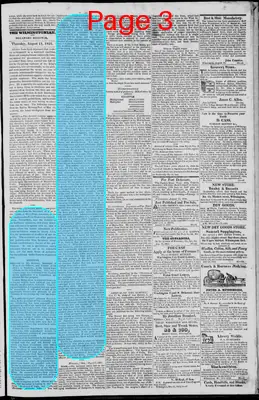
Story
August 11, 1825
The Wilmingtonian, And Delaware Register
Wilmington, New Castle County, Delaware
What is this article about?
Secretary of War Mr. Barbour delivers a paternal and patriotic farewell address to West Point cadets and officers on June 14, 1825, praising their progress, urging moral duty, subordination, and national unity against sectional prejudices.
Clipping
OCR Quality
97%
Excellent
Full Text
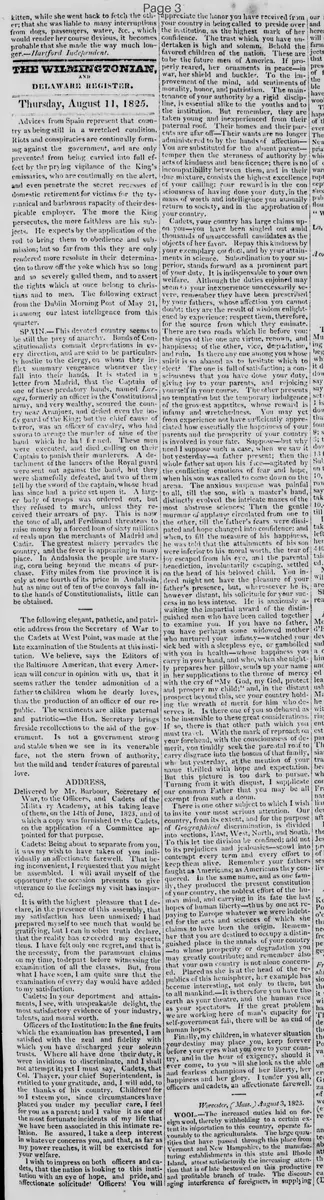
The following elegant, pathetic, and patriotic address from the Secretary of War to the Cadets at West Point, was made at the late examination of the Students at this institution. We believe, says the Editors of the Baltimore American, that every American will concur in opinion with us, that it seems rather the tender admonition of a father to children whom he dearly loves, than the production of an officer of our republic. The sentiments are alike paternal and patriotic—the Hon. Secretary brings fireside recollections to the aid of the government. Is not a government strong and stable when we see in its venerable face, not the stern frown of authority, but the mild and tender features of parental love.
ADDRESS,
Delivered by Mr. Barbour, Secretary of War, to the Officers, and Cadets of the Military Academy, at his taking leave of them, on the 14th of June, 1825, and of which a copy was furnished to the Cadets, on the application of a Committee appointed for that purpose.
Cadets: Being about to separate from you, it was my wish to have taken of you individually an affectionate farewell. That being inconvenient, I requested that you might be assembled. I will avail myself of the opportunity the occasion presents to give utterance to the feelings my visit has inspired.
It is with the highest pleasure that I declare, in the presence of this assembly, that my satisfaction has been unmixed: I had prepared myself to see much that would be gratifying, but I can in sober truth declare, that the reality has exceeded my expectations. I have felt only one regret, and that is the necessity, from the paramount claims on my time, to depart before witnessing the examination of all the classes. But, from what I have seen, I am quite sure that the examination of every day would have added to my satisfaction.
Cadets: In your deportment and attainments, I see, with unspeakable delight, the most satisfactory evidence of your industry, talents, and moral worth.
Officers of the Institution: In the fine fruits which the examination has presented, I am satisfied with the zeal and fidelity with which you have discharged your solemn trusts. Where all have done their duty, it were invidious to discriminate, and I shall not attempt it; yet I must say, Cadets, that Col. Thayer, your chief Superintendent, is entitled to your gratitude, and, I will add, to the thanks of his country. Children! for so I esteem you, since circumstances have placed you under my peculiar care, I feel for you as a parent; and I value it as one of the most fortunate incidents of my life that we have been associated in this intimate relation. Be assured, I take a deep interest in whatever concerns you, and that, as far as my power reaches, it will be exercised for your welfare.
I wish to impress on both officers and cadets, that the nation is looking to this institution with an eye of hope, and pride, and affectionate solicitude! Officers! You will appreciate the honor you have received from your country in being called to preside over the institution, as the highest mark of her confidence. The trust which you have undertaken is high and solemn. Behold the favored children of the nation. These are to be the future men of America. If properly reared, her ornaments in peace—in war, her shield and buckler. To the improvement of the mind, add sentiments of morality, honor, and patriotism. The maintenance of your authority by a rigid discipline, is essential alike to the youths and to the institution. But remember, they are taken young and inexperienced from their paternal roof. Their homes and their parents are afar off—Their wants are no longer administered to by the hands of affection—You are substituted for the absent parent—temper then the sternness of authority by acts of kindness and beneficence; there is no incompatibility between them, and in their due mixture, consists the highest excellence of your calling: your reward is in the consciousness of having done your duty, in the mass of worth and intelligence you annually return to society, and in the approbation of your country.
Cadets, your country has large claims upon you—you have been singled out amid thousands of unsuccessful candidates as the objects of her favor. Repay this kindness by your exemplary conduct, and by your attainments in science. Subordination to your superior, stands forward as a prominent part of your duty. It is indispensable to your own welfare. Although the duties enjoined may seem to your inexperience unnecessarily severe, remember they have been prescribed by your fathers, whose affection you cannot doubt; they are the result of wisdom enlightened by experience: respect them, therefore for the source from which they emanate.
There are two roads which lie before you: the signs of the one are virtue, renown, and happiness: of the other, vice, degradation and ruin. Is there any one among you whose spirit is so abased as to hesitate which to elect? The one is full of satisfaction; a consciousness that you have done your duty, giving joy to your parents, and rejoicing yourself in your course. The other presents no temptation but the temporary indulgence of the grossest appetites, whose reward is infamy and wretchedness. You may yet from experience not have sufficiently appreciated how essentially the happiness of your parents and the prosperity of your country is involved in your fate. Suppose— but why need I suppose such a case, when we saw it but yesterday--a father present; then the whole father sat upon his face—agitated by the conflicting emotions of fear and hope, when his son was called to come down on the arena. The anxious suspense was painful to all, till the son, with a master's hand, distinctly evolved the intricate mazes of the most abstruse sciences: Then the gentle murmur of applause circulated from one to the other, till the father's fears were dissipated and hope changed into confidence: and when, to fill the measure of his happiness, he was told that the attainments of his son were inferior to his moral worth, the tear of joy escaped from his eye, and the parental benediction, involuntarily escaping, settled on the head of his beloved child. You indeed might not have the pleasure of your father's presence, but, wheresoever he is, however distant, his solicitude for your success in no less intense. He is anxiously awaiting the impartial award of the distinguished men who have been called together to examine you. If you have no father, you have perhaps some widowed mother who nurtured your infancy—watched your sick bed with a sleepless eye, or gambolled with you in health—whose happiness you carry in your hand, and who, when she nightly prepares her pillow, sends up your name in her supplications to the throne of mercy with the cry of "My God, my God, protect and prosper my child;" and, in the distant prospect beyond this, see your country holding the wreath of merit for him who deserves it. Is there one of you so debased as to be insensible to these great considerations? If so, there is that other path which you must travel. With the mark of reproach on your forehead, with the consciousness of demerit, you timidly seek the parental roof to carry disgrace into the bosom of that family, where but yesterday, at the mention of your name thrilled with hope and expectation. But this picture is too dark to pursue. Turning from it with disgust, I supplicate our common Father that you may be all exempt from such a doom.
There is one other subject to which I wish to invite your most serious attention. Our country, from its extent, and for the purpose of Geographical discrimination, is divided into sections. East, West, North, and South. To its prejudices and jealousies—scowl into contempt every term and every effort to keep them alive. Remember your fathers fought as Americans; as Americans they conquered. In the same name, and as one family, they produced the present constitution of your country, the noblest effort of the human mind, and carrying in its fate the last hopes of human liberty—thus by one act repaying to Europe whatever we were indebted to her that you are destined to occupy a distinguished place in the annals of your country—to whose prosperity or degradation you may greatly contribute; and remember also that your own country is not alone concerned. Placed as she is at the head of the republics of this hemisphere, her example has become interesting, not only to them, but as your spectators. If the great problem we are working here of man's capacity for self-government fail, there will be an end of human hopes.
Finally, my children, in whatever situation your destiny may place you, keep forever before your eyes what you owe to your country, and in the hour of exigency, should it ever come, to you will she look as the able and fearless champions of her liberty, her happiness and her glory. I tender you all, officers and cadets, an affectionate farewell.
ADDRESS,
Delivered by Mr. Barbour, Secretary of War, to the Officers, and Cadets of the Military Academy, at his taking leave of them, on the 14th of June, 1825, and of which a copy was furnished to the Cadets, on the application of a Committee appointed for that purpose.
Cadets: Being about to separate from you, it was my wish to have taken of you individually an affectionate farewell. That being inconvenient, I requested that you might be assembled. I will avail myself of the opportunity the occasion presents to give utterance to the feelings my visit has inspired.
It is with the highest pleasure that I declare, in the presence of this assembly, that my satisfaction has been unmixed: I had prepared myself to see much that would be gratifying, but I can in sober truth declare, that the reality has exceeded my expectations. I have felt only one regret, and that is the necessity, from the paramount claims on my time, to depart before witnessing the examination of all the classes. But, from what I have seen, I am quite sure that the examination of every day would have added to my satisfaction.
Cadets: In your deportment and attainments, I see, with unspeakable delight, the most satisfactory evidence of your industry, talents, and moral worth.
Officers of the Institution: In the fine fruits which the examination has presented, I am satisfied with the zeal and fidelity with which you have discharged your solemn trusts. Where all have done their duty, it were invidious to discriminate, and I shall not attempt it; yet I must say, Cadets, that Col. Thayer, your chief Superintendent, is entitled to your gratitude, and, I will add, to the thanks of his country. Children! for so I esteem you, since circumstances have placed you under my peculiar care, I feel for you as a parent; and I value it as one of the most fortunate incidents of my life that we have been associated in this intimate relation. Be assured, I take a deep interest in whatever concerns you, and that, as far as my power reaches, it will be exercised for your welfare.
I wish to impress on both officers and cadets, that the nation is looking to this institution with an eye of hope, and pride, and affectionate solicitude! Officers! You will appreciate the honor you have received from your country in being called to preside over the institution, as the highest mark of her confidence. The trust which you have undertaken is high and solemn. Behold the favored children of the nation. These are to be the future men of America. If properly reared, her ornaments in peace—in war, her shield and buckler. To the improvement of the mind, add sentiments of morality, honor, and patriotism. The maintenance of your authority by a rigid discipline, is essential alike to the youths and to the institution. But remember, they are taken young and inexperienced from their paternal roof. Their homes and their parents are afar off—Their wants are no longer administered to by the hands of affection—You are substituted for the absent parent—temper then the sternness of authority by acts of kindness and beneficence; there is no incompatibility between them, and in their due mixture, consists the highest excellence of your calling: your reward is in the consciousness of having done your duty, in the mass of worth and intelligence you annually return to society, and in the approbation of your country.
Cadets, your country has large claims upon you—you have been singled out amid thousands of unsuccessful candidates as the objects of her favor. Repay this kindness by your exemplary conduct, and by your attainments in science. Subordination to your superior, stands forward as a prominent part of your duty. It is indispensable to your own welfare. Although the duties enjoined may seem to your inexperience unnecessarily severe, remember they have been prescribed by your fathers, whose affection you cannot doubt; they are the result of wisdom enlightened by experience: respect them, therefore for the source from which they emanate.
There are two roads which lie before you: the signs of the one are virtue, renown, and happiness: of the other, vice, degradation and ruin. Is there any one among you whose spirit is so abased as to hesitate which to elect? The one is full of satisfaction; a consciousness that you have done your duty, giving joy to your parents, and rejoicing yourself in your course. The other presents no temptation but the temporary indulgence of the grossest appetites, whose reward is infamy and wretchedness. You may yet from experience not have sufficiently appreciated how essentially the happiness of your parents and the prosperity of your country is involved in your fate. Suppose— but why need I suppose such a case, when we saw it but yesterday--a father present; then the whole father sat upon his face—agitated by the conflicting emotions of fear and hope, when his son was called to come down on the arena. The anxious suspense was painful to all, till the son, with a master's hand, distinctly evolved the intricate mazes of the most abstruse sciences: Then the gentle murmur of applause circulated from one to the other, till the father's fears were dissipated and hope changed into confidence: and when, to fill the measure of his happiness, he was told that the attainments of his son were inferior to his moral worth, the tear of joy escaped from his eye, and the parental benediction, involuntarily escaping, settled on the head of his beloved child. You indeed might not have the pleasure of your father's presence, but, wheresoever he is, however distant, his solicitude for your success in no less intense. He is anxiously awaiting the impartial award of the distinguished men who have been called together to examine you. If you have no father, you have perhaps some widowed mother who nurtured your infancy—watched your sick bed with a sleepless eye, or gambolled with you in health—whose happiness you carry in your hand, and who, when she nightly prepares her pillow, sends up your name in her supplications to the throne of mercy with the cry of "My God, my God, protect and prosper my child;" and, in the distant prospect beyond this, see your country holding the wreath of merit for him who deserves it. Is there one of you so debased as to be insensible to these great considerations? If so, there is that other path which you must travel. With the mark of reproach on your forehead, with the consciousness of demerit, you timidly seek the parental roof to carry disgrace into the bosom of that family, where but yesterday, at the mention of your name thrilled with hope and expectation. But this picture is too dark to pursue. Turning from it with disgust, I supplicate our common Father that you may be all exempt from such a doom.
There is one other subject to which I wish to invite your most serious attention. Our country, from its extent, and for the purpose of Geographical discrimination, is divided into sections. East, West, North, and South. To its prejudices and jealousies—scowl into contempt every term and every effort to keep them alive. Remember your fathers fought as Americans; as Americans they conquered. In the same name, and as one family, they produced the present constitution of your country, the noblest effort of the human mind, and carrying in its fate the last hopes of human liberty—thus by one act repaying to Europe whatever we were indebted to her that you are destined to occupy a distinguished place in the annals of your country—to whose prosperity or degradation you may greatly contribute; and remember also that your own country is not alone concerned. Placed as she is at the head of the republics of this hemisphere, her example has become interesting, not only to them, but as your spectators. If the great problem we are working here of man's capacity for self-government fail, there will be an end of human hopes.
Finally, my children, in whatever situation your destiny may place you, keep forever before your eyes what you owe to your country, and in the hour of exigency, should it ever come, to you will she look as the able and fearless champions of her liberty, her happiness and her glory. I tender you all, officers and cadets, an affectionate farewell.
What sub-type of article is it?
Historical Event
What themes does it cover?
Moral Virtue
Bravery Heroism
Family
What keywords are associated?
West Point
Military Cadets
Patriotic Address
Secretary Of War
Moral Duty
National Unity
What entities or persons were involved?
Mr. Barbour
Col. Thayer
Where did it happen?
West Point Military Academy
Story Details
Key Persons
Mr. Barbour
Col. Thayer
Location
West Point Military Academy
Event Date
June 14, 1825
Story Details
Mr. Barbour, Secretary of War, delivers a farewell address to cadets and officers, expressing satisfaction with their progress, praising Col. Thayer, urging moral conduct, subordination, patriotism, and unity against sectionalism, while emphasizing parental and national expectations.