Thank you for visiting SNEWPapers!
Sign up free
Story
April 21, 1859
The Daily Gate City
Keokuk, Lee County, Iowa
What is this article about?
Critique in the Knickerbocker magazine by Mr. Gordon of the N.Y. Tribune condemns modern spiritualism for vulgarizing divine concepts of death and heaven, portraying it as materialistic, theatrical, and inferior to true faith and revelation.
Clipping
OCR Quality
95%
Excellent
Full Text
Spiritualist Views
In the last number of the Knickerbocker we observe an article upon the subject of Spiritualism, by Mr. Gordon, of the N. Y. Tribune, in which the subject is discussed from an antagonistic point of view. The following thoughtful and eloquent paragraph will afford a taste of its quality.--
And does it not justly delineate the scope and character of the so-called spiritual views of Death and Heaven?
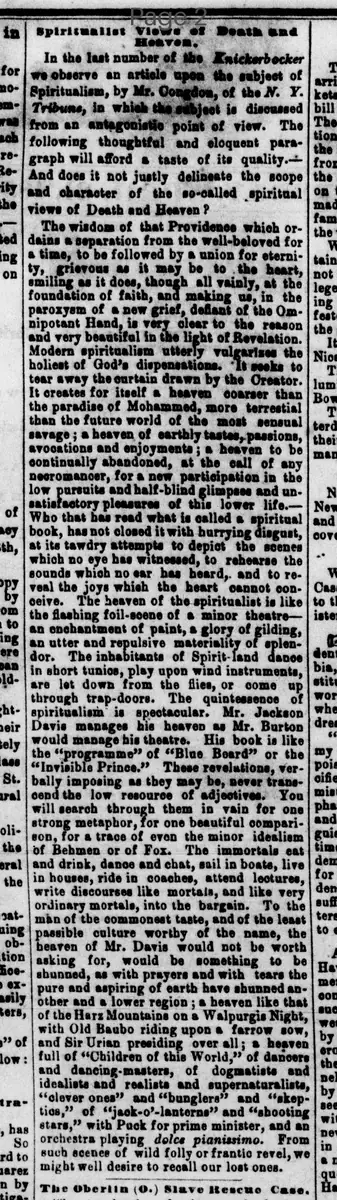
The wisdom of that Providence which ordains separation from the well-beloved for a time, to be followed by a union for eternity, grievous as it may be to the heart smiling as it does, though all vainly, at the foundation of faith, and making us, in the paroxysm of a new grief, defiers of the Omnipotent Hand, is very clear to the reason and very beautiful in the light of Revelation. Modern spiritualism utterly vulgarises the holiest of God's dispensations. It seeks to tear away the curtain drawn by the Creator. It creates for itself a heaven coarser than the paradise of Mohammed, more terrestrial than the future world of the most sensual savage; a heaven of earthly tastes, passions, avocations and enjoyments; a heaven to be continually abandoned, at the call of any necromancer, for a new participation in the low pursuits and half-blind glimpses and unsatisfactory pleasures of this lower life. Who that has read what is called a spiritual book, has not closed it with hurrying disgust, at its tawdry attempts to depict the scenes which no eye has witnessed, to rehearse the sounds which no ear has heard, and to reveal the joys which the heart cannot conceive. The heaven of the spiritualist is like the flashing foil-scene of a minor theatre-- an enchantment of paint, a glory of gilding an utter and repulsive materiality of splendor. The inhabitants of Spirit-land dance in short tunics, play upon wind instruments, are let down from the flies, or come up through trap-doors. The quintessence of spiritualism is spectacular. Mr. Jackson Davis manages his heaven as Mr. Burton would manage his theatre. His book is like the "programme" of "Blue Beard" or the "Invisible Prince." These revelations, verbally imposing as they may be, never transcend the low resource of adjectives. You will search through them in vain for one strong metaphor, for one beautiful comparison, for a trace of even the minor idealism of Behmen or of Fox. The immortals eat and drink, dance and chat, sail in boats, live in houses, ride in coaches, attend lectures, write discourses like mortals, and like very ordinary mortals, into the bargain. To the man of the commonest taste, and of the least possible culture worthy of the name, the heaven of Mr. Davis would not be worth asking for, would be something to be shunned, as with prayers and with tears the pure and aspiring of earth have shunned another and a lower region: a heaven like that of the Harz Mountains on a Walpurgis Night, with Old Baubo riding upon a farrow sow, and Sir Urian presiding over all; a heaven full of "Children of this World," of dancers and dancing-masters, of dogmatists and idealists and realists and supernaturalists "clever ones" and "bunglers" and "skeptics," of "jack-o'-lanterns" and "shooting stars," with Puck for prime minister, and an orchestra playing dolce pianissimo. From such scenes of wild folly or frantic revel, we might well desire to recall our lost ones.
In the last number of the Knickerbocker we observe an article upon the subject of Spiritualism, by Mr. Gordon, of the N. Y. Tribune, in which the subject is discussed from an antagonistic point of view. The following thoughtful and eloquent paragraph will afford a taste of its quality.--
And does it not justly delineate the scope and character of the so-called spiritual views of Death and Heaven?
The wisdom of that Providence which ordains separation from the well-beloved for a time, to be followed by a union for eternity, grievous as it may be to the heart smiling as it does, though all vainly, at the foundation of faith, and making us, in the paroxysm of a new grief, defiers of the Omnipotent Hand, is very clear to the reason and very beautiful in the light of Revelation. Modern spiritualism utterly vulgarises the holiest of God's dispensations. It seeks to tear away the curtain drawn by the Creator. It creates for itself a heaven coarser than the paradise of Mohammed, more terrestrial than the future world of the most sensual savage; a heaven of earthly tastes, passions, avocations and enjoyments; a heaven to be continually abandoned, at the call of any necromancer, for a new participation in the low pursuits and half-blind glimpses and unsatisfactory pleasures of this lower life. Who that has read what is called a spiritual book, has not closed it with hurrying disgust, at its tawdry attempts to depict the scenes which no eye has witnessed, to rehearse the sounds which no ear has heard, and to reveal the joys which the heart cannot conceive. The heaven of the spiritualist is like the flashing foil-scene of a minor theatre-- an enchantment of paint, a glory of gilding an utter and repulsive materiality of splendor. The inhabitants of Spirit-land dance in short tunics, play upon wind instruments, are let down from the flies, or come up through trap-doors. The quintessence of spiritualism is spectacular. Mr. Jackson Davis manages his heaven as Mr. Burton would manage his theatre. His book is like the "programme" of "Blue Beard" or the "Invisible Prince." These revelations, verbally imposing as they may be, never transcend the low resource of adjectives. You will search through them in vain for one strong metaphor, for one beautiful comparison, for a trace of even the minor idealism of Behmen or of Fox. The immortals eat and drink, dance and chat, sail in boats, live in houses, ride in coaches, attend lectures, write discourses like mortals, and like very ordinary mortals, into the bargain. To the man of the commonest taste, and of the least possible culture worthy of the name, the heaven of Mr. Davis would not be worth asking for, would be something to be shunned, as with prayers and with tears the pure and aspiring of earth have shunned another and a lower region: a heaven like that of the Harz Mountains on a Walpurgis Night, with Old Baubo riding upon a farrow sow, and Sir Urian presiding over all; a heaven full of "Children of this World," of dancers and dancing-masters, of dogmatists and idealists and realists and supernaturalists "clever ones" and "bunglers" and "skeptics," of "jack-o'-lanterns" and "shooting stars," with Puck for prime minister, and an orchestra playing dolce pianissimo. From such scenes of wild folly or frantic revel, we might well desire to recall our lost ones.
What sub-type of article is it?
Curiosity
Supernatural
Deception Fraud
What themes does it cover?
Deception
Providence Divine
Moral Virtue
What keywords are associated?
Spiritualism Critique
Heaven Vulgarization
Divine Providence
Materialistic Afterlife
Necromancy
Revelation Contrast
What entities or persons were involved?
Mr. Gordon
Mr. Jackson Davis
Story Details
Key Persons
Mr. Gordon
Mr. Jackson Davis
Story Details
An article critiques modern spiritualism for vulgarizing divine separation and reunion in death and heaven, depicting spiritualists' afterlife as materialistic, theatrical, and inferior to biblical revelation, exemplified by Mr. Jackson Davis's visions.