Thank you for visiting SNEWPapers!
Sign up free
Editorial
January 28, 1811
Portland Gazette, And Maine Advertiser
Portland, Cumberland County, Maine
What is this article about?
Satirical critique of Congressman Willis Alston's argument on representation ratios in Congress, using a centipede analogy to mock the idea that large states' proportional losses justify small states' greater absolute losses.
Clipping
OCR Quality
98%
Excellent
Full Text
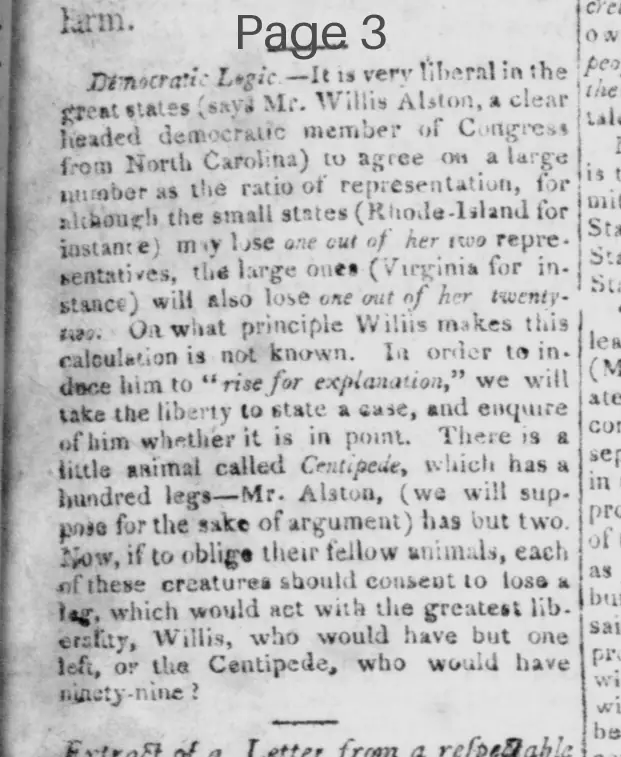
Democratic Logic.—It is very liberal in the great states (said Mr. Willis Alston, a clear headed democratic member of Congress from North Carolina) to agree on a large number as the ratio of representation. For although the small states (Rhode-Island for instance) may lose one out of her two representatives, the large ones (Virginia for instance) will also lose one out of her twenty-two. On what principle Willis makes this calculation is not known. In order to induce him to "rise for explanation," we will take the liberty to state a case, and enquire of him whether it is in point. There is a little animal called Centipede, which has a hundred legs—Mr. Alston, (we will suppose for the sake of argument) has but two. Now, if to oblige their fellow animals, each of these creatures should consent to lose a leg, which would act with the greatest liberality, Willis, who would have but one left, or the Centipede, who would have ninety-nine?
What sub-type of article is it?
Satire
Constitutional
Partisan Politics
What keywords are associated?
Representation Ratio
Congressional Debate
Democratic Logic
Satirical Analogy
Small States
Large States
What entities or persons were involved?
Willis Alston
Congress
Rhode Island
Virginia
North Carolina
Editorial Details
Primary Topic
Mockery Of Representation Ratio Logic
Stance / Tone
Satirical Ridicule Of Democratic Argument
Key Figures
Willis Alston
Congress
Rhode Island
Virginia
North Carolina
Key Arguments
Large States' Proportional Losses Do Not Equate To Small States' Absolute Losses
Analogy: Centipede Losing One Of 100 Legs Vs. Man Losing One Of Two Shows Unfairness