Thank you for visiting SNEWPapers!
Sign up free
Editorial
May 12, 1842
Watchman Of The South
Richmond, Virginia
What is this article about?
This editorial satirizes an Episcopal clergyman's attempt to link Nestorian Bishop Mar Yohannan's Persian cloak to Episcopalian robes as proof of apostolic Episcopacy. It criticizes emphasis on forms over faith, praises Mar Yohannan's call for Christian unity, and contrasts with anti-Masonic anecdotes.
Clipping
OCR Quality
98%
Excellent
Full Text
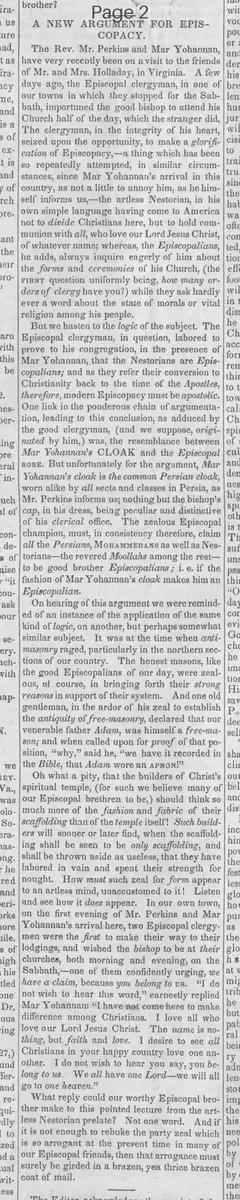
A NEW ARGUMENT FOR EPISCOPACY.
The Rev. Mr. Perkins and Mar Yohannan have very recently been on a visit to the friends of Mr. and Mrs. Holladay, in Virginia. A few days ago, the Episcopal clergyman, in one of our towns in which they stopped for the Sabbath, importuned the good bishop to attend his Church half of the day, which the stranger did. The clergyman, in the integrity of his heart, seized upon the opportunity, to make a glorification of Episcopacy,—a thing which has been so repeatedly attempted, in similar circumstances, since Mar Yohannan's arrival in this country, as not a little to annoy him, as he himself informs us,—the artless Nestorian, in his own simple language having come to America not to divide Christians here, but to hold communion with all, who love our Lord Jesus Christ, of whatever name; whereas, the Episcopalians, he adds, always inquire eagerly of him about the forms and ceremonies of his Church, (the FIRST question uniformly being, how many orders of clergy have you?) while they ask hardly ever a word about the state of morals or vital religion among his people. But we hasten to the logic of the subject. The Episcopal clergyman, in question, labored to prove to his congregation, in the presence of Mar Yohannan, that the Nestorians are Episcopalians; and as they refer their conversion to Christianity back to the time of the Apostles therefore, modern Episcopacy must be apostolic. One link in the ponderous chain of argumentation, leading to this conclusion, as adduced by the good clergyman, (and we suppose, originated by him,) was, the resemblance between Mar Yohannan's CLOAK and the Episcopal ROBE. But unfortunately for the argument, Mar Yohannan's cloak is the common Persian cloak, worn alike by all sects and classes in Persia, as Mr. Perkins informs us; nothing but the bishop's cap, in his dress, being peculiar and distinctive of his clerical office. The zealous Episcopal champion, must, in consistency therefore, claim all the Persians, MOHAMMEDANS as well as Nestorians—the revered Moollahs among the rest— to be good brother Episcopalians; i. e. if the fashion of Mar Yohannan's cloak makes him an Episcopalian
On hearing of this argument we were reminded of an instance of the application of the same kind of logic, on another, but perhaps somewhat similar subject. It was at the time when anti-masonry raged, particularly in the northern sections of our country. The honest masons, like the good Episcopalians of our day, were zealous, of course, in bringing forth their strong reasons in support of their system. And one old gentleman, in the ardor of his zeal to establish the antiquity of free-masonry, declared that our venerable father Adam, was himself a free-mason; and when called upon for proof of that position, "why," said he, "we have it recorded in the Bible, that Adam wore an APRON!"
Oh what a pity, that the builders of Christ's spiritual temple, (for such we believe many of our Episcopal brethren to be,) should think so much more of the fashion and fabric of their scaffolding than of the temple itself! Such builders will sooner or later find, when the scaffolding shall be seen to be only scaffolding, and shall be thrown aside as useless, that they have labored in vain and spent their strength for nought. How must such zeal for form appear to an artless mind, unaccustomed to it! Listen and see how it does appear. In our own town, on the first evening of Mr. Perkins and Mar Yohannan's arrival here, two Episcopal clergymen were the first to make their way to their lodgings, and wished the bishop to be at their churches, both morning and evening, on the Sabbath,—one of them confidently urging, we have a claim, because you belong to us. "I do not wish to hear this word," earnestly replied Mar Yohannan: "I have not come here to make difference among Christians, I love all who love our Lord Jesus Christ. The name is nothing, but faith and love. I desire to see all Christians in your happy country love one another. I do not wish to hear you say, you belong to us. We all have one Lord—we will all go to one heaven."
What reply could our worthy Episcopal brother make to this pointed lecture from the artless Nestorian prelate? Not one word. And if it is not enough to rebuke the party zeal which is so arrogant at the present time in many of our Episcopal friends, then that arrogance must surely be girded in a brazen, yea thrice brazen coat of mail.
The Rev. Mr. Perkins and Mar Yohannan have very recently been on a visit to the friends of Mr. and Mrs. Holladay, in Virginia. A few days ago, the Episcopal clergyman, in one of our towns in which they stopped for the Sabbath, importuned the good bishop to attend his Church half of the day, which the stranger did. The clergyman, in the integrity of his heart, seized upon the opportunity, to make a glorification of Episcopacy,—a thing which has been so repeatedly attempted, in similar circumstances, since Mar Yohannan's arrival in this country, as not a little to annoy him, as he himself informs us,—the artless Nestorian, in his own simple language having come to America not to divide Christians here, but to hold communion with all, who love our Lord Jesus Christ, of whatever name; whereas, the Episcopalians, he adds, always inquire eagerly of him about the forms and ceremonies of his Church, (the FIRST question uniformly being, how many orders of clergy have you?) while they ask hardly ever a word about the state of morals or vital religion among his people. But we hasten to the logic of the subject. The Episcopal clergyman, in question, labored to prove to his congregation, in the presence of Mar Yohannan, that the Nestorians are Episcopalians; and as they refer their conversion to Christianity back to the time of the Apostles therefore, modern Episcopacy must be apostolic. One link in the ponderous chain of argumentation, leading to this conclusion, as adduced by the good clergyman, (and we suppose, originated by him,) was, the resemblance between Mar Yohannan's CLOAK and the Episcopal ROBE. But unfortunately for the argument, Mar Yohannan's cloak is the common Persian cloak, worn alike by all sects and classes in Persia, as Mr. Perkins informs us; nothing but the bishop's cap, in his dress, being peculiar and distinctive of his clerical office. The zealous Episcopal champion, must, in consistency therefore, claim all the Persians, MOHAMMEDANS as well as Nestorians—the revered Moollahs among the rest— to be good brother Episcopalians; i. e. if the fashion of Mar Yohannan's cloak makes him an Episcopalian
On hearing of this argument we were reminded of an instance of the application of the same kind of logic, on another, but perhaps somewhat similar subject. It was at the time when anti-masonry raged, particularly in the northern sections of our country. The honest masons, like the good Episcopalians of our day, were zealous, of course, in bringing forth their strong reasons in support of their system. And one old gentleman, in the ardor of his zeal to establish the antiquity of free-masonry, declared that our venerable father Adam, was himself a free-mason; and when called upon for proof of that position, "why," said he, "we have it recorded in the Bible, that Adam wore an APRON!"
Oh what a pity, that the builders of Christ's spiritual temple, (for such we believe many of our Episcopal brethren to be,) should think so much more of the fashion and fabric of their scaffolding than of the temple itself! Such builders will sooner or later find, when the scaffolding shall be seen to be only scaffolding, and shall be thrown aside as useless, that they have labored in vain and spent their strength for nought. How must such zeal for form appear to an artless mind, unaccustomed to it! Listen and see how it does appear. In our own town, on the first evening of Mr. Perkins and Mar Yohannan's arrival here, two Episcopal clergymen were the first to make their way to their lodgings, and wished the bishop to be at their churches, both morning and evening, on the Sabbath,—one of them confidently urging, we have a claim, because you belong to us. "I do not wish to hear this word," earnestly replied Mar Yohannan: "I have not come here to make difference among Christians, I love all who love our Lord Jesus Christ. The name is nothing, but faith and love. I desire to see all Christians in your happy country love one another. I do not wish to hear you say, you belong to us. We all have one Lord—we will all go to one heaven."
What reply could our worthy Episcopal brother make to this pointed lecture from the artless Nestorian prelate? Not one word. And if it is not enough to rebuke the party zeal which is so arrogant at the present time in many of our Episcopal friends, then that arrogance must surely be girded in a brazen, yea thrice brazen coat of mail.
What sub-type of article is it?
Moral Or Religious
Satire
What keywords are associated?
Episcopacy
Nestorians
Religious Unity
Form Vs Faith
Christian Communion
Satirical Argument
What entities or persons were involved?
Mar Yohannan
Rev. Mr. Perkins
Episcopal Clergyman
Nestorians
Episcopalians
Editorial Details
Primary Topic
Critique Of Episcopalian Emphasis On Forms Over Christian Unity
Stance / Tone
Satirical Criticism Of Denominational Arrogance
Key Figures
Mar Yohannan
Rev. Mr. Perkins
Episcopal Clergyman
Nestorians
Episcopalians
Key Arguments
Nestorians' Apostolic Origins Do Not Validate Modern Episcopacy Via Superficial Resemblances Like Clothing
Episcopalians Focus On Ceremonies Rather Than Morals Or Vital Religion
Christian Unity Should Prioritize Faith And Love Over Names And Forms
Zeal For External Forms Distracts From Building Christ's Spiritual Temple