Thank you for visiting SNEWPapers!
Sign up free
Literary
August 28, 1830
Republican Herald
Providence, Providence County, Rhode Island
What is this article about?
In Paris, a vain widow competes with her budding daughter Nichon for the affections of Chevalier Pastourd. When he prefers the daughter, his valet Combiac impersonates Marquis de Mascarille to deceive the widow into consenting to their marriage, exposing her vanity. She eventually forgives them.
Clipping
OCR Quality
95%
Excellent
Full Text
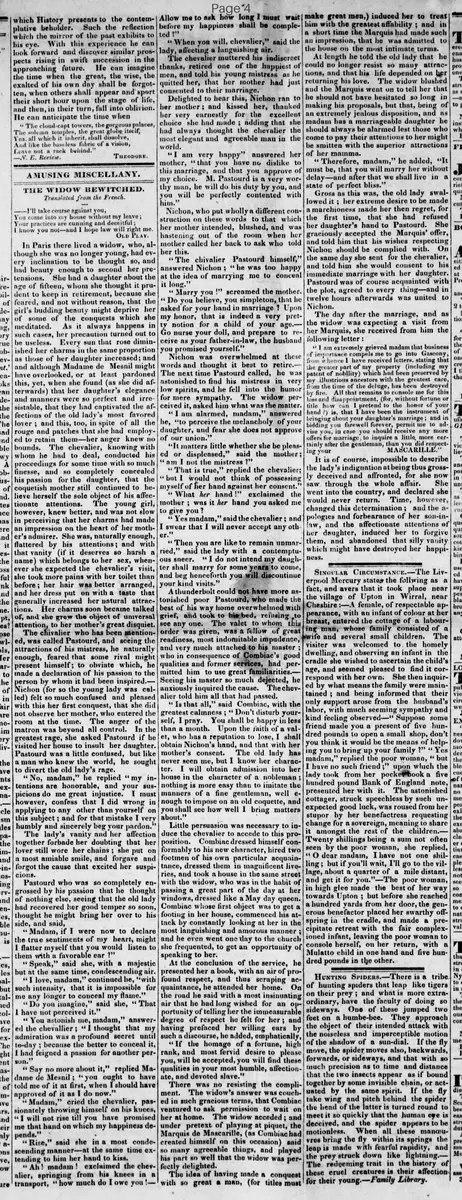
AMUSING MISCELLANY.
THE WIDOW BEWITCHED.
Translated from the French.
—I'll take course against you,
You come into my house without my leave;
Your practices are cunning and deceitful;
I know you not—and I hope law will right me.
Old Play.
In Paris there lived a widow, who, although she was no longer young, had every inclination to be thought so, and had beauty enough to second her pretensions. She had a daughter about the age of fifteen, whom she thought it prudent to keep in retirement, because she feared, and not without reason, that the girl's budding beauty might deprive her of some of the conquests which she meditated. As it always happens in such cases, her precaution turned out to be useless. Every sun that rose diminished her charms in the same proportion as those of her daughter increased; and although Madame de Mesnil might have overlooked, or at least pardoned this, yet, when she found (as she did afterwards) that her daughter's elegance and manners were so perfect and irresistible, that they had captivated the affections of the old lady's most favored lover; and this, too, in spite of all the rouge and patches that she had employed to retain them her anger knew no bounds. The chevalier, knowing with whom he had to deal, conducted his proceedings for some time with so much finesse, and so completely concealed his passion for the daughter, that the coquetish mother still continued to believe herself the sole object of his affectionate attentions. The young girl, however, knew better, and was not slow in perceiving that her charms had made an impression on the heart of her mother's admirer. She was, naturally enough, flattered by his attentions; and with that vanity (if it deserves so harsh a name) which belongs to her sex, whenever she expected the chevalier's visit, she took more pains with her toilet than before; her hair was better arranged, and her dress put on with a taste that generally increased her natural attractions. Her charms soon became talked of, and she grew the object of universal attention, to her mother's great disquiet.
The chevalier who has been mentioned, was called Pastourd, and seeing the attractions of his mistress, he naturally enough, feared that some rival might present himself; to obviate which, he made a declaration of his passion to the person by whom it had been inspired.—Nichon (for so the young lady was called) felt so much confused and pleased with this her first conquest, that she did not observe her mother, who entered the room at the time. The anger of the matron was beyond all control. In the greatest rage, she asked Pastourd if he visited her house to insult her daughter. Pastourd was a little confused, but like a man who knew the world, he sought to divert the old lady's rage.
'No, madam,' he replied 'my intentions are honorable, and your suspicions do me great injustice. I must however, confess that I did wrong in applying to any other than yourself on this subject; and for that mistake I very humbly and sincerely beg your pardon.'
The lady's vanity and her affection together forbade her doubting that her lover still wore her chains; she put on a most amiable smile, and forgave and forgot the cause that excited her suspicions. Pastourd who was so completely engrossed by his passion that he thought of nothing else, seeing that the old lady had recovered her good temper so soon, thought he might bring her over to his side, and said,
'Madam, if I were now to declare the true sentiments of my heart, might I flatter myself that you would listen to them with a favorable ear?'
'Speak,' said she, with a majestic but at the same time, condescending air.
'I love, madam,' continued he, 'with such intensity, that it is impossible for me any longer to conceal my flame.'
'Do you imagine,' said she, 'That I have not perceived it.'
'You astonish me, madam,' answered the chevalier; 'I thought that my admiration was a profound secret until to-day; because the better to conceal it, I had feigned a passion for another person.'
'Say no more about it,' replied Madame de Mesnil; 'you ought to have told me of it at first, when I should have approved of it as I do now.'
'Madam,' cried the chevalier, passionately throwing himself on his knees, 'I will not rise till you have promised me that hand on which my happiness depends.'
'Ris,' said she in a most condescending manner—at the same time extending to him her hand to kiss.
'Ah! madam! exclaimed the chevalier, springing from his knees in a transport, 'how much do I owe you!
Allow me to ask how long I must wait before my happiness shall be completed?'
'When you will, chevalier,' said the lady, affecting a languishing air.
The chevalier muttered his indiscreet thanks, retired one of the happiest of men, and told his young mistress as he quitted her, that her mother had just consented to their marriage.
Delighted to hear this, Nichon ran to her mother; and kissed her, thanked her very earnestly for the excellent choice she had made; adding that she had always thought the chevalier the most elegant and agreeable man in the world.
'I am very happy' answered her mother, 'that you have no dislike to this marriage, and that you approve of my choice. M. Pastourd is a very worthy man, he will do his duty by you, and you will be perfectly contented with him.'
Nichon, who put wholly a different construction on these words to that which her mother intended, blushed, and was hastening out of the room when her mother called her back to ask who told her this.
'The chevalier Pastourd himself,' answered Nichon; 'he was too happy at the idea of marrying me to conceal it long.'
'Marry you!' screamed the mother.
'Do you believe, you simpleton, that he asked for your hand in marriage? Upon my honor, that is indeed a very pretty notion for a child of your age.—Go nurse your doll, and prepare to receive as your father-in-law, the husband you promised yourself.'
Nichon was overwhelmed at these words and thought it best to retire.—The next time Pastourd called, he was astonished to find his mistress in very low spirits, and he fell into the humor for mere sympathy. The widow perceived it, asked him what was the matter.
'I am alarmed, madam,' answered he, 'to perceive the melancholy of your daughter, and fear she does not approve of our union.'
'It matters little whether she be pleased or displeased,' said the mother; 'am I not the mistress?'
'That is true,' replied the chevalier; 'but I would not think of possessing myself of her hand against her consent.'
'What her hand!' exclaimed the mother; 'was it her hand you asked me to give you?'
'Yes madam,' said the chevalier; 'and I swear that I will never accept any other.'
'Then you are like to remain unmarried,' said the lady with a contemptuous sneer. 'I do not intend my daughter shall marry for some years to come, and beg henceforth you will discontinue your kind visits.'
A thunderbolt could not have more astonished poor Pastourd, who made the best of his way home overwhelmed with grief, and took to his bed, refusing to see any one. The valet to whom this order was given, was a fellow of great readiness, most indomitable impudence, and very much attached to his master; who in consequence of Combiac's good qualities and former services, had permitted him to use great familiarities.—Seeing his master so much dejected, he anxiously inquired the cause. The chevalier told him all that had passed.
'Is that all.' said Combiac, with the greatest calmness; 'Don't disturb yourself, I pray. You shall be happy in less than a month. Upon the faith of a valet, who has a reputation to lose, I shall obtain Nichon's hand, and that with her mother's consent. The old lady has never seen me, but I know her character. I will obtain admission into her house in the character of a nobleman; nothing is more easy than to imitate the manners of a fine gentleman, well enough to impose on an old coquette, and you shall see how well I bring matters about.'
Little persuasion was necessary to induce the chevalier to accede to this proposition. Combiac dressed himself conformably to his new character, hired two footmen of his own particular acquaintance, dressed them in magnificent liveries, and took a house in the same street with the widow, who was in the habit of passing a great part of the day at her windows, dressed like a May day queen. Combiac whose first object was to get a footing in her house, commenced his attack by constantly looking at her in the most languishing and amorous manner; and he even went one day to the church she frequented, to get an opportunity of speaking to her.
At the conclusion of the service, he presented her a book, with an air of profound respect, and thus scraping acquaintance, he attended her home. On the road he said with a most insinuating air that he had long wished for an opportunity of telling her the immeasurable degree of respect he felt for her; and having prefaced her willing ears by such a discourse, he added, emphatically,
'If the homage of a fortune, high rank, and most fervid desire to please you, will be accepted, you will find these qualities in your most humble, affectionate, and devoted slave.'
There was no resisting the compliment. The widow's answer was couched in such gracious terms, that Combiac ventured to ask permission to wait on her at home. The widow acceded; and under pretext of playing at piquet, the Marquis de Mascarille, (as Combiac had created himself on this occasion) said so many agreeable things, and played his part so well that the widow was perfectly delighted.
The idea of having made a conquest with so great a man, (for titles must make great men,) induced her to treat him with the greatest affability; and in a short time the Marquis had made such an impression, that he was admitted to the house on the most intimate terms.
At length he told the old lady that he could no longer resist so many attractions, and that his life depended on her returning his love. The widow blushed and the Marquis went on to tell her that he should not have hesitated so long in making his proposals, but that, being of an extremely jealous disposition, and as madam has a marriageable daughter he should always be alarmed lest those who come to pay their attentions to her might be smitten with the superior attractions of her mamma.
'Therefore, madam,' he added, 'It must be, that you will marry her without delay—and after that we shall live in a state of perfect bliss.'
Gross as this was, the old lady swallowed it; her extreme desire to be made a marchioness made her then regret, for the first time, that she had refused her daughter's hand to Pastourd. She graciously accepted the Marquis' offer, and told him that his wishes respecting Nichon should be complied with. On the same day she sent for the chevalier, and told him she would consent to his immediate marriage with her daughter.
Pastourd was of course acquainted with the plot, agreed to every thing—and in twelve hours afterwards was united to Nichon.
The day after the marriage, and as the widow was expecting a visit from her Marquis, she received from him the following letter:
'I am extremely grieved madam that business of importance compels me to go into Gascony, from whence I have received letters, stating that the greater part of my property (including my patent of nobility) which had been preserved by my illustrious ancestors with the greatest care, from the time of the deluge, has been destroyed by fire. All that remains to console me for this loss and disappointment, (for, without fortune or title how can I pretend to the honor of your hand?) is, that I have been the instrument of bringing about your daughter's marriage; and in bidding you farewell forever, permit me to advise you, in case you should receive any more offers for marriage, to inquire a little more certainly after the gentleman, than you did respecting your
MASCARILLE.'
It is of course, impossible to describe the lady's indignation at being thus grossly deceived and affronted, for she now saw through the whole affair. She went into the country, and declared she would never return. Time, however, changed this determination; and the apologies and forbearance of her son-in-law, and the affectionate attentions of her daughter, induced her to forgive them, and abandoned that silly vanity which might have destroyed her happiness.
THE WIDOW BEWITCHED.
Translated from the French.
—I'll take course against you,
You come into my house without my leave;
Your practices are cunning and deceitful;
I know you not—and I hope law will right me.
Old Play.
In Paris there lived a widow, who, although she was no longer young, had every inclination to be thought so, and had beauty enough to second her pretensions. She had a daughter about the age of fifteen, whom she thought it prudent to keep in retirement, because she feared, and not without reason, that the girl's budding beauty might deprive her of some of the conquests which she meditated. As it always happens in such cases, her precaution turned out to be useless. Every sun that rose diminished her charms in the same proportion as those of her daughter increased; and although Madame de Mesnil might have overlooked, or at least pardoned this, yet, when she found (as she did afterwards) that her daughter's elegance and manners were so perfect and irresistible, that they had captivated the affections of the old lady's most favored lover; and this, too, in spite of all the rouge and patches that she had employed to retain them her anger knew no bounds. The chevalier, knowing with whom he had to deal, conducted his proceedings for some time with so much finesse, and so completely concealed his passion for the daughter, that the coquetish mother still continued to believe herself the sole object of his affectionate attentions. The young girl, however, knew better, and was not slow in perceiving that her charms had made an impression on the heart of her mother's admirer. She was, naturally enough, flattered by his attentions; and with that vanity (if it deserves so harsh a name) which belongs to her sex, whenever she expected the chevalier's visit, she took more pains with her toilet than before; her hair was better arranged, and her dress put on with a taste that generally increased her natural attractions. Her charms soon became talked of, and she grew the object of universal attention, to her mother's great disquiet.
The chevalier who has been mentioned, was called Pastourd, and seeing the attractions of his mistress, he naturally enough, feared that some rival might present himself; to obviate which, he made a declaration of his passion to the person by whom it had been inspired.—Nichon (for so the young lady was called) felt so much confused and pleased with this her first conquest, that she did not observe her mother, who entered the room at the time. The anger of the matron was beyond all control. In the greatest rage, she asked Pastourd if he visited her house to insult her daughter. Pastourd was a little confused, but like a man who knew the world, he sought to divert the old lady's rage.
'No, madam,' he replied 'my intentions are honorable, and your suspicions do me great injustice. I must however, confess that I did wrong in applying to any other than yourself on this subject; and for that mistake I very humbly and sincerely beg your pardon.'
The lady's vanity and her affection together forbade her doubting that her lover still wore her chains; she put on a most amiable smile, and forgave and forgot the cause that excited her suspicions. Pastourd who was so completely engrossed by his passion that he thought of nothing else, seeing that the old lady had recovered her good temper so soon, thought he might bring her over to his side, and said,
'Madam, if I were now to declare the true sentiments of my heart, might I flatter myself that you would listen to them with a favorable ear?'
'Speak,' said she, with a majestic but at the same time, condescending air.
'I love, madam,' continued he, 'with such intensity, that it is impossible for me any longer to conceal my flame.'
'Do you imagine,' said she, 'That I have not perceived it.'
'You astonish me, madam,' answered the chevalier; 'I thought that my admiration was a profound secret until to-day; because the better to conceal it, I had feigned a passion for another person.'
'Say no more about it,' replied Madame de Mesnil; 'you ought to have told me of it at first, when I should have approved of it as I do now.'
'Madam,' cried the chevalier, passionately throwing himself on his knees, 'I will not rise till you have promised me that hand on which my happiness depends.'
'Ris,' said she in a most condescending manner—at the same time extending to him her hand to kiss.
'Ah! madam! exclaimed the chevalier, springing from his knees in a transport, 'how much do I owe you!
Allow me to ask how long I must wait before my happiness shall be completed?'
'When you will, chevalier,' said the lady, affecting a languishing air.
The chevalier muttered his indiscreet thanks, retired one of the happiest of men, and told his young mistress as he quitted her, that her mother had just consented to their marriage.
Delighted to hear this, Nichon ran to her mother; and kissed her, thanked her very earnestly for the excellent choice she had made; adding that she had always thought the chevalier the most elegant and agreeable man in the world.
'I am very happy' answered her mother, 'that you have no dislike to this marriage, and that you approve of my choice. M. Pastourd is a very worthy man, he will do his duty by you, and you will be perfectly contented with him.'
Nichon, who put wholly a different construction on these words to that which her mother intended, blushed, and was hastening out of the room when her mother called her back to ask who told her this.
'The chevalier Pastourd himself,' answered Nichon; 'he was too happy at the idea of marrying me to conceal it long.'
'Marry you!' screamed the mother.
'Do you believe, you simpleton, that he asked for your hand in marriage? Upon my honor, that is indeed a very pretty notion for a child of your age.—Go nurse your doll, and prepare to receive as your father-in-law, the husband you promised yourself.'
Nichon was overwhelmed at these words and thought it best to retire.—The next time Pastourd called, he was astonished to find his mistress in very low spirits, and he fell into the humor for mere sympathy. The widow perceived it, asked him what was the matter.
'I am alarmed, madam,' answered he, 'to perceive the melancholy of your daughter, and fear she does not approve of our union.'
'It matters little whether she be pleased or displeased,' said the mother; 'am I not the mistress?'
'That is true,' replied the chevalier; 'but I would not think of possessing myself of her hand against her consent.'
'What her hand!' exclaimed the mother; 'was it her hand you asked me to give you?'
'Yes madam,' said the chevalier; 'and I swear that I will never accept any other.'
'Then you are like to remain unmarried,' said the lady with a contemptuous sneer. 'I do not intend my daughter shall marry for some years to come, and beg henceforth you will discontinue your kind visits.'
A thunderbolt could not have more astonished poor Pastourd, who made the best of his way home overwhelmed with grief, and took to his bed, refusing to see any one. The valet to whom this order was given, was a fellow of great readiness, most indomitable impudence, and very much attached to his master; who in consequence of Combiac's good qualities and former services, had permitted him to use great familiarities.—Seeing his master so much dejected, he anxiously inquired the cause. The chevalier told him all that had passed.
'Is that all.' said Combiac, with the greatest calmness; 'Don't disturb yourself, I pray. You shall be happy in less than a month. Upon the faith of a valet, who has a reputation to lose, I shall obtain Nichon's hand, and that with her mother's consent. The old lady has never seen me, but I know her character. I will obtain admission into her house in the character of a nobleman; nothing is more easy than to imitate the manners of a fine gentleman, well enough to impose on an old coquette, and you shall see how well I bring matters about.'
Little persuasion was necessary to induce the chevalier to accede to this proposition. Combiac dressed himself conformably to his new character, hired two footmen of his own particular acquaintance, dressed them in magnificent liveries, and took a house in the same street with the widow, who was in the habit of passing a great part of the day at her windows, dressed like a May day queen. Combiac whose first object was to get a footing in her house, commenced his attack by constantly looking at her in the most languishing and amorous manner; and he even went one day to the church she frequented, to get an opportunity of speaking to her.
At the conclusion of the service, he presented her a book, with an air of profound respect, and thus scraping acquaintance, he attended her home. On the road he said with a most insinuating air that he had long wished for an opportunity of telling her the immeasurable degree of respect he felt for her; and having prefaced her willing ears by such a discourse, he added, emphatically,
'If the homage of a fortune, high rank, and most fervid desire to please you, will be accepted, you will find these qualities in your most humble, affectionate, and devoted slave.'
There was no resisting the compliment. The widow's answer was couched in such gracious terms, that Combiac ventured to ask permission to wait on her at home. The widow acceded; and under pretext of playing at piquet, the Marquis de Mascarille, (as Combiac had created himself on this occasion) said so many agreeable things, and played his part so well that the widow was perfectly delighted.
The idea of having made a conquest with so great a man, (for titles must make great men,) induced her to treat him with the greatest affability; and in a short time the Marquis had made such an impression, that he was admitted to the house on the most intimate terms.
At length he told the old lady that he could no longer resist so many attractions, and that his life depended on her returning his love. The widow blushed and the Marquis went on to tell her that he should not have hesitated so long in making his proposals, but that, being of an extremely jealous disposition, and as madam has a marriageable daughter he should always be alarmed lest those who come to pay their attentions to her might be smitten with the superior attractions of her mamma.
'Therefore, madam,' he added, 'It must be, that you will marry her without delay—and after that we shall live in a state of perfect bliss.'
Gross as this was, the old lady swallowed it; her extreme desire to be made a marchioness made her then regret, for the first time, that she had refused her daughter's hand to Pastourd. She graciously accepted the Marquis' offer, and told him that his wishes respecting Nichon should be complied with. On the same day she sent for the chevalier, and told him she would consent to his immediate marriage with her daughter.
Pastourd was of course acquainted with the plot, agreed to every thing—and in twelve hours afterwards was united to Nichon.
The day after the marriage, and as the widow was expecting a visit from her Marquis, she received from him the following letter:
'I am extremely grieved madam that business of importance compels me to go into Gascony, from whence I have received letters, stating that the greater part of my property (including my patent of nobility) which had been preserved by my illustrious ancestors with the greatest care, from the time of the deluge, has been destroyed by fire. All that remains to console me for this loss and disappointment, (for, without fortune or title how can I pretend to the honor of your hand?) is, that I have been the instrument of bringing about your daughter's marriage; and in bidding you farewell forever, permit me to advise you, in case you should receive any more offers for marriage, to inquire a little more certainly after the gentleman, than you did respecting your
MASCARILLE.'
It is of course, impossible to describe the lady's indignation at being thus grossly deceived and affronted, for she now saw through the whole affair. She went into the country, and declared she would never return. Time, however, changed this determination; and the apologies and forbearance of her son-in-law, and the affectionate attentions of her daughter, induced her to forgive them, and abandoned that silly vanity which might have destroyed her happiness.
What sub-type of article is it?
Prose Fiction
Satire
What themes does it cover?
Social Manners
Love Romance
Moral Virtue
What keywords are associated?
Widow Vanity
Daughter Marriage
Chevalier Pastourd
Valet Deception
Marquis Mascarille
French Translation
Satirical Tale
What entities or persons were involved?
Translated From The French.
Literary Details
Title
The Widow Bewitched.
Author
Translated From The French.
Key Lines
—I'll Take Course Against You,
You Come Into My House Without My Leave;
Your Practices Are Cunning And Deceitful;
I Know You Not—And I Hope Law Will Right Me.
Old Play.
'If The Homage Of A Fortune, High Rank, And Most Fervid Desire To Please You, Will Be Accepted, You Will Find These Qualities In Your Most Humble, Affectionate, And Devoted Slave.'
'Therefore, Madam,' He Added, 'It Must Be, That You Will Marry Her Without Delay—And After That We Shall Live In A State Of Perfect Bliss.'
'I Am Extremely Grieved Madam That Business Of Importance Compels Me To Go Into Gascony... Permit Me To Advise You, In Case You Should Receive Any More Offers For Marriage, To Inquire A Little More Certainly After The Gentleman, Than You Did Respecting Your
Mascarille.'