Thank you for visiting SNEWPapers!
Sign up free
Editorial
February 16, 1927
The Cody Enterprise
Cody, Park County, Wyoming
What is this article about?
An editorial praising a city's 'Pay Your Bills Promptly Week' campaign, emphasizing mutual benefits for businesses and customers through prompt payments, which reduce merchant losses passed on via higher prices to all consumers.
Clipping
OCR Quality
98%
Excellent
Full Text
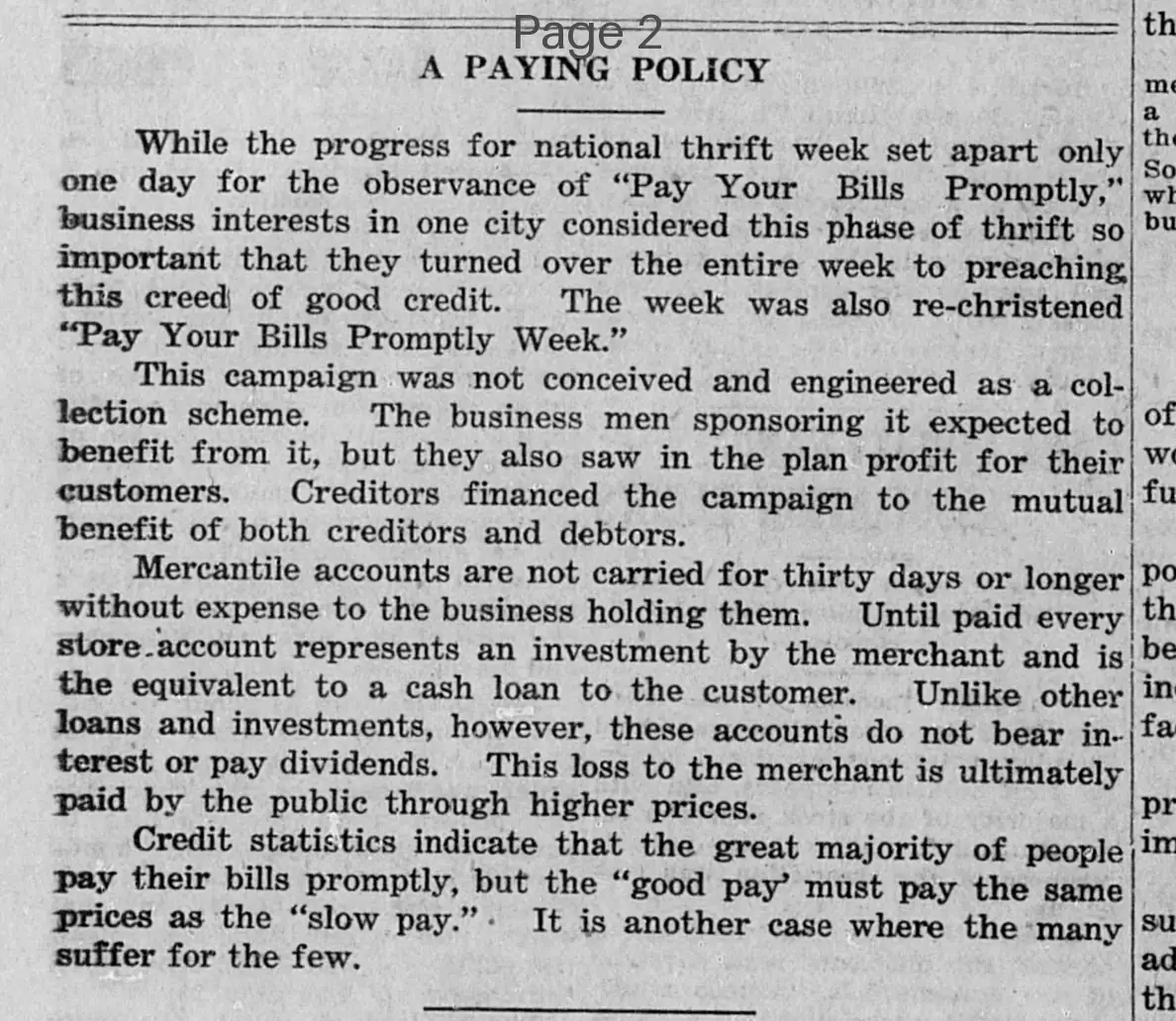
A PAYING POLICY
While the progress for national thrift week set apart only one day for the observance of "Pay Your Bills Promptly,"
business interests in one city considered this phase of thrift so important that they turned over the entire week to preaching this creed of good credit. The week was also re-christened "Pay Your Bills Promptly Week."
This campaign was not conceived and engineered as a collection scheme. The business men sponsoring it expected to benefit from it, but they also saw in the plan profit for their customers. Creditors financed the campaign to the mutual benefit of both creditors and debtors.
Mercantile accounts are not carried for thirty days or longer without expense to the business holding them. Until paid every store account represents an investment by the merchant and is the equivalent to a cash loan to the customer. Unlike other loans and investments, however, these accounts do not bear interest or pay dividends. This loss to the merchant is ultimately paid by the public through higher prices.
Credit statistics indicate that the great majority of people pay their bills promptly, but the "good pay" must pay the same prices as the "slow pay." It is another case where the many suffer for the few.
While the progress for national thrift week set apart only one day for the observance of "Pay Your Bills Promptly,"
business interests in one city considered this phase of thrift so important that they turned over the entire week to preaching this creed of good credit. The week was also re-christened "Pay Your Bills Promptly Week."
This campaign was not conceived and engineered as a collection scheme. The business men sponsoring it expected to benefit from it, but they also saw in the plan profit for their customers. Creditors financed the campaign to the mutual benefit of both creditors and debtors.
Mercantile accounts are not carried for thirty days or longer without expense to the business holding them. Until paid every store account represents an investment by the merchant and is the equivalent to a cash loan to the customer. Unlike other loans and investments, however, these accounts do not bear interest or pay dividends. This loss to the merchant is ultimately paid by the public through higher prices.
Credit statistics indicate that the great majority of people pay their bills promptly, but the "good pay" must pay the same prices as the "slow pay." It is another case where the many suffer for the few.
What sub-type of article is it?
Economic Policy
Social Reform
What keywords are associated?
Thrift Week
Pay Bills Promptly
Good Credit
Mercantile Accounts
Credit Statistics
Higher Prices
What entities or persons were involved?
Business Men
Creditors
Debtors
Merchants
Customers
Editorial Details
Primary Topic
Promotion Of Prompt Bill Payment
Stance / Tone
Supportive Of Thrift And Good Credit Practices
Key Figures
Business Men
Creditors
Debtors
Merchants
Customers
Key Arguments
Prompt Payment Benefits Both Creditors And Debtors Mutually.
Carrying Accounts Incurs Costs To Merchants Equivalent To Interest Free Loans.
Merchant Losses From Slow Payments Lead To Higher Prices For All Consumers.
Most People Pay Promptly, But All Bear The Cost Of Slow Payers.