Thank you for visiting SNEWPapers!

Sign up free
Page thumbnail for Saint Croix Union
Story October 23, 1854

Saint Croix Union

Stillwater, Washington County, Minnesota

What is this article about?

The magnet, or loadstone, is an oxide found in iron ore, discovered in Magnesia, Asia, with occurrences in Sweden, Norway, Elba, Arabia, China, Siam, Philippines, and North America. It varies in size, with one 125-pound specimen supporting 200 pounds of iron; artificial versions are stronger, and meteoric stones share its properties.

Clipping
OCR Quality

98% Excellent

Full Text

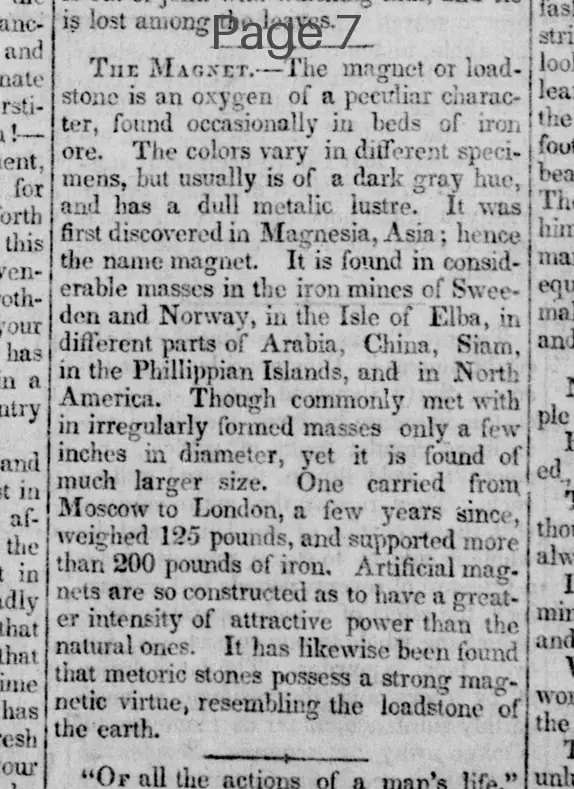
The Magnet.—The magnet or loadstone is an oxide of a peculiar character, found occasionally in beds of iron ore. The colors vary in different specimens, but usually is of a dark gray hue, and has a dull metallic lustre. It was first discovered in Magnesia, Asia; hence the name magnet. It is found in considerable masses in the iron mines of Sweden and Norway, in the Isle of Elba, in different parts of Arabia, China, Siam, in the Philippine Islands, and in North America. Though commonly met with in irregularly formed masses only a few inches in diameter, yet it is found of much larger size. One carried from Moscow to London, a few years since, weighed 125 pounds, and supported more than 200 pounds of iron. Artificial magnets are so constructed as to have a greater intensity of attractive power than the natural ones. It has likewise been found that meteoric stones possess a strong magnetic virtue, resembling the loadstone of the earth.

What sub-type of article is it?

Curiosity

What themes does it cover?

Nature

What keywords are associated?

Magnet Loadstone Iron Ore Magnesia Sweden Norway Meteoric Stones

Story Details

Story Details

Description of the magnet or loadstone as an oxide found in iron ore beds, its appearance, discovery in Magnesia, Asia, locations including Sweden, Norway, Isle of Elba, Arabia, China, Siam, Philippine Islands, and North America, sizes up to 125 pounds supporting 200 pounds of iron, greater intensity in artificial magnets, and magnetic virtue in meteoric stones.

Are you sure?