Thank you for visiting SNEWPapers!
Sign up free
Editorial
July 8, 1835
Morning Star
Limerick, York County, Maine
What is this article about?
This editorial extols the spiritual power of sacred music in worship and strongly advocates for Freewill Baptist churches to adopt the 'Christian Melody' hymn book, citing its superior selection from various poets, variety of subjects, doctrinal alignment, and permanence through stereotyping.
Clipping
OCR Quality
98%
Excellent
Full Text
VOL. X.
MORNING STAR.
Editorial.
CHRISTIAN MELODY.
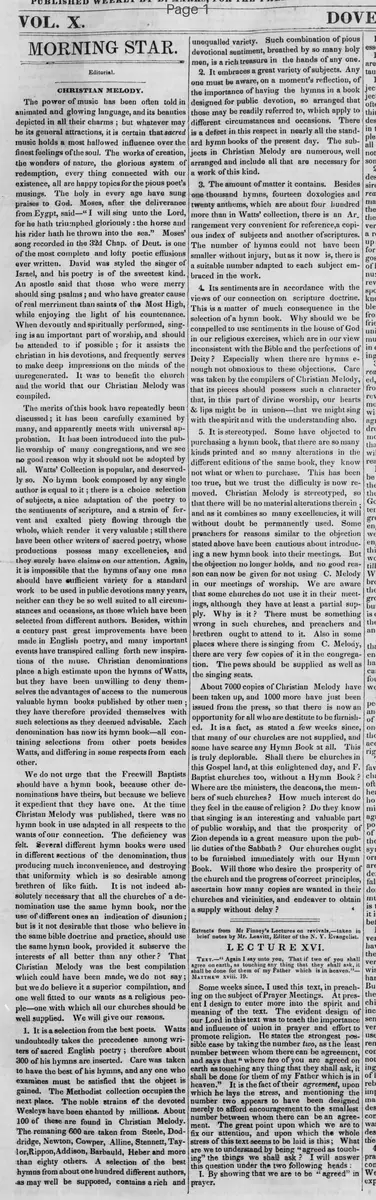
The power of music has been often told in animated and glowing language, and its beauties depicted in all their charms; but whatever may be its general attractions, it is certain that sacred music holds a most hallowed influence over the finest feelings of the soul. The works of creation, the wonders of nature, the glorious system of redemption, every thing connected with our existence, all are happy topics for the pious poet's musings. The holy in every age have sung praises to God. Moses, after the deliverance from Egypt, said—"I will sing unto the Lord, for he hath triumphed gloriously: the horse and his rider hath he thrown into the sea." Moses' song recorded in the 32d Chap. of Deut. is one of the most complete and lofty poetic effusions ever written. David was styled the singer of Israel, and his poetry is of the sweetest kind. An apostle said that those who were merry should sing psalms; and who have greater cause of real merriment than saints of the Most High, while enjoying the light of his countenance.
When devoutly and spiritually performed, singing is an important part of worship, and should be attended to if possible; for it assists the christian in his devotions, and frequently serves to make deep impressions on the minds of the unregenerated. It was to benefit the church and the world that our Christian Melody was compiled.
The merits of this book have repeatedly been discussed; it has been carefully examined by many, and apparently meets with universal approbation. It has been introduced into the public worship of many congregations, and we see no good reason why it should not be adopted by all. Watts' Collection is popular, and deservedly so. No hymn book composed by any single author is equal to it; there is a choice selection of subjects, a nice adaptation of the poetry to the sentiments of scripture, and a strain of fervent and exalted piety flowing through the whole, which render it very valuable; still there have been other writers of sacred poetry, whose productions possess many excellencies, and they surely have claims on our attention. Again, it is impossible that the hymns of any one man should have sufficient variety for a standard work to be used in public devotions many years; neither can they be so well suited to all circumstances and occasions, as those which have been selected from different authors. Besides, within a century past great improvements have been made in English poetry, and many important events have transpired calling forth new inspirations of the muse. Christian denominations place a high estimate upon the hymns of Watts but they have been unwilling to deny themselves the advantages of access to the numerous valuable hymn books published by other men; they have therefore provided themselves with such selections as they deemed advisable. Each denomination has now its hymn book—all containing selections from other poets besides Watts, and differing in some respects from each other.
We do not urge that the Freewill Baptists should have a hymn book, because other denominations have theirs, but because we believe it expedient that they have one. At the time Christian Melody was published, there was no hymn book in use adapted in all respects to the wants of our connection. The deficiency was felt. Several different hymn books were used in different sections of the denomination, thus producing much inconvenience, and destroying that uniformity which is so desirable among brethren of like faith. It is not indeed absolutely necessary that all the churches of a denomination use the same hymn book, nor the use of different ones an indication of disunion; but is it not desirable that those who believe in the same bible doctrine and practice, should use the same hymn book, provided it subserve the interests of all better than any other? That Christian Melody was the best compilation which could have been made, we do not say; but we do believe it a superior compilation, and one well fitted to our wants as a religious people—one with which all our churches should be well supplied. We will give our reasons.
1. It is a selection from the best poets. Watts undoubtedly takes the precedence among writers of sacred English poetry; therefore about 300 of his hymns are inserted. Care was taken to have the best of his hymns, and any one who examines must be satisfied that the object is gained. The Methodist collection occupies the next place. The noble strains of the devoted Wesleys have been chanted by millions. About 100 of these are found in Christian Melody. The remaining 600 are taken from Steele, Doddridge, Newton, Cowper, Alline, Stennett, Taylor, Rippon, Addison, Barbauld, Heber and more than eighty others. A selection of the best hymns from about one hundred different authors, as may well be supposed, contains a rich and unequalled variety. Such combination of pious devotional sentiment, breathed by so many holy men, is a rich treasure in the hands of any one.
2. It embraces a great variety of subjects. Any one must be aware, on a moment's reflection, of the importance of having the hymns in a book designed for public devotion, so arranged that those may be readily referred to, which apply to different circumstances and occasions. There is a defect in this respect in nearly all the standard hymn books of the present day. The subjects in Christian Melody are numerous, well arranged and include all that are necessary for a work of this kind.
3. The amount of matter it contains. Besides one thousand hymns, fourteen doxologies and twenty anthems, which are about four hundred more than in Watts' collection, there is an Arrangement very convenient for reference, a copious index of subjects and another of scriptures. The number of hymns could not have been smaller without injury, but as it now is, there is a suitable number adapted to each subject embraced in the work.
4. Its sentiments are in accordance with the views of our connection on scripture doctrine. This is a matter of much consequence in the selection of a hymn book. Why should we be compelled to use sentiments in the house of God in our religious exercises, which are in our view inconsistent with the Bible and the perfections of Deity? Especially when there are hymns enough not obnoxious to these objections. Care was taken by the compilers of Christian Melody, that its pieces should possess such a character that, in this part of divine worship, our hearts & lips might be in unison—that we might sing with the spirit and with the understanding also.
5. It is stereotyped. Some have objected to purchasing a hymn book, that there are so many kinds printed and so many alterations in the different editions of the same book, they know not what or when to purchase. This has been too true, but we trust the difficulty is now removed. Christian Melody is stereotyped, so that there will be no material alterations therein and as it combines so many excellencies, it will without doubt be permanently used. Some preachers for reasons similar to the objection stated above have been cautious about introducing a new hymn book into their meetings. But the objection no longer holds, and no good reason can now be given for not using C. Melody in our meetings of worship. We are aware that some churches do not use it in their meetings, although they have at least a partial supply. Why is it? There must be something wrong in such churches, and preachers and brethren ought to attend to it. Also in some places where there is singing from C. Melody, there are very few copies of it in the congregation. The pews should be supplied as well as the singing seats.
About 7000 copies of Christian Melody have been taken up, and 1000 more have just been issued from the press, so that there is now an opportunity for all who are destitute to be furnished. It is a fact, as stated a few weeks since, that many of our churches are not supplied, and some have scarce any Hymn Book at all. This is truly deplorable. Shall there be churches in this Gospel land, at this enlightened day, and F. Baptist churches too, without a Hymn Book? Where are the ministers, the deacons, the members of such churches? How much interest do they feel in the cause of religion? Do they know that singing is an interesting and valuable part of public worship, and that the prosperity of Zion depends in a great measure upon the public duties of the Sabbath? Our churches ought to be furnished immediately with our Hymn Book. Will those who desire the prosperity of the church and the progress of correct principles, ascertain how many copies are wanted in their churches and vicinities, and endeavor to obtain a supply without delay?
MORNING STAR.
Editorial.
CHRISTIAN MELODY.
The power of music has been often told in animated and glowing language, and its beauties depicted in all their charms; but whatever may be its general attractions, it is certain that sacred music holds a most hallowed influence over the finest feelings of the soul. The works of creation, the wonders of nature, the glorious system of redemption, every thing connected with our existence, all are happy topics for the pious poet's musings. The holy in every age have sung praises to God. Moses, after the deliverance from Egypt, said—"I will sing unto the Lord, for he hath triumphed gloriously: the horse and his rider hath he thrown into the sea." Moses' song recorded in the 32d Chap. of Deut. is one of the most complete and lofty poetic effusions ever written. David was styled the singer of Israel, and his poetry is of the sweetest kind. An apostle said that those who were merry should sing psalms; and who have greater cause of real merriment than saints of the Most High, while enjoying the light of his countenance.
When devoutly and spiritually performed, singing is an important part of worship, and should be attended to if possible; for it assists the christian in his devotions, and frequently serves to make deep impressions on the minds of the unregenerated. It was to benefit the church and the world that our Christian Melody was compiled.
The merits of this book have repeatedly been discussed; it has been carefully examined by many, and apparently meets with universal approbation. It has been introduced into the public worship of many congregations, and we see no good reason why it should not be adopted by all. Watts' Collection is popular, and deservedly so. No hymn book composed by any single author is equal to it; there is a choice selection of subjects, a nice adaptation of the poetry to the sentiments of scripture, and a strain of fervent and exalted piety flowing through the whole, which render it very valuable; still there have been other writers of sacred poetry, whose productions possess many excellencies, and they surely have claims on our attention. Again, it is impossible that the hymns of any one man should have sufficient variety for a standard work to be used in public devotions many years; neither can they be so well suited to all circumstances and occasions, as those which have been selected from different authors. Besides, within a century past great improvements have been made in English poetry, and many important events have transpired calling forth new inspirations of the muse. Christian denominations place a high estimate upon the hymns of Watts but they have been unwilling to deny themselves the advantages of access to the numerous valuable hymn books published by other men; they have therefore provided themselves with such selections as they deemed advisable. Each denomination has now its hymn book—all containing selections from other poets besides Watts, and differing in some respects from each other.
We do not urge that the Freewill Baptists should have a hymn book, because other denominations have theirs, but because we believe it expedient that they have one. At the time Christian Melody was published, there was no hymn book in use adapted in all respects to the wants of our connection. The deficiency was felt. Several different hymn books were used in different sections of the denomination, thus producing much inconvenience, and destroying that uniformity which is so desirable among brethren of like faith. It is not indeed absolutely necessary that all the churches of a denomination use the same hymn book, nor the use of different ones an indication of disunion; but is it not desirable that those who believe in the same bible doctrine and practice, should use the same hymn book, provided it subserve the interests of all better than any other? That Christian Melody was the best compilation which could have been made, we do not say; but we do believe it a superior compilation, and one well fitted to our wants as a religious people—one with which all our churches should be well supplied. We will give our reasons.
1. It is a selection from the best poets. Watts undoubtedly takes the precedence among writers of sacred English poetry; therefore about 300 of his hymns are inserted. Care was taken to have the best of his hymns, and any one who examines must be satisfied that the object is gained. The Methodist collection occupies the next place. The noble strains of the devoted Wesleys have been chanted by millions. About 100 of these are found in Christian Melody. The remaining 600 are taken from Steele, Doddridge, Newton, Cowper, Alline, Stennett, Taylor, Rippon, Addison, Barbauld, Heber and more than eighty others. A selection of the best hymns from about one hundred different authors, as may well be supposed, contains a rich and unequalled variety. Such combination of pious devotional sentiment, breathed by so many holy men, is a rich treasure in the hands of any one.
2. It embraces a great variety of subjects. Any one must be aware, on a moment's reflection, of the importance of having the hymns in a book designed for public devotion, so arranged that those may be readily referred to, which apply to different circumstances and occasions. There is a defect in this respect in nearly all the standard hymn books of the present day. The subjects in Christian Melody are numerous, well arranged and include all that are necessary for a work of this kind.
3. The amount of matter it contains. Besides one thousand hymns, fourteen doxologies and twenty anthems, which are about four hundred more than in Watts' collection, there is an Arrangement very convenient for reference, a copious index of subjects and another of scriptures. The number of hymns could not have been smaller without injury, but as it now is, there is a suitable number adapted to each subject embraced in the work.
4. Its sentiments are in accordance with the views of our connection on scripture doctrine. This is a matter of much consequence in the selection of a hymn book. Why should we be compelled to use sentiments in the house of God in our religious exercises, which are in our view inconsistent with the Bible and the perfections of Deity? Especially when there are hymns enough not obnoxious to these objections. Care was taken by the compilers of Christian Melody, that its pieces should possess such a character that, in this part of divine worship, our hearts & lips might be in unison—that we might sing with the spirit and with the understanding also.
5. It is stereotyped. Some have objected to purchasing a hymn book, that there are so many kinds printed and so many alterations in the different editions of the same book, they know not what or when to purchase. This has been too true, but we trust the difficulty is now removed. Christian Melody is stereotyped, so that there will be no material alterations therein and as it combines so many excellencies, it will without doubt be permanently used. Some preachers for reasons similar to the objection stated above have been cautious about introducing a new hymn book into their meetings. But the objection no longer holds, and no good reason can now be given for not using C. Melody in our meetings of worship. We are aware that some churches do not use it in their meetings, although they have at least a partial supply. Why is it? There must be something wrong in such churches, and preachers and brethren ought to attend to it. Also in some places where there is singing from C. Melody, there are very few copies of it in the congregation. The pews should be supplied as well as the singing seats.
About 7000 copies of Christian Melody have been taken up, and 1000 more have just been issued from the press, so that there is now an opportunity for all who are destitute to be furnished. It is a fact, as stated a few weeks since, that many of our churches are not supplied, and some have scarce any Hymn Book at all. This is truly deplorable. Shall there be churches in this Gospel land, at this enlightened day, and F. Baptist churches too, without a Hymn Book? Where are the ministers, the deacons, the members of such churches? How much interest do they feel in the cause of religion? Do they know that singing is an interesting and valuable part of public worship, and that the prosperity of Zion depends in a great measure upon the public duties of the Sabbath? Our churches ought to be furnished immediately with our Hymn Book. Will those who desire the prosperity of the church and the progress of correct principles, ascertain how many copies are wanted in their churches and vicinities, and endeavor to obtain a supply without delay?
What sub-type of article is it?
Moral Or Religious
What keywords are associated?
Sacred Music
Hymn Book
Christian Melody
Freewill Baptists
Worship
Watts Collection
Religious Poetry
What entities or persons were involved?
Moses
David
Watts
Wesleys
Steele
Doddridge
Newton
Cowper
Alline
Stennett
Taylor
Rippon
Addison
Barbauld
Heber
Freewill Baptists
Christian Melody Compilers
Editorial Details
Primary Topic
Promotion Of Christian Melody Hymn Book For Freewill Baptists
Stance / Tone
Strongly Supportive And Exhortative
Key Figures
Moses
David
Watts
Wesleys
Steele
Doddridge
Newton
Cowper
Alline
Stennett
Taylor
Rippon
Addison
Barbauld
Heber
Freewill Baptists
Christian Melody Compilers
Key Arguments
Sacred Music Enhances Worship And Impressions On The Unregenerated
Christian Melody Is A Superior Compilation From Multiple Authors Including 300 From Watts And 100 From Wesleys
It Offers Great Variety Of Subjects Well Arranged For Occasions
Contains Over 1000 Hymns, Doxologies, Anthems, And Useful Indexes
Sentiments Align With Freewill Baptist Doctrine
Stereotyped For Permanence Without Alterations