Thank you for visiting SNEWPapers!
Sign up free
Literary
January 19, 1870
The Southern Enterprise
Greenville, Greenville County, South Carolina
What is this article about?
Edward Jones, a 14-year-old boy from a struggling widow's family, works at Hubbard & Son's warehouse. Tempted by a found $10 bill to help his sick sister Mary, he returns it to employer Mr. Hubbard, who rewards his honesty with a salary increase from $50 to $200 annually, relieving the family's hardships.
Clipping
OCR Quality
95%
Excellent
Full Text
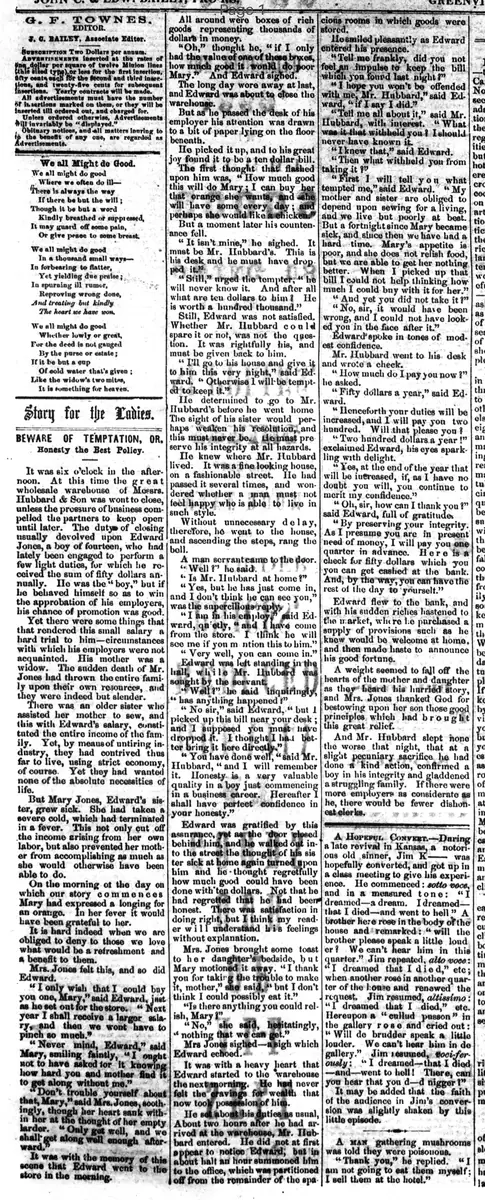
Story for the Ladies.
BEWARE
OF TEMPTATION, OR,
Honesty the Best Policy.
It was six o'clock in the afternoon. At this time the great wholesale warehouse of Messrs. Hubbard & Son was wont to close, unless the pressure of business compelled the partners to keep open until later. The duty of "closing" usually devolved upon Edward Jones, a boy of fourteen, who had lately been engaged to perform a few light duties, for which he received the sum of fifty dollars annually. He was the "boy," but if he behaved himself so as to win the approbation of his employers, his chance of promotion was good.
Yet there were some things that rendered this small salary a hard trial to him—circumstances with which his employers were not acquainted. His mother was a widow. The sudden death of Mr. Jones had thrown the entire family upon their own resources, and they were indeed but slender. There was an older sister who assisted her mother to sew, and this with Edward's salary, constituted the entire income of the family. Yet, by means of untiring industry, they had contrived thus far to live, using strict economy, of course. Yet they had wanted none of the absolute necessities of life.
But Mary Jones, Edward's sister, grew sick. She had taken a severe cold, which had terminated in a fever. This not only cut off the income arising from her own labor, but also prevented her mother from accomplishing as much as she would otherwise have been able to do.
On the morning of the day on which our story commences Mary had expressed a longing for an orange. In her fever it would have been grateful to her.
It is hard indeed when we are obliged to deny to those we love what would be a refreshment and a benefit to them.
Mrs. Jones felt this, and so did Edward.
"I only wish that I could buy you one, Mary," said Edward, just as he set out for the store. "Next year I shall receive a larger salary, and then we won't have to pinch so much."
"Never mind, Edward," said Mary, smiling faintly, "I ought not to have asked for it knowing how hard you and mother find it to get along without me."
"Don't trouble yourself about that, Mary," said Mrs. Jones, soothingly, though her heart sank within her at the thought of her empty larder. "Only get well, and we shall get along well enough afterward."
It was with the memory of this scene that Edward went to the store in the morning.
All around were boxes of rich goods representing thousands of dollars in money:
"Oh," thought he, "if I only had the value of one of these boxes, how much good it would do poor Mary." And Edward sighed.
The long day wore away at last, and Edward was about to close the warehouse.
But as he passed the desk of his employer his attention was drawn to a bit of paper lying on the floor beneath.
He picked it up, and to his great joy found it to be a ten dollar bill.
The first thought that flashed upon him was, "How much good this will do Mary; I can buy her that orange she wants, and she will have some every day; and perhaps she would like a chicken."
But a moment later his countenance fell.
"It isn't mine," he sighed. "It must be Mr. Hubbard's. This is his desk and he must have dropped it."
Still, urged the tempter, "he will never know it. And after all what are ten dollars to him? He is worth a hundred thousand."
Still, Edward was not satisfied.
Whether Mr. Hubbard could spare it or not, was not the question. It was rightfully his, and must be given back to him.
"I'll go to his house and give it to him this very night," said Edward. "Otherwise I will be tempted to keep it."
He determined to go to Mr. Hubbard's before he went home. The sight of his sister would perhaps weaken his resolution, and this must never be. He must preserve his integrity at all hazards.
He knew where Mr. Hubbard lived. It was a fine looking house on a fashionable street. He had passed it several times, and wondered whether a man must not feel happy who is able to live in such style.
Without unnecessary delay, therefore, he went to the house, and ascending the steps, rang the bell.
A man servant came to the door.
"Well?" he said.
"Is Mr. Hubbard at home?"
"Yes, but he has just come in, and I don't think he can see you," was the supercilious reply.
"I am in his employ," said Edward, quietly, "and I have come from the store." I think he will see me if you mention this to him."
"Very well, you can come in."
Edward was left standing in the hall, while Mr. Hubbard was sought by the servant.
"Well?" he said inquiringly. "Has anything happened?"
"No sir," said Edward, "but I picked up this bill near your desk; and I supposed you must have dropped it. I thought I had better bring it here directly."
"You have done well," said Mr. Hubbard, "and I will remember it. Honesty is a very valuable quality in a boy just commencing in a business career. Hereafter I shall have perfect confidence in your honesty."
Edward was gratified by this assurance, yet as the door closed behind him, and he walked out into the street the thought of his sister sick at home again turned upon him and he thought regretfully how much good could have been done with ten dollars. Not that he had regretted that he had been honest. There was satisfaction in doing right, but I think my reader will understand his feelings without explanation.
Mrs. Jones brought some toast to her daughter's bedside, but Mary motioned it away, "I thank you for taking the trouble to make it, mother," she said. "but I don't think I could possibly eat it."
"Is there anything you could relish, Mary?"
"No," she said, hesitatingly "nothing that we can get."
Mrs. Jones sighed—a sigh which Edward echoed.
It was with a heavy heart that Edward started to the warehouse the next morning. He had never felt the cravings for wealth that now took possession of him.
He set about his duties as usual.
About two hours after he had arrived at the warehouse, Mr. Hubbard entered. He did not at first appear to notice Edward; but in about half an hour summoned him to the office, which was partitioned off from the remainder of the spacious rooms in which goods were stored.
He smiled pleasantly as Edward entered his presence.
"Tell me frankly, did you not feel an impulse to keep the bill which you found last night?"
"I hope you won't be offended with me Mr. Hubbard," said Edward, "if I say I did."
"Tell me all about it," said Mr. Hubbard, with interest. "What was it that withheld you? I should never have known it."
"I knew that," said Edward. "Then what withheld you from taking it?"
"First I will tell you what tempted me," said Edward. "My mother and sister are obliged to depend upon sewing for a living, and we live but poorly at best. But a fortnight since Mary became sick, and since then we have had a hard time. Mary's appetite is poor, and she does not relish food, but we are able to get her nothing better. When I picked up that bill I could not help thinking how much I could buy with it for her."
"And yet you did not take it?"
"No, sir, it would have been wrong, and I could not have looked you in the face after it."
Edward spoke in tones of modest confidence.
Mr. Hubbard went to his desk and wrote a check.
"How much do I pay you now?" he asked.
"Fifty dollars a year," said Edward.
"Henceforth your duties will be increased, and I will pay you two hundred. Will that please you?"
"Two hundred dollars a year!" exclaimed Edward, his eyes sparkling with delight.
"Yes, at the end of the year that will be increased, if, as I have no doubt you will, you continue to merit my confidence."
"Oh, sir, how can I thank you?" said Edward, full of gratitude.
"By preserving your integrity. As I presume you are in present need of money, I will pay you one quarter in advance. Here is a check for fifty dollars which you can get cashed at the bank.
And, by the way, you can have the rest of the day to yourself."
Edward flew to the bank, and with his sudden riches hastened to the market, where he purchased a supply of provisions such as he knew would be welcome at home, and then made haste to announce his good fortune.
A weight seemed to fall off the hearts of the mother and daughter as they heard his hurried story, and Mrs. Jones thanked God for bestowing upon her son those good principles, which had brought this great relief.
And Mr. Hubbard slept none the worse that night, that at a slight pecuniary sacrifice he had done a kind action, confirmed a boy in his integrity and gladdened a struggling family. If there were more employers as considerate as he, there would be fewer dishonest clerks.
BEWARE
OF TEMPTATION, OR,
Honesty the Best Policy.
It was six o'clock in the afternoon. At this time the great wholesale warehouse of Messrs. Hubbard & Son was wont to close, unless the pressure of business compelled the partners to keep open until later. The duty of "closing" usually devolved upon Edward Jones, a boy of fourteen, who had lately been engaged to perform a few light duties, for which he received the sum of fifty dollars annually. He was the "boy," but if he behaved himself so as to win the approbation of his employers, his chance of promotion was good.
Yet there were some things that rendered this small salary a hard trial to him—circumstances with which his employers were not acquainted. His mother was a widow. The sudden death of Mr. Jones had thrown the entire family upon their own resources, and they were indeed but slender. There was an older sister who assisted her mother to sew, and this with Edward's salary, constituted the entire income of the family. Yet, by means of untiring industry, they had contrived thus far to live, using strict economy, of course. Yet they had wanted none of the absolute necessities of life.
But Mary Jones, Edward's sister, grew sick. She had taken a severe cold, which had terminated in a fever. This not only cut off the income arising from her own labor, but also prevented her mother from accomplishing as much as she would otherwise have been able to do.
On the morning of the day on which our story commences Mary had expressed a longing for an orange. In her fever it would have been grateful to her.
It is hard indeed when we are obliged to deny to those we love what would be a refreshment and a benefit to them.
Mrs. Jones felt this, and so did Edward.
"I only wish that I could buy you one, Mary," said Edward, just as he set out for the store. "Next year I shall receive a larger salary, and then we won't have to pinch so much."
"Never mind, Edward," said Mary, smiling faintly, "I ought not to have asked for it knowing how hard you and mother find it to get along without me."
"Don't trouble yourself about that, Mary," said Mrs. Jones, soothingly, though her heart sank within her at the thought of her empty larder. "Only get well, and we shall get along well enough afterward."
It was with the memory of this scene that Edward went to the store in the morning.
All around were boxes of rich goods representing thousands of dollars in money:
"Oh," thought he, "if I only had the value of one of these boxes, how much good it would do poor Mary." And Edward sighed.
The long day wore away at last, and Edward was about to close the warehouse.
But as he passed the desk of his employer his attention was drawn to a bit of paper lying on the floor beneath.
He picked it up, and to his great joy found it to be a ten dollar bill.
The first thought that flashed upon him was, "How much good this will do Mary; I can buy her that orange she wants, and she will have some every day; and perhaps she would like a chicken."
But a moment later his countenance fell.
"It isn't mine," he sighed. "It must be Mr. Hubbard's. This is his desk and he must have dropped it."
Still, urged the tempter, "he will never know it. And after all what are ten dollars to him? He is worth a hundred thousand."
Still, Edward was not satisfied.
Whether Mr. Hubbard could spare it or not, was not the question. It was rightfully his, and must be given back to him.
"I'll go to his house and give it to him this very night," said Edward. "Otherwise I will be tempted to keep it."
He determined to go to Mr. Hubbard's before he went home. The sight of his sister would perhaps weaken his resolution, and this must never be. He must preserve his integrity at all hazards.
He knew where Mr. Hubbard lived. It was a fine looking house on a fashionable street. He had passed it several times, and wondered whether a man must not feel happy who is able to live in such style.
Without unnecessary delay, therefore, he went to the house, and ascending the steps, rang the bell.
A man servant came to the door.
"Well?" he said.
"Is Mr. Hubbard at home?"
"Yes, but he has just come in, and I don't think he can see you," was the supercilious reply.
"I am in his employ," said Edward, quietly, "and I have come from the store." I think he will see me if you mention this to him."
"Very well, you can come in."
Edward was left standing in the hall, while Mr. Hubbard was sought by the servant.
"Well?" he said inquiringly. "Has anything happened?"
"No sir," said Edward, "but I picked up this bill near your desk; and I supposed you must have dropped it. I thought I had better bring it here directly."
"You have done well," said Mr. Hubbard, "and I will remember it. Honesty is a very valuable quality in a boy just commencing in a business career. Hereafter I shall have perfect confidence in your honesty."
Edward was gratified by this assurance, yet as the door closed behind him, and he walked out into the street the thought of his sister sick at home again turned upon him and he thought regretfully how much good could have been done with ten dollars. Not that he had regretted that he had been honest. There was satisfaction in doing right, but I think my reader will understand his feelings without explanation.
Mrs. Jones brought some toast to her daughter's bedside, but Mary motioned it away, "I thank you for taking the trouble to make it, mother," she said. "but I don't think I could possibly eat it."
"Is there anything you could relish, Mary?"
"No," she said, hesitatingly "nothing that we can get."
Mrs. Jones sighed—a sigh which Edward echoed.
It was with a heavy heart that Edward started to the warehouse the next morning. He had never felt the cravings for wealth that now took possession of him.
He set about his duties as usual.
About two hours after he had arrived at the warehouse, Mr. Hubbard entered. He did not at first appear to notice Edward; but in about half an hour summoned him to the office, which was partitioned off from the remainder of the spacious rooms in which goods were stored.
He smiled pleasantly as Edward entered his presence.
"Tell me frankly, did you not feel an impulse to keep the bill which you found last night?"
"I hope you won't be offended with me Mr. Hubbard," said Edward, "if I say I did."
"Tell me all about it," said Mr. Hubbard, with interest. "What was it that withheld you? I should never have known it."
"I knew that," said Edward. "Then what withheld you from taking it?"
"First I will tell you what tempted me," said Edward. "My mother and sister are obliged to depend upon sewing for a living, and we live but poorly at best. But a fortnight since Mary became sick, and since then we have had a hard time. Mary's appetite is poor, and she does not relish food, but we are able to get her nothing better. When I picked up that bill I could not help thinking how much I could buy with it for her."
"And yet you did not take it?"
"No, sir, it would have been wrong, and I could not have looked you in the face after it."
Edward spoke in tones of modest confidence.
Mr. Hubbard went to his desk and wrote a check.
"How much do I pay you now?" he asked.
"Fifty dollars a year," said Edward.
"Henceforth your duties will be increased, and I will pay you two hundred. Will that please you?"
"Two hundred dollars a year!" exclaimed Edward, his eyes sparkling with delight.
"Yes, at the end of the year that will be increased, if, as I have no doubt you will, you continue to merit my confidence."
"Oh, sir, how can I thank you?" said Edward, full of gratitude.
"By preserving your integrity. As I presume you are in present need of money, I will pay you one quarter in advance. Here is a check for fifty dollars which you can get cashed at the bank.
And, by the way, you can have the rest of the day to yourself."
Edward flew to the bank, and with his sudden riches hastened to the market, where he purchased a supply of provisions such as he knew would be welcome at home, and then made haste to announce his good fortune.
A weight seemed to fall off the hearts of the mother and daughter as they heard his hurried story, and Mrs. Jones thanked God for bestowing upon her son those good principles, which had brought this great relief.
And Mr. Hubbard slept none the worse that night, that at a slight pecuniary sacrifice he had done a kind action, confirmed a boy in his integrity and gladdened a struggling family. If there were more employers as considerate as he, there would be fewer dishonest clerks.
What sub-type of article is it?
Prose Fiction
What themes does it cover?
Moral Virtue
What keywords are associated?
Honesty
Temptation
Moral Tale
Family Hardship
Employer Reward
Integrity
Literary Details
Title
Beware Of Temptation, Or, Honesty The Best Policy
Subject
Moral Tale On Honesty And Temptation
Key Lines
"You Have Done Well," Said Mr. Hubbard, "And I Will Remember It. Honesty Is A Very Valuable Quality In A Boy Just Commencing In A Business Career."
"By Preserving Your Integrity."
If There Were More Employers As Considerate As He, There Would Be Fewer Dishonest Clerks.