Thank you for visiting SNEWPapers!
Sign up free
Watauga Democrat
Boone, Watauga County, North Carolina
What is this article about?
C. H. Brannon, extension entomologist at State College, advises North Carolina wheat growers to plant seed between September 15-October 5 in mountains and October 1-15 in piedmont to avoid Hessian Fly damage, which reduces yields via larval feeding. Controls include rotation, plowing stubble, destroying volunteers, good seed, fertilizer, and community cooperation.
Clipping
OCR Quality
Full Text
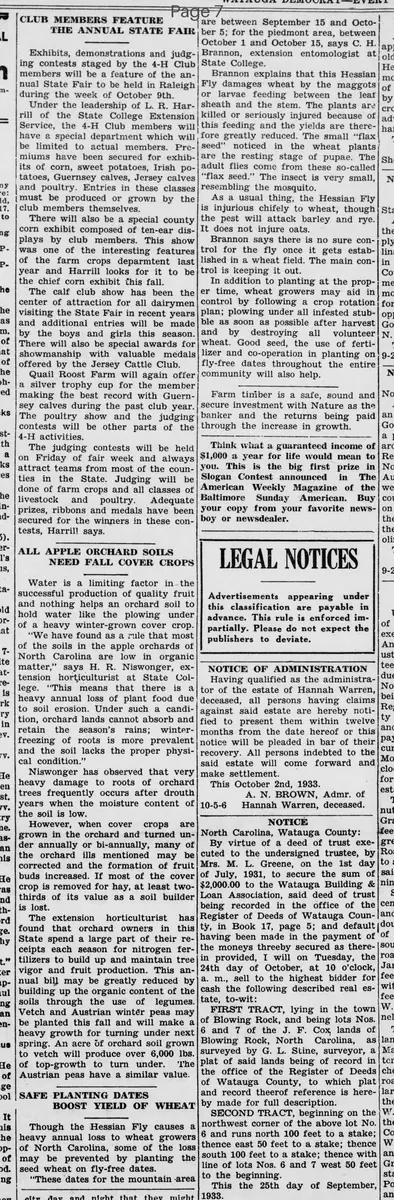
Though the Hessian Fly causes a heavy annual loss to wheat growers of North Carolina, some of the loss may be prevented by planting the seed wheat on fly-free dates.
"These dates for the mountain area are between September 15 and October 5; for the piedmont area, between October 1 and October 15," says C. H. Brannon, extension entomologist at State College.
Brannon explains that this Hessian Fly damages wheat by the maggots or larvae feeding between the leaf sheath and the stem. The plants are killed or seriously injured because of this feeding and the yields are therefore greatly reduced. The small "flax seed" noticed in the wheat plants are the resting stage of pupae. The adult flies come from these so-called "flax seed." The insect is very small, resembling the mosquito.
As a usual thing, the Hessian Fly is injurious chiefly to wheat, though the pest will attack barley and rye. It does not injure oats.
Brannon says there is no sure control for the fly once it gets established in a wheat field. The main control is keeping it out.
In addition to planting at the proper time, wheat growers may aid in control by following a crop rotation plan; plowing under all infested stubble as soon as possible after harvest and by destroying all volunteer wheat. Good seed, the use of fertilizer and co-operation in planting on fly-free dates throughout the entire community will also help.
What sub-type of article is it?
What keywords are associated?
What entities or persons were involved?
Where did it happen?
Domestic News Details
Primary Location
North Carolina
Key Persons
Outcome
heavy annual loss to wheat yields from hessian fly; prevention reduces damage
Event Details
Hessian Fly damages wheat by maggots feeding on stems, reducing yields; affects wheat, barley, rye but not oats; control via timely planting on fly-free dates, crop rotation, plowing stubble, destroying volunteer wheat, good seed, fertilizer, community cooperation