Thank you for visiting SNEWPapers!
Sign up free
Story
May 2, 1881
Sacramento Daily Record Union
Sacramento, Sacramento County, California
What is this article about?
The 'Tunnel Disease' in St. Gothard Tunnel excavation killed 117 workers due to a parasitic nematoid worm, not bad air or heat; similar to Egyptian chlorosis, discovery delayed by aversion to autopsies.
Clipping
OCR Quality
95%
Excellent
Full Text
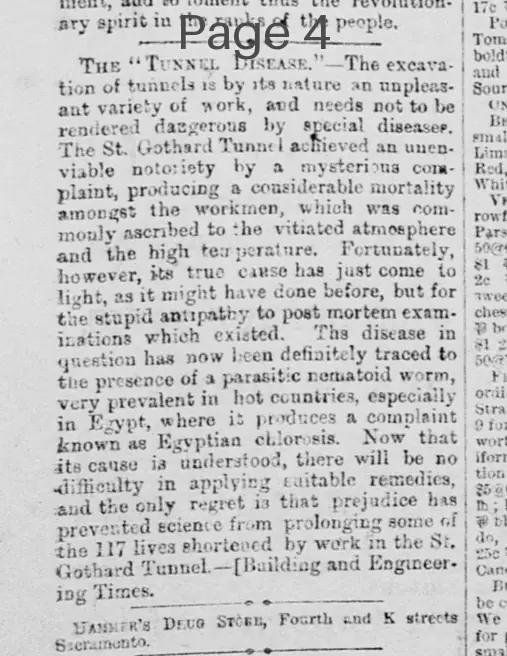
The "Tunnel Disease."
The excavation of tunnels is by its nature an unpleasant variety of work and rendered dangerous by special diseases.
The St. Gothard Tunnel achieved an unenviable notoriety by a mysterious complaint, producing a considerable mortality amongst the workmen, which was commonly ascribed to the vitiated atmosphere and the high temperature. Fortunately, however, its true cause has just come to light, as it might have done before, but for the stupid antipathy to post mortem examinations which existed. The disease in question has now been definitely traced to the presence of a parasitic nematoid worm, very prevalent in hot countries, especially in Egypt, where it produces a complaint known as Egyptian chlorosis. Now that its cause is understood, there will be no difficulty in applying suitable remedies, and the only regret is that prejudice has prevented science from prolonging some of the 117 lives shortened by work in the St. Gothard Tunnel.—[Building and Engineering Times.
The excavation of tunnels is by its nature an unpleasant variety of work and rendered dangerous by special diseases.
The St. Gothard Tunnel achieved an unenviable notoriety by a mysterious complaint, producing a considerable mortality amongst the workmen, which was commonly ascribed to the vitiated atmosphere and the high temperature. Fortunately, however, its true cause has just come to light, as it might have done before, but for the stupid antipathy to post mortem examinations which existed. The disease in question has now been definitely traced to the presence of a parasitic nematoid worm, very prevalent in hot countries, especially in Egypt, where it produces a complaint known as Egyptian chlorosis. Now that its cause is understood, there will be no difficulty in applying suitable remedies, and the only regret is that prejudice has prevented science from prolonging some of the 117 lives shortened by work in the St. Gothard Tunnel.—[Building and Engineering Times.
What sub-type of article is it?
Medical Curiosity
Historical Event
Curiosity
What themes does it cover?
Misfortune
Recovery
What keywords are associated?
Tunnel Disease
St Gothard Tunnel
Parasitic Worm
Egyptian Chlorosis
Workmen Mortality
Where did it happen?
St. Gothard Tunnel
Story Details
Location
St. Gothard Tunnel
Story Details
Excavation of St. Gothard Tunnel caused mysterious disease killing 117 workmen, traced to parasitic nematoid worm prevalent in hot countries like Egypt, known as Egyptian chlorosis, not vitiated atmosphere; prejudice against post mortem examinations delayed discovery.