Thank you for visiting SNEWPapers!
Sign up free
Editorial
May 17, 1918
The Mahnomen Pioneer
Mahnomen, Mahnomen County, Minnesota
What is this article about?
Editorial urges Americans to maintain normal social activities and wholesome hospitality toward soldiers during World War I, quoting Raymond B. Fosdick and citing President Wilson's example, to preserve morale and efficiency.
Clipping
OCR Quality
98%
Excellent
Full Text
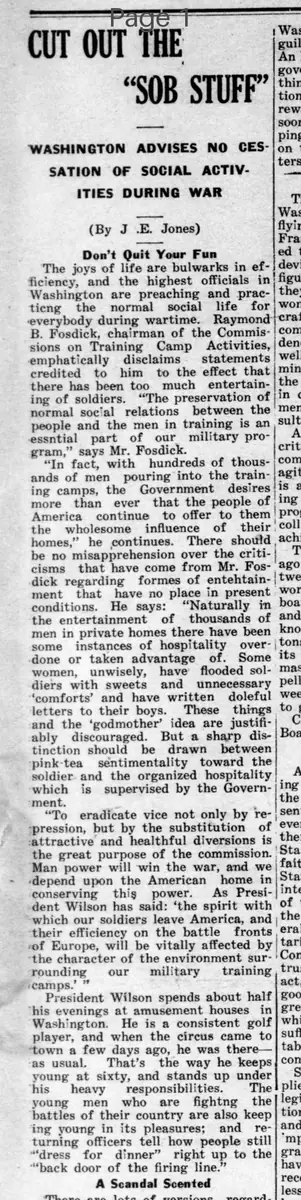
CUT OUT THE "SOB STUFF"
WASHINGTON ADVISES NO CESSATION OF SOCIAL ACTIVITIES DURING WAR.
(By J. E. Jones)
Don't Quit Your Fun.
The joys of life are bulwarks in efficiency, and the highest officials in Washington are preaching and practicing the normal social life for everybody during wartime. Raymond B. Fosdick, chairman of the Commission on Training Camp Activities, emphatically disclaims statements credited to him to the effect that there has been too much entertaining of soldiers. "The preservation of normal social relations between the people and the men in training is an essential part of our military program," says Mr. Fosdick.
"In fact, with hundreds of thousands of men pouring into the training camps, the Government desires more than ever that the people of America continue to offer to them the wholesome influence of their homes," he continues. There should be no misapprehension over the criticisms that have come from Mr. Fosdick regarding forms of entertainment that have no place in present conditions. He says:
"Naturally in the entertainment of thousands of men in private homes there have been some instances of hospitality overdone or taken advantage of. Some women, unwisely, have flooded soldiers with sweets and unnecessary comforts and have written doleful letters to their boys. These things and the 'godmother' idea are justifiably discouraged. But a sharp distinction should be drawn between pink-tea sentimentality toward the soldier and the organized hospitality which is supervised by the Government."
"To eradicate vice not only by repression, but by the substitution of attractive and healthful diversions is the great purpose of the commission. Man power will win the war, and we depend upon the American home in conserving this power. As President Wilson has said: the spirit with which our soldiers leave America, and their efficiency on the battle fronts of Europe, will be vitally affected by the character of the environment surrounding our military training camps."
President Wilson spends about half his evenings at amusement houses in Washington. He is a consistent golf player, and when the circus came to town a few days ago, he was there as usual. That's the way he keeps young at sixty, and stands up under his heavy responsibilities.
The young men who are fighting the battles of their country are also keeping young in its pleasures; and returning officers tell how people still "dress for dinner" right up to the "back door of the firing line."
WASHINGTON ADVISES NO CESSATION OF SOCIAL ACTIVITIES DURING WAR.
(By J. E. Jones)
Don't Quit Your Fun.
The joys of life are bulwarks in efficiency, and the highest officials in Washington are preaching and practicing the normal social life for everybody during wartime. Raymond B. Fosdick, chairman of the Commission on Training Camp Activities, emphatically disclaims statements credited to him to the effect that there has been too much entertaining of soldiers. "The preservation of normal social relations between the people and the men in training is an essential part of our military program," says Mr. Fosdick.
"In fact, with hundreds of thousands of men pouring into the training camps, the Government desires more than ever that the people of America continue to offer to them the wholesome influence of their homes," he continues. There should be no misapprehension over the criticisms that have come from Mr. Fosdick regarding forms of entertainment that have no place in present conditions. He says:
"Naturally in the entertainment of thousands of men in private homes there have been some instances of hospitality overdone or taken advantage of. Some women, unwisely, have flooded soldiers with sweets and unnecessary comforts and have written doleful letters to their boys. These things and the 'godmother' idea are justifiably discouraged. But a sharp distinction should be drawn between pink-tea sentimentality toward the soldier and the organized hospitality which is supervised by the Government."
"To eradicate vice not only by repression, but by the substitution of attractive and healthful diversions is the great purpose of the commission. Man power will win the war, and we depend upon the American home in conserving this power. As President Wilson has said: the spirit with which our soldiers leave America, and their efficiency on the battle fronts of Europe, will be vitally affected by the character of the environment surrounding our military training camps."
President Wilson spends about half his evenings at amusement houses in Washington. He is a consistent golf player, and when the circus came to town a few days ago, he was there as usual. That's the way he keeps young at sixty, and stands up under his heavy responsibilities.
The young men who are fighting the battles of their country are also keeping young in its pleasures; and returning officers tell how people still "dress for dinner" right up to the "back door of the firing line."
What sub-type of article is it?
War Or Peace
Moral Or Religious
Social Reform
What keywords are associated?
Wartime Social Activities
Soldier Hospitality
Normalcy During War
Vice Eradication
Military Morale
American Home Influence
What entities or persons were involved?
Raymond B. Fosdick
President Wilson
Commission On Training Camp Activities
Editorial Details
Primary Topic
Maintaining Normal Social Activities During Wartime
Stance / Tone
Encouraging Wholesome Social Life And Hospitality For Soldiers
Key Figures
Raymond B. Fosdick
President Wilson
Commission On Training Camp Activities
Key Arguments
Preservation Of Normal Social Relations Is Essential To Military Program
Government Desires Continued Wholesome Home Influences For Soldiers
Distinction Between Sentimentality And Supervised Hospitality
Eradicate Vice Through Healthful Diversions
American Home Conserves Man Power For War
Wilson's Personal Example Of Maintaining Amusements