Thank you for visiting SNEWPapers!
Sign up free
The Record Visitor
Pawtucket, Providence County, Rhode Island
What is this article about?
In Chapter II of 'A Weird Lover,' Princess Madeleine suffers terror in the ghostly Janos castle, married to the enigmatic Keretsenyi. Amid silent retainers and eerie omens, she explores and peeks into a recently sealed room, seeing something behind a curtain that fills her with horror.
Merged-components note: Original label 'literary' changed to 'story' as this is a narrative chapter from a serialized story. Image overlaps spatially with story bboxes (y-range 3898-4591 overlaps 3511-4852, x overlap), indicating it is an illustration for the story; merged accordingly.
Clipping
OCR Quality
Full Text
A WEIRD LOVER.
DAVID KER
[Copyright by American Press Association.]
CHAPTER II
WHAT MADELEINE SAW BEHIND THE CURTAIN,
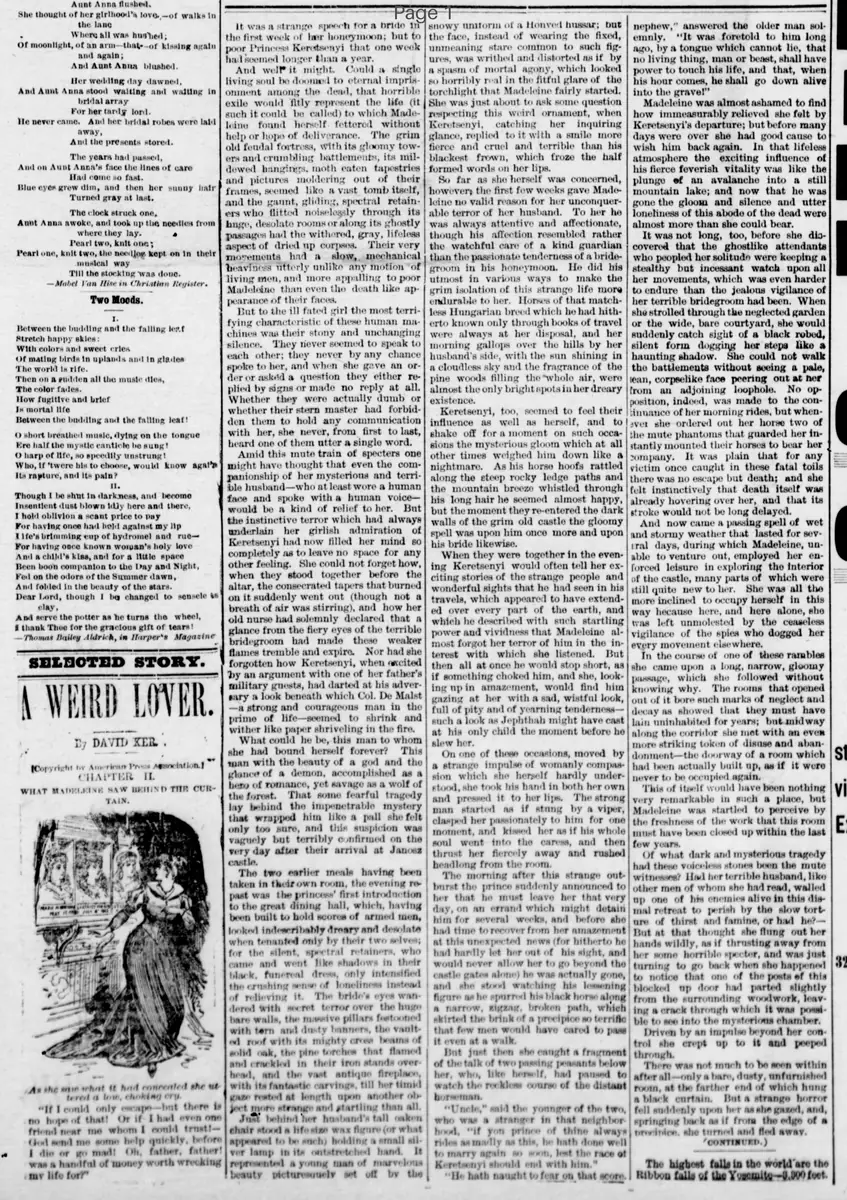
As she saw what it had concealed she uttered a low, choking cry.
"If I could only escape—but there is no hope of that! Or if I had even one friend near me whom I could trust!—
God send me some help quickly, before I die or go mad! Oh, father, father!
was a handful of money worth wrecking my life for?"
It was a strange speech for a bride in the first week of her honeymoon; but to poor Princess Keretsenyi that one week had seemed longer than a year. And well it might. Could a single living soul be doomed to eternal imprisonment among the dead, that horrible exile would fitly represent the life (if such it could be called) to which Madeleine found herself fettered without help or hope of deliverance. The grim old feudal fortress, with its gloomy towers and crumbling battlements, its mildewed hangings, moth-eaten tapestries and pictures moldering out of their frames, seemed like a vast tomb itself, and the gaunt, gliding, spectral retainers who flitted noiselessly through its huge, desolate rooms or along its ghostly passages had the withered, gray, lifeless aspect of dried-up corpses. Their very movements had a slow, mechanical heaviness utterly unlike any motion of living men, and more appalling to poor Madeleine than even the deathlike appearance of their faces.
But to the ill-fated girl the most terrifying characteristic of these human machines was their stony and unchanging silence. They never seemed to speak to each other; they never by any chance spoke to her, and when she gave an order or asked a question they either replied by signs or made no reply at all. Whether they were actually dumb or whether their stern master had forbidden them to hold any communication with her, she never, from first to last, heard one of them utter a single word.
Amid this mute train of specters one might have thought that even the companionship of her mysterious and terrible husband—who at least wore a human face and spoke with a human voice—would be a kind of relief to her. But the instinctive terror which had always underlain her girlish admiration of Keretsenyi had now filled her mind so completely as to leave no space for any other feeling. She could not forget how, when they stood together before the altar, the consecrated tapers that burned on it suddenly went out (though not a breath of air was stirring), and how her old nurse had solemnly declared that a glance from the fiery eyes of the terrible bridegroom had made these weaker flames tremble and expire. Nor had she forgotten how Keretsenyi, when excited by an argument with one of her father's military guests, had darted at his adversary a look beneath which Col. De Malet—a strong and courageous man in the prime of life—seemed to shrink and wither like paper shriveling in the fire.
What could he be, this man to whom she had bound herself forever? This man with the beauty of a god and the glance of a demon, accomplished as a hero of romance, yet savage as a wolf of the forest. That some fearful tragedy lay behind the impenetrable mystery that wrapped him like a pall she felt only too sure, and this suspicion was vaguely but terribly confirmed on the very day after their arrival at Janos castle.
The two earlier meals having been taken in their own room, the evening repast was the princess' first introduction to the great dining hall, which, having been built to hold scores of armed men, looked indescribably dreary and desolate when tenanted only by their two selves; for the silent, spectral retainers, who came and went like shadows in their black, funereal dress, only intensified the crushing sense of loneliness instead of relieving it. The bride's eyes wandered with secret terror over the huge bare walls, the massive pillars festooned with torn and dusty banners, the vaulted roof with its mighty cross beams of solid oak, the pine torches that flamed and crackled in their iron stands overhead, and the vast antique fireplace, with its fantastic carvings, till her timid gaze rested at length upon another object more strange and startling than all.
Just behind her husband's tall oaken chair stood a life-size wax figure (or what appeared to be such) holding a small silver lamp in its outstretched hand. It represented a young man of marvelous beauty, picturesquely set off by the snowy uniform of a Honved hussar; but the face, instead of wearing the fixed, unmeaning stare common to such figures, was writhed and distorted as if by a spasm of mortal agony, which looked so horribly real in the fitful glare of the torchlight that Madeleine fairly started.
She was just about to ask some question respecting this weird ornament, when Keretsenyi, catching her inquiring glance, replied to it with a smile more fierce and cruel and terrible than his blackest frown, which froze the half-formed words on her lips.
So far as she herself was concerned, however, the first few weeks gave Madeleine no valid reason for her unconquerable terror of her husband. To her he was always attentive and affectionate, though his affection resembled rather the watchful care of a kind guardian than the passionate tenderness of a bridegroom in his honeymoon. He did his utmost in various ways to make the grim isolation of this strange life more endurable to her. Horses of that matchless Hungarian breed which she had hitherto known only through books of travel were always at her disposal, and her morning gallops over the hills by her husband's side, with the sun shining in a cloudless sky and the fragrance of the pine woods filling the whole air, were almost the only bright spots in her dreary existence.
Keretsenyi, too, seemed to feel their influence as well as herself, and to shake off for a moment on such occasions the mysterious gloom which at all other times weighed him down like a nightmare. As his horse's hoofs rattled along the steep rocky ledge paths and the mountain breeze whistled through his long hair he seemed almost happy, but the moment they re-entered the dark walls of the grim old castle the gloomy spell was upon him once more and upon his bride likewise.
When they were together in the evening Keretsenyi would often tell her exciting stories of the strange people and wonderful sights that he had seen in his travels, which appeared to have extended over every part of the earth, and which he described with such startling power and vividness that Madeleine almost forgot her terror of him in the interest with which she listened. But then all at once he would stop short, as if something choked him, and she, looking up in amazement, would find him gazing at her with a sad, wistful look, full of pity and of yearning tenderness—such a look as Jephthah might have cast at his only child the moment before he slew her.
On one of these occasions, moved by a strange impulse of womanly compassion which she herself hardly understood, she took his hand in both her own and pressed it to her lips. The strong man started as if stung by a viper, clasped her passionately to him for one moment, and kissed her as if his whole soul went into the caress, and then thrust her fiercely away and rushed headlong from the room.
The morning after this strange outburst the prince suddenly announced to her that he must leave her that very day, on an errand which might detain him for several weeks, and before she had time to recover from her amazement at this unexpected news (for hitherto he had hardly let her out of his sight, and would never allow her to go beyond the castle gates alone) he was actually gone, and she stood watching his lessening figure as he spurred his black horse along a narrow, zigzag, broken path, which skirted the brink of a precipice so terrific that few men would have cared to pass it even at a walk.
But just then she caught a fragment of the talk of two passing peasants below her, who, like herself, had paused to watch the reckless course of the distant horseman.
"Uncle," said the younger of the two, who was a stranger in that neighborhood, "if yon prince of thine always rides as madly as this, he hath done well to marry again so soon, lest the race of Keretsenyi should end with him."
"He hath naught to fear on that score, nephew," answered the older man solemnly. "It was foretold to him long ago, by a tongue which cannot lie, that no living thing, man or beast, shall have power to touch his life, and that, when his hour comes, he shall go down alive into the grave!"
Madeleine was almost ashamed to find how immeasurably relieved she felt by Keretsenyi's departure; but before many days were over she had good cause to wish him back again. In that lifeless atmosphere the exciting influence of his fierce feverish vitality was like the plunge of an avalanche into a still mountain lake; and now that he was gone the gloom and silence and utter loneliness of this abode of the dead were almost more than she could bear.
It was not long, too, before she discovered that the ghostlike attendants who peopled her solitude were keeping a stealthy but incessant watch upon all her movements, which was even harder to endure than the jealous vigilance of her terrible bridegroom had been. When she strolled through the neglected garden or the wide, bare courtyard, she would suddenly catch sight of a black-robed silent form dogging her steps like a haunting shadow. She could not walk the battlements without seeing a pale, lean, corpselike face peering out at her from an adjoining loophole. No opposition, indeed, was made to the continuance of her morning rides, but whenever she ordered out her horse two of the mute phantoms that guarded her instantly mounted their horses to bear her company. It was plain that for any victim once caught in these fatal toils there was no escape but death; and she felt instinctively that death itself was already hovering over her, and that its stroke would not be long delayed.
And now came a passing spell of wet and stormy weather that lasted for several days, during which Madeleine, unable to venture out, employed her enforced leisure in exploring the interior of the castle, many parts of which were still quite new to her. She was all the more inclined to occupy herself in this way because here, and here alone, she was left unmolested by the ceaseless vigilance of the spies who dogged her every movement elsewhere.
In the course of one of these rambles she came upon a long, narrow, gloomy passage, which she followed without knowing why. The rooms that opened out of it bore such marks of neglect and decay as showed that they must have lain uninhabited for years; but midway along the corridor she met with an even more striking token of disuse and abandonment—the doorway of a room which had been actually built up, as if it were never to be occupied again.
This of itself would have been nothing very remarkable in such a place, but Madeleine was startled to perceive by the freshness of the work that this room must have been closed up within the last few years.
Of what dark and mysterious tragedy had these voiceless stones been the mute witnesses? Had her terrible husband, like other men of whom she had read, walled up one of his enemies alive in this dismal retreat to perish by the slow torture of thirst and famine, or had he?—
But at that thought she flung out her hands wildly, as if thrusting away from her some horrible specter, and was just turning to go back when she happened to notice that one of the posts of this blocked-up door had parted slightly from the surrounding woodwork, leaving a crack through which it was possible to see into the mysterious chamber.
Driven by an impulse beyond her control she crept up to it and peeped through.
There was not much to be seen within after all—only a bare, dusty, unfurnished room, at the farther end of which hung a black curtain. But a strange horror fell suddenly upon her as she gazed, and, springing back as if from the edge of a precipice, she turned and fled away.
(CONTINUED.)
What sub-type of article is it?
What themes does it cover?
What keywords are associated?
What entities or persons were involved?
Where did it happen?
Story Details
Key Persons
Location
Janos Castle
Story Details
Princess Madeleine, newly married to the mysterious and terrifying Keretsenyi, endures isolation and horror in the grim Janos castle surrounded by silent, ghostly retainers. She fears her husband's demonic nature and discovers a recently walled-up room with a black curtain behind which she glimpses something horrifying, fleeing in terror.