Thank you for visiting SNEWPapers!
Sign up free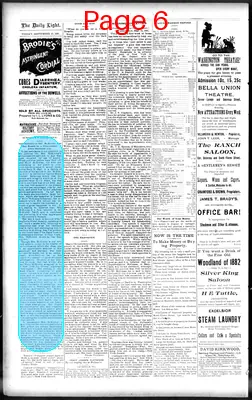
Story
September 25, 1891
San Antonio Daily Light
San Antonio, Bexar County, Texas
What is this article about?
Biographical sketch of Mrs. McKinley, devoted wife of Major McKinley, who supports his political career despite ill health, believes in his tariff policies, manages charities discreetly, and enjoys arts and theater.
Clipping
OCR Quality
95%
Excellent
Full Text
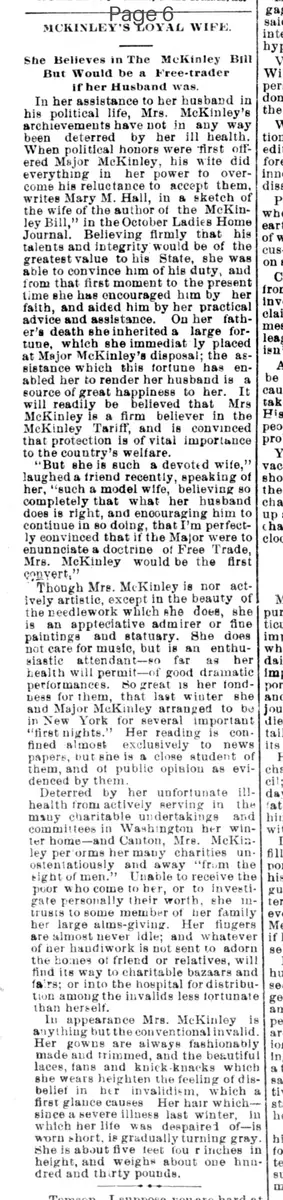
MCKINLEY'S LOYAL WIFE.
She Believes in The McKinley Bill
But Would be a Free-trader
if her Husband was.
In her assistance to her husband in his political life, Mrs. McKinley's achievements have not in any way been deterred by her ill health.
When political honors were first offered Major McKinley, his wife did everything in her power to overcome his reluctance to accept them, writes Mary M. Hall, in a sketch of the wife of the author of the McKinley Bill, in the October Ladies Home Journal. Believing firmly that his talents and integrity would be of the greatest value to his State, she was able to convince him of his duty, and from that first moment to the present time she has encouraged him by her faith, and aided him by her practical advice and assistance. On her father's death she inherited a large fortune, which she immediately placed at Major McKinley's disposal; the assistance which this fortune has enabled her to render her husband is a source of great happiness to her. It will readily be believed that Mrs. McKinley is a firm believer in the McKinley Tariff, and is convinced that protection is of vital importance to the country's welfare.
"But she is such a devoted wife," laughed a friend recently, speaking of her, "such a model wife, believing so completely that what her husband does is right, and encouraging him to continue in so doing, that I'm perfectly convinced that if the Major were to enunciate a doctrine of Free Trade, Mrs. McKinley would be the first convert."
Though Mrs. McKinley is not actively artistic, except in the beauty of the needlework which she does, she is an appreciative admirer of fine paintings and statuary. She does not care for music, but is an enthusiastic attendant-so far as her health will permit-of good dramatic performances. So great is her fondness for them, that last winter she and Major McKinley arranged to be in New York for several important "first nights." Her reading is confined almost exclusively to newspapers, but she is a close student of them, and of public opinion as evidenced by them.
Deterred by her unfortunate ill-health from actively serving in the many charitable undertakings and committees in Washington her winter home-and Canton, Mrs. McKinley performs her many charities unobtrusively and away "from the sight of men." Unable to receive the poor who come to her, or to investigate personally their worth, she intrusts to some member of her family her large alms-giving. Her fingers are almost never idle; and whatever of her handiwork is not sent to adorn the bones of friend or relatives, will find its way to charitable bazaars and fairs; or into the hospital for distribution among the invalids less fortunate than herself.
In appearance Mrs. McKinley is anything but the conventional invalid. Her gowns are always fashionably made and trimmed, and the beautiful laces, fans and knick-knacks which she wears heighten the feeling of disbelief in her invalidism, which a first glance causes. Her hair which-since a severe illness last winter, in which her life was despaired of-is worn short, is gradually turning gray. She is about five feet four inches in height, and weighs about one hundred and thirty pounds.
She Believes in The McKinley Bill
But Would be a Free-trader
if her Husband was.
In her assistance to her husband in his political life, Mrs. McKinley's achievements have not in any way been deterred by her ill health.
When political honors were first offered Major McKinley, his wife did everything in her power to overcome his reluctance to accept them, writes Mary M. Hall, in a sketch of the wife of the author of the McKinley Bill, in the October Ladies Home Journal. Believing firmly that his talents and integrity would be of the greatest value to his State, she was able to convince him of his duty, and from that first moment to the present time she has encouraged him by her faith, and aided him by her practical advice and assistance. On her father's death she inherited a large fortune, which she immediately placed at Major McKinley's disposal; the assistance which this fortune has enabled her to render her husband is a source of great happiness to her. It will readily be believed that Mrs. McKinley is a firm believer in the McKinley Tariff, and is convinced that protection is of vital importance to the country's welfare.
"But she is such a devoted wife," laughed a friend recently, speaking of her, "such a model wife, believing so completely that what her husband does is right, and encouraging him to continue in so doing, that I'm perfectly convinced that if the Major were to enunciate a doctrine of Free Trade, Mrs. McKinley would be the first convert."
Though Mrs. McKinley is not actively artistic, except in the beauty of the needlework which she does, she is an appreciative admirer of fine paintings and statuary. She does not care for music, but is an enthusiastic attendant-so far as her health will permit-of good dramatic performances. So great is her fondness for them, that last winter she and Major McKinley arranged to be in New York for several important "first nights." Her reading is confined almost exclusively to newspapers, but she is a close student of them, and of public opinion as evidenced by them.
Deterred by her unfortunate ill-health from actively serving in the many charitable undertakings and committees in Washington her winter home-and Canton, Mrs. McKinley performs her many charities unobtrusively and away "from the sight of men." Unable to receive the poor who come to her, or to investigate personally their worth, she intrusts to some member of her family her large alms-giving. Her fingers are almost never idle; and whatever of her handiwork is not sent to adorn the bones of friend or relatives, will find its way to charitable bazaars and fairs; or into the hospital for distribution among the invalids less fortunate than herself.
In appearance Mrs. McKinley is anything but the conventional invalid. Her gowns are always fashionably made and trimmed, and the beautiful laces, fans and knick-knacks which she wears heighten the feeling of disbelief in her invalidism, which a first glance causes. Her hair which-since a severe illness last winter, in which her life was despaired of-is worn short, is gradually turning gray. She is about five feet four inches in height, and weighs about one hundred and thirty pounds.
What sub-type of article is it?
Biography
What themes does it cover?
Family
Moral Virtue
What keywords are associated?
Mckinley Wife
Political Support
Charity Work
Ill Health
Devoted Spouse
What entities or persons were involved?
Mrs. Mckinley
Major Mckinley
Where did it happen?
Washington, Canton, New York
Story Details
Key Persons
Mrs. Mckinley
Major Mckinley
Location
Washington, Canton, New York
Event Date
Last Winter
Story Details
Mrs. McKinley supports her husband's political career despite health issues, inherits fortune to aid him, believes in his tariff policies loyally, engages in discreet charity, enjoys arts and theater.