Thank you for visiting SNEWPapers!
Sign up free
Editorial
November 1, 1796
Gazette Of The United States, & Philadelphia Daily Advertiser
Philadelphia, Philadelphia County, Pennsylvania
What is this article about?
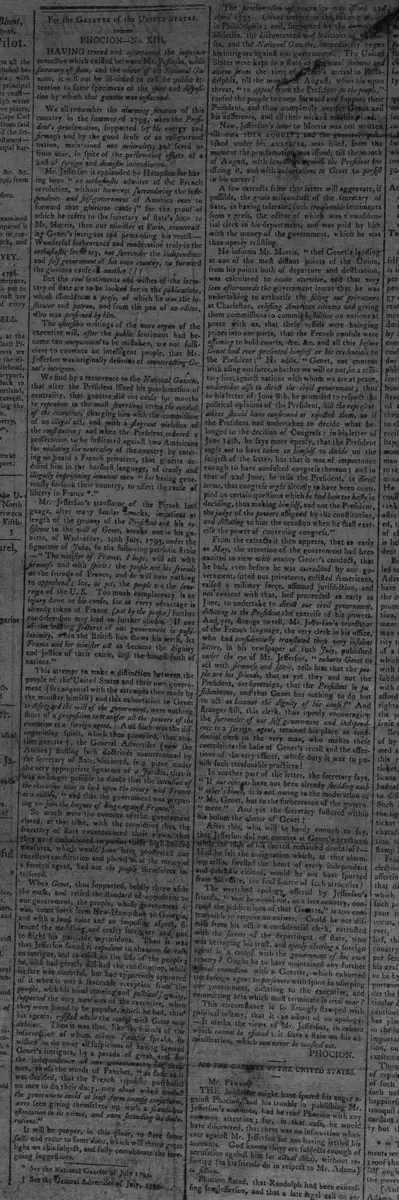
Phocion No. XIII critiques Thomas Jefferson's role as Secretary of State in 1793, alleging he funded the National Gazette to undermine President Washington's neutrality proclamation and support French minister Genet's intrigues until public opposition forced his reversal.
Merged-components note: These four sequential components form a single continuous editorial essay 'PHOCION No. XIII' on Jefferson and Genet.
Clipping
OCR Quality
95%
Excellent
Full Text
For the Gazette of the United States.
PHOCION No. XIII
HAVING traced and ascertained the improper
connection which existed between Mr. Jefferson, while
secretary of state, and the editor of the National Gazette, it will not be ill-timed to call the public attention
to some specimens of the spirit and disposition by which that gazette was influenced.
We all remember the alarming situation of this
country in the summer of 1793, when the President's proclamation, supported by his energy and
firmness and by the good sense of an enlightened
nation, maintained our neutrality and saved us
from war, in spite of the persevering efforts of a
host of foreign and domestic incendiaries.
Mr. Jefferson is applauded by Hampden for having been "an enthusiastic admirer of the French
revolution, without however surrendering the independence and self-government of America even to
forward that glorious cause;" for the proof of
which he refers to this secretary of state's letter to
Mr. Morris, then our minister at Paris, counteracting Genet's intrigues and demanding his recall. Wonderful forbearance and moderation truly in the
enthusiastic secretary, not surrender the independence
and self government of his own country, to forward
the glorious cause another!!!
But the real sentiments and wishes of the secretary of state are to be looked for in the publications,
which issued from a press, of which he was the institutor and patron, and from the pen of an editor,
who was pensioned by him.
The ostensible writings of the mere organ of the
executive will, after the public sentiment had become too unequivocal to be mistaken, are not sufficient to convince an intelligent people, that Mr.
Jefferson was originally desirous of counteracting Genet's intrigues.
We find by a recurrence to the National Gazette,
that after the President issued his proclamation of
neutrality, that gazette did not cease for months
to reprobate in the most scurrilous terms the conduct
of the executive, charging him with the commission
of an illegal act, and with a flagrant violation of
the constitution; and when the President ordered a
prosecution to be instituted against two Americans
for violating the neutrality of the country by entering on board a French privateer, that gazette accused him in the harshest language, of cruelly and
illegally imprisoning innocent men "for having generously forsook their country, to assert the cause of
liberty in France.".
Mr. Jefferson's translator of the French language, after many similar attacks, impatient at
length of the tyranny of the President and his resistance to the will of Genet, breaks out in his gazette, of Wednesday, 10th July, 1793, under the
signature of Fabius, in the following patriotic strain — The minister of France, I hope, will act with
firmness and with spirit; the people are his friends
or the friends of France, and he will have nothing
to apprehend; for, as yet, the people are the sovereign of the U. S. Too much complacency is an
injury done to his cause, for as every advantage is
already taken of France (not by the people) further
concession may lead to further abuses. If one
of the leading features of our government is pusillanimity, when the British lion shows his teeth, let
France and her minister act as becomes the dignity
and justice of their cause, and the plighted faith of
nations."
This attempt to make a distinction between,
the people of the United States and their own government (so congenial with the attempts then made by
the minister himself) and this exhortation to Genet
to disregard the will of the government, were nothing
short of a proposition to transfer all the powers of the
executive to a foreign agent. And such was the disorganizing spirit, which then prevailed, that another gazette, the General Advertiser (now the
Aurora) finding such doctrines countenanced by
the secretary of state, declared, in a piece under
the very appropriate signature of a Fabius, that it
was no longer possible to doubt that the intention of
the executive was to look upon the treaty with France
as a nullity, "and that the government was preparing to join the leagues of kings against France."
So much were the enemies of the government
elated, at that time, with the conviction that the
secretary of state countenanced their views, that
they were emboldened to pursue those high-handed
measures, which would soon have prostrated our
excellent constitution and placed us at the mercy of
a foreign agent, had not the people, themselves interfered.
When Genet, thus supported, boldly threw aside
the mask, and raised the standard of opposition to
our government, the people, whose government it
was, came forth from New-Hampshire to Georgia,
and with a loud voice and an imposing aspect, silenced the meddling and crafty foreigner and put
to flight his patricide myrmidons. Then it was
that Jefferson found it expedient to abandon so rash
an intrigue, and to enlist on the side of the people;
he, who had greatly disliked the constitution, while
its fate was doubtful, but had apparently approved
of it when it met a favorable reception from the
people, with his usual cunning and political sagacity,
supported the very measures of the executive, when
they were found to be popular, which he had, through his agents, resisted while the contest with Genet was
dubious. Then it was that, like the friends of the
insurrection of whom citizen Fauchet speaks, he
wished to do away all suspicions of having favored
Genet's intrigues, by a parade of great zeal for
the independence of our government, for these
men, to use the words of Fauchet, "as soon as it
was decided, that the French republic purchased
no men to do their duty, men about whose conduct
the government could at least form uneasy conjectures,
were seen giving themselves up with a scandalous
ostentation to its views, and even seconding its declarations."
It will be proper, in this place, to state some
facts and recur to some dates, which will throw great
light on this subject, and fully corroborate the foregoing suggestions.
*See the National Gazette of July 1793
See the General Advertiser of July
April 1793. Genet arrived in the ensuing month
in Philadelphia; and, supported by the democratic
societies, the discontented and seditious of all classes, and the National Gazette, immediately began
his intrigues against our government. The United
States were kept in a state of factious ferment and
alarm from the time of Genet's arrival in Philadelphia, till the month of August, when his open
threat, "to appeal from the President to the people,"
roused the people to come forward and support their
President, and thus completely overthrew Genet and
his adherents, and all their wicked machinations.
Now. Jefferson's letter to Morris was not written
till THE 16TH AUGUST: and the gazette, published under his auspices, was filled, from the
moment the proclamation was issued, till the month
of August, with invectives against the President for
issuing it, and with exhortations to Genet to persist in his career!
A few extracts from that letter will aggravate, if
possible, the gross misconduct of the secretary of
state, in having tolerated such treasonable sentiments
from a press, the editor of which was a confidential clerk in his department, and was paid by him
with the money of the government, which he was
thus openly resisting.
He informs Mr. Morris, "that Genet's landing
at one of the most distant points of the Union,
from his ports both of departure and destination,
was calculated to excite attention, and that very
soon afterwards the government learnt that he was
undertaking to authorize the fitting out privateers
at Charleston, enlisting American citizens and giving
them commissions to commit hostilities on nations at
peace with us, that these vessels were bringing
prizes into our ports, that the French consuls were
assuming to hold courts, &c. &c. and all this before
Genet had ever presented himself or his credentials to
the President:" He adds, "Genet, not content
with using our force, whether we will or not, in a military line, against nations with whom we are at peace,
undertakes also to direct the civil government; thus
in his letter of June 8th, he promised to respect the
political opinions of the President, till the representatives should have confirmed or rejected them, as if
the President had undertaken to decide what belonged to the decision of Congress: in his letter of
June 14th, he says more openly, that the President
ought not to have taken on himself to decide on the
subject of the letter, but that it was of importance
enough to have consulted congress thereon; and in
that of 22d June, he tells the President, in direct
terms, that congress ought already to have been occupied on certain questions which he had been too hasty in
deciding, thus making himself, and not the President,
the judge of the powers assigned by the constitution,
and dictating to him the occasion when he shall exercise the power of convening congress."
From the extracts it then appears, that as early
as May, the attention of the government had been
excited to view with anxiety Genet's conduct, that
he had, even before he was accredited by our government, fitted out privateers, enlisted Americans
raised a military force, assumed jurisdiction, and
not content with that, had proceeded as early as
June, to undertake to direct our civil government
dictating to the President the exercise of his powers.
And yet, strange to tell, Mr. Jefferson's translator
of the French language, the very clerk in his office,
who had confidentially translated these very insolent
letters, in his newspaper of 10th July, published
under the eye of Mr. Jefferson, "exhorts Genet to
act with firmness and spirit, tells him that the people are his friends, that as yet. they and not the
President, are sovereign, that the President is pusillanimous, and that Genet has nothing to do but
to act as becomes the dignity of his cause!" And
stranger still, this clerk, thus openly encouraging
the surrender of our self government and independence to a foreign agent, retained his place as confidential clerk to the very man, who makes these
complaints the basis of Genet's recall and the affections of the very officer, whose duty it was to punish such treasonable practices!
In another part of the letter, the secretary says,
"If our citizens have not been already shedding each
"other's blood, it is not owing to the moderation of
"Mr. Genet, but to the forbearance of the government." And yet the secretary harbored within
his bosom the abettor of Genet!
After this, who will be hardy enough to say,
that Jefferson did not connive at Genet's practices.
while the issue of his contest remained doubtful? Had he felt the indignation which, at that alarming crisis, swelled the heart of every independent
and patriotic citizen, would he not have spurned
from his office. the foul source of such atrocities?
The wretched apology. offered by Jefferson's
friends, "that he could not, in a free country, control the publications of that Gazette," is too contemptible to require an answer. Could be not dismiss from his office a confidential clerk, entrusted
with the secrets of the department of state, who
was betraying his trust, and openly abetting a foreign
agent in a contest with the government of his own
country? Ought he to have maintained any further
official connection with a Gazette, which exhorted
the foreign agent to persevere with spirit in usurping
our government, dictating to the executive, and
committing acts which must terminate in civil war?
This circumstance is so strongly stamped with
political infamy, that it can admit of no apology.
It marks the views of Mr. Jefferson, in colours
which cannot be effaced: it fixes a stain on his administration, which can never be washed out.
PHOCION.
PHOCION No. XIII
HAVING traced and ascertained the improper
connection which existed between Mr. Jefferson, while
secretary of state, and the editor of the National Gazette, it will not be ill-timed to call the public attention
to some specimens of the spirit and disposition by which that gazette was influenced.
We all remember the alarming situation of this
country in the summer of 1793, when the President's proclamation, supported by his energy and
firmness and by the good sense of an enlightened
nation, maintained our neutrality and saved us
from war, in spite of the persevering efforts of a
host of foreign and domestic incendiaries.
Mr. Jefferson is applauded by Hampden for having been "an enthusiastic admirer of the French
revolution, without however surrendering the independence and self-government of America even to
forward that glorious cause;" for the proof of
which he refers to this secretary of state's letter to
Mr. Morris, then our minister at Paris, counteracting Genet's intrigues and demanding his recall. Wonderful forbearance and moderation truly in the
enthusiastic secretary, not surrender the independence
and self government of his own country, to forward
the glorious cause another!!!
But the real sentiments and wishes of the secretary of state are to be looked for in the publications,
which issued from a press, of which he was the institutor and patron, and from the pen of an editor,
who was pensioned by him.
The ostensible writings of the mere organ of the
executive will, after the public sentiment had become too unequivocal to be mistaken, are not sufficient to convince an intelligent people, that Mr.
Jefferson was originally desirous of counteracting Genet's intrigues.
We find by a recurrence to the National Gazette,
that after the President issued his proclamation of
neutrality, that gazette did not cease for months
to reprobate in the most scurrilous terms the conduct
of the executive, charging him with the commission
of an illegal act, and with a flagrant violation of
the constitution; and when the President ordered a
prosecution to be instituted against two Americans
for violating the neutrality of the country by entering on board a French privateer, that gazette accused him in the harshest language, of cruelly and
illegally imprisoning innocent men "for having generously forsook their country, to assert the cause of
liberty in France.".
Mr. Jefferson's translator of the French language, after many similar attacks, impatient at
length of the tyranny of the President and his resistance to the will of Genet, breaks out in his gazette, of Wednesday, 10th July, 1793, under the
signature of Fabius, in the following patriotic strain — The minister of France, I hope, will act with
firmness and with spirit; the people are his friends
or the friends of France, and he will have nothing
to apprehend; for, as yet, the people are the sovereign of the U. S. Too much complacency is an
injury done to his cause, for as every advantage is
already taken of France (not by the people) further
concession may lead to further abuses. If one
of the leading features of our government is pusillanimity, when the British lion shows his teeth, let
France and her minister act as becomes the dignity
and justice of their cause, and the plighted faith of
nations."
This attempt to make a distinction between,
the people of the United States and their own government (so congenial with the attempts then made by
the minister himself) and this exhortation to Genet
to disregard the will of the government, were nothing
short of a proposition to transfer all the powers of the
executive to a foreign agent. And such was the disorganizing spirit, which then prevailed, that another gazette, the General Advertiser (now the
Aurora) finding such doctrines countenanced by
the secretary of state, declared, in a piece under
the very appropriate signature of a Fabius, that it
was no longer possible to doubt that the intention of
the executive was to look upon the treaty with France
as a nullity, "and that the government was preparing to join the leagues of kings against France."
So much were the enemies of the government
elated, at that time, with the conviction that the
secretary of state countenanced their views, that
they were emboldened to pursue those high-handed
measures, which would soon have prostrated our
excellent constitution and placed us at the mercy of
a foreign agent, had not the people, themselves interfered.
When Genet, thus supported, boldly threw aside
the mask, and raised the standard of opposition to
our government, the people, whose government it
was, came forth from New-Hampshire to Georgia,
and with a loud voice and an imposing aspect, silenced the meddling and crafty foreigner and put
to flight his patricide myrmidons. Then it was
that Jefferson found it expedient to abandon so rash
an intrigue, and to enlist on the side of the people;
he, who had greatly disliked the constitution, while
its fate was doubtful, but had apparently approved
of it when it met a favorable reception from the
people, with his usual cunning and political sagacity,
supported the very measures of the executive, when
they were found to be popular, which he had, through his agents, resisted while the contest with Genet was
dubious. Then it was that, like the friends of the
insurrection of whom citizen Fauchet speaks, he
wished to do away all suspicions of having favored
Genet's intrigues, by a parade of great zeal for
the independence of our government, for these
men, to use the words of Fauchet, "as soon as it
was decided, that the French republic purchased
no men to do their duty, men about whose conduct
the government could at least form uneasy conjectures,
were seen giving themselves up with a scandalous
ostentation to its views, and even seconding its declarations."
It will be proper, in this place, to state some
facts and recur to some dates, which will throw great
light on this subject, and fully corroborate the foregoing suggestions.
*See the National Gazette of July 1793
See the General Advertiser of July
April 1793. Genet arrived in the ensuing month
in Philadelphia; and, supported by the democratic
societies, the discontented and seditious of all classes, and the National Gazette, immediately began
his intrigues against our government. The United
States were kept in a state of factious ferment and
alarm from the time of Genet's arrival in Philadelphia, till the month of August, when his open
threat, "to appeal from the President to the people,"
roused the people to come forward and support their
President, and thus completely overthrew Genet and
his adherents, and all their wicked machinations.
Now. Jefferson's letter to Morris was not written
till THE 16TH AUGUST: and the gazette, published under his auspices, was filled, from the
moment the proclamation was issued, till the month
of August, with invectives against the President for
issuing it, and with exhortations to Genet to persist in his career!
A few extracts from that letter will aggravate, if
possible, the gross misconduct of the secretary of
state, in having tolerated such treasonable sentiments
from a press, the editor of which was a confidential clerk in his department, and was paid by him
with the money of the government, which he was
thus openly resisting.
He informs Mr. Morris, "that Genet's landing
at one of the most distant points of the Union,
from his ports both of departure and destination,
was calculated to excite attention, and that very
soon afterwards the government learnt that he was
undertaking to authorize the fitting out privateers
at Charleston, enlisting American citizens and giving
them commissions to commit hostilities on nations at
peace with us, that these vessels were bringing
prizes into our ports, that the French consuls were
assuming to hold courts, &c. &c. and all this before
Genet had ever presented himself or his credentials to
the President:" He adds, "Genet, not content
with using our force, whether we will or not, in a military line, against nations with whom we are at peace,
undertakes also to direct the civil government; thus
in his letter of June 8th, he promised to respect the
political opinions of the President, till the representatives should have confirmed or rejected them, as if
the President had undertaken to decide what belonged to the decision of Congress: in his letter of
June 14th, he says more openly, that the President
ought not to have taken on himself to decide on the
subject of the letter, but that it was of importance
enough to have consulted congress thereon; and in
that of 22d June, he tells the President, in direct
terms, that congress ought already to have been occupied on certain questions which he had been too hasty in
deciding, thus making himself, and not the President,
the judge of the powers assigned by the constitution,
and dictating to him the occasion when he shall exercise the power of convening congress."
From the extracts it then appears, that as early
as May, the attention of the government had been
excited to view with anxiety Genet's conduct, that
he had, even before he was accredited by our government, fitted out privateers, enlisted Americans
raised a military force, assumed jurisdiction, and
not content with that, had proceeded as early as
June, to undertake to direct our civil government
dictating to the President the exercise of his powers.
And yet, strange to tell, Mr. Jefferson's translator
of the French language, the very clerk in his office,
who had confidentially translated these very insolent
letters, in his newspaper of 10th July, published
under the eye of Mr. Jefferson, "exhorts Genet to
act with firmness and spirit, tells him that the people are his friends, that as yet. they and not the
President, are sovereign, that the President is pusillanimous, and that Genet has nothing to do but
to act as becomes the dignity of his cause!" And
stranger still, this clerk, thus openly encouraging
the surrender of our self government and independence to a foreign agent, retained his place as confidential clerk to the very man, who makes these
complaints the basis of Genet's recall and the affections of the very officer, whose duty it was to punish such treasonable practices!
In another part of the letter, the secretary says,
"If our citizens have not been already shedding each
"other's blood, it is not owing to the moderation of
"Mr. Genet, but to the forbearance of the government." And yet the secretary harbored within
his bosom the abettor of Genet!
After this, who will be hardy enough to say,
that Jefferson did not connive at Genet's practices.
while the issue of his contest remained doubtful? Had he felt the indignation which, at that alarming crisis, swelled the heart of every independent
and patriotic citizen, would he not have spurned
from his office. the foul source of such atrocities?
The wretched apology. offered by Jefferson's
friends, "that he could not, in a free country, control the publications of that Gazette," is too contemptible to require an answer. Could be not dismiss from his office a confidential clerk, entrusted
with the secrets of the department of state, who
was betraying his trust, and openly abetting a foreign
agent in a contest with the government of his own
country? Ought he to have maintained any further
official connection with a Gazette, which exhorted
the foreign agent to persevere with spirit in usurping
our government, dictating to the executive, and
committing acts which must terminate in civil war?
This circumstance is so strongly stamped with
political infamy, that it can admit of no apology.
It marks the views of Mr. Jefferson, in colours
which cannot be effaced: it fixes a stain on his administration, which can never be washed out.
PHOCION.
What sub-type of article is it?
Partisan Politics
Foreign Affairs
Constitutional
What keywords are associated?
Jefferson
Genet
Neutrality
French Revolution
National Gazette
Partisan Politics
Genet Affair
What entities or persons were involved?
Jefferson
Genet
Washington
Morris
Hampden
Fabius
Fauchet
National Gazette
Editorial Details
Primary Topic
Critique Of Jefferson's Support For Genet's Intrigues Against U.S. Neutrality
Stance / Tone
Strongly Critical Of Jefferson, Supportive Of Washington's Neutrality
Key Figures
Jefferson
Genet
Washington
Morris
Hampden
Fabius
Fauchet
National Gazette
Key Arguments
Jefferson Funded The National Gazette To Oppose Neutrality Proclamation
Gazette Exhorted Genet To Defy U.S. Government
Jefferson Delayed Opposing Genet Until Public Support For President Grew
Jefferson's Clerk Translated Genet's Letters Yet Supported Him Publicly
Jefferson Connived At Genet's Practices While Outcome Was Uncertain
No Excuse For Retaining Disloyal Clerk In Office