Thank you for visiting SNEWPapers!
Sign up free
The Virginia Gazette
Richmond, Williamsburg, Richmond County, Virginia
What is this article about?
Debate in the Irish House of Commons on November 23 and 25 regarding a royal message requesting up to 4000 Irish troops for service in America, to be replaced by foreign Protestant troops from Brunswick and Hesse Cassel, at no cost to Ireland. Resolutions proposed to approve the measure amid arguments on loyalty, justice, and policy.
Merged-components note: This is a direct textual continuation of the Irish House of Commons debate on sending troops to America, split across pages; merging as sequential reading order and coherent topic.
Clippings
1 of 2
OCR Quality
Full Text
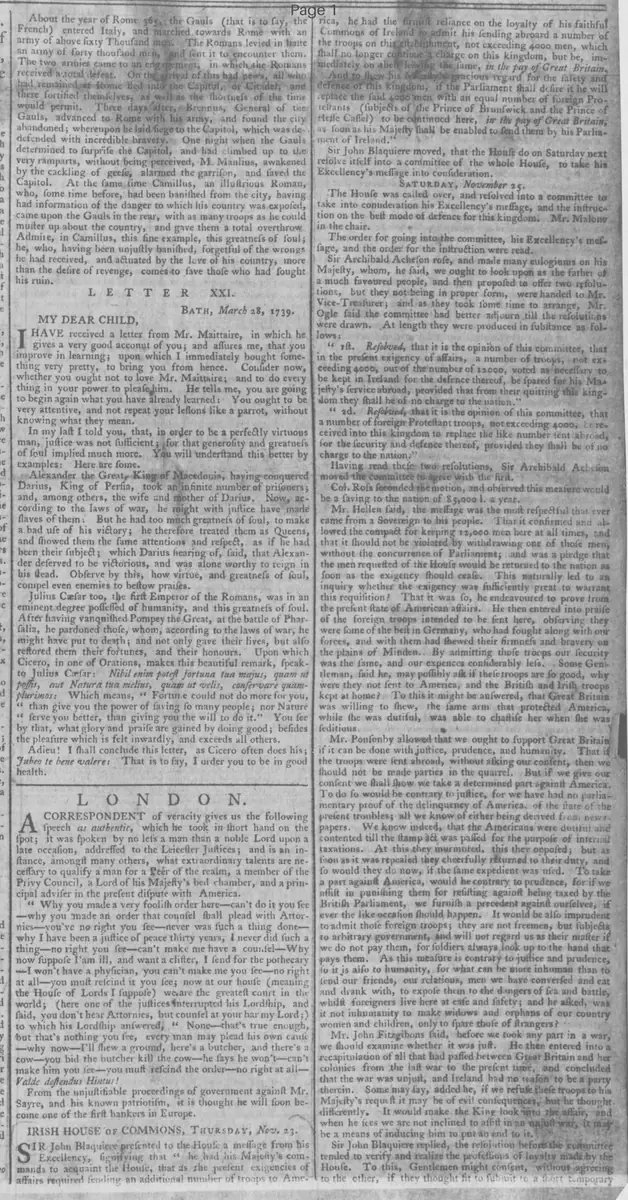
Sir John Blaquiere presented to the House a message from his Excellency, signifying that " he had his Majesty's commands to acquaint the House, that as the present exigencies of affairs required sending an additional number of troops to America, he had the first reliance on the loyalty of his faithful Commons of Ireland to admit his sending abroad a number of the troops on this establishment, not exceeding 4000 men, which shall no longer constitute a charge on this kingdom, but be, immediately on their leaving the same, in the pay of Great Britain. And to shew his Majesty gracious regard for the safety and defence of this kingdom, if the Parliament shall desire it he will replace the said 4000 men with an equal number of foreign Protestants (subjects of the Prince of Brunswick and the Prince of Hesse Cassel) to be continued here, in the pay of Great Britain, as soon as his Majesty shall be enabled to send them by his Parliament of Ireland.'"
Sir John Blaquiere moved, that the House do on Saturday next resolve itself into a committee of the whole House, to take his Excellency's message into consideration.
SATURDAY, November 25.
The House was called over, and resolved into a committee to take into consideration his Excellency's message, and the instruction on the best mode of defence for this kingdom. Mr. Malone in the chair.
The order for going into the committee, his Excellency's message, and the order for the instruction were read.
Sir Archibald Acheson rose, and made many eulogiums on his Majesty, whom, he said, we ought to look upon as the father of a much favoured people, and then proposed to offer two resolutions, but they not being in proper form, were handed to Mr. Vice-Treasurer; and as they took some time to arrange, Mr. Ogle said the committee had better adjourn till the resolutions were drawn. At length they were produced in substance as follows:
"1st. Resolved, that it is the opinion of this committee, that in the present exigency of affairs, a number of troops, not exceeding 4000, out of the number of 12000, voted as necessary to be kept in Ireland for the defence thereof, be spared for his Majesty's service abroad, provided that from their quitting this kingdom they shall be of no charge to the nation."
"2d. Resolved, that it is the opinion of this committee, that a number of foreign Protestant troops, not exceeding 4000, to be received into this kingdom to replace the like number sent abroad, for the security and defence thereof, provided they shall be of no charge to the nation."
Having read these two resolutions, Sir Archibald Acheson moved the committee to agree with the first.
Col. Rose seconded the motion, and observed this measure would be a saving to the nation of 80,000 l. a year.
Mr. Hellen said, the message was the most respectful that ever came from a Sovereign to his people. That it confirmed and allowed the compact for keeping 12,000 men here at all times, and that it should not be violated by withdrawing one of those men, without the concurrence of Parliament; and was a pledge that the men requested of the House would be returned to the nation as soon as the exigency should cease. This naturally led to an inquiry whether the exigency was sufficiently great to warrant this requisition? That it was so, he endeavoured to prove from the present state of American affairs. He then entered into praise of the foreign troops intended to be sent here, observing they were some of the best in Germany, who had fought along with our forces, and with them had shewed their firmness and bravery on the plains of Minden. By admitting those troops our security was the same, and our expences considerably less. Some Gentleman, said he, may possibly ask if these troops are so good, why were they not sent to America, and the British and Irish troops kept at home? To this it might be answered, that Great Britain was willing to shew, the same arm that protected America, while she was dutiful, was able to chastise her when she was seditious.
Mr. Ponsonby allowed that we ought to support Great Britain if it can be done with justice, prudence, and humanity. That if the troops were sent abroad, without asking our consent, then we should not be made parties in the quarrel. But if we give our consent we shall shew we take a determined part against America. To do so would be contrary to justice, for we have had no parliamentary proof of the delinquency of America, of the state of the present troubles; all we know of either being derived from news. papers. We know indeed, that the Americans were dutiful and contented till the stamp act was passed for the purpose of internal taxations. At this they murmured, this they opposed; but as soon as it was repealed they cheerfully returned to their duty, and so would they do now, if the same expedient was used. To take a part against America, would be contrary to prudence, for if we assist in punishing them for resisting against being taxed by the British Parliament, we furnish a precedent against ourselves, if ever the like occasion should happen. It would be also imprudent to admit those foreign troops; they are not freemen, but subjects to arbitrary government, and will not regard us as their masters if we do not pay them, for soldiers always look up to the hand that pays them. As this measure is contrary to justice and prudence, so it is also to humanity, for what can be more inhuman than to lend our friends, our relations, men we have conversed and eat and drank with, to expose them to the dangers of sea and battle, whilst foreigners live here at ease and safety; and he asked, was it not inhumanity to make widows and orphans of our country women and children, only to spare those of strangers?
Mr. John Fitzgibbons said, before we took any part in a war, we should examine whether it was just. He then entered into a recapitulation of all that had passed between Great Britain and her colonies from the last war to the present time, and concluded that the war was unjust, and Ireland had no reason to be a party therein. Some may say, added he, if we refuse these troops to his Majesty's request it may be of evil consequences, but he thought differently. It would make the King look into the affair, and when he sees we are not inclined to assist in an unjust war, it may be a means of inducing him to put an end to it.
Sir John Blaquiere replied, the resolution before the committee tended to verify and realize the professions of loyalty made by the House. To this, Gentlemen might consent, without agreeing to the other, if they thought fit to submit to a short temporary
inconveniency, rather than receive foreign troops, which would only be sent at the desire of the House.
Sir Edward Newenham said, as he had given his negative to the address, which denounced vengeance against his fellow subjects, he could not agree to the sending of more troops to butcher men who were fighting for their liberty. He said, that we might bid farewell to such as we sent to America; for that if America was conquered, the troops would be kept there to preserve that conquest; for though it might be conquered, the spirit of liberty would not be ever subdued. He was violently against the introduction of foreign mercenaries, and argued that the introduction of them had occasioned the fall of many great empires and states. He instanced the danger of having foreign troops in any kingdom where they would not be amenable to the laws, by mentioning the case of a Hessian soldier, who committed a robbery, and was confined by the civil magistrates, but was released and given up to the military. That Hanoverian, Hessian, and Brunswick troops were more dangerous than any others; for that German connections were always fatal to the true interests of Old England. He entered largely into the present system of affairs in Europe. He insisted upon it, that German influence was so powerful in the Cabinet of Great Britain, that the most valuable interests of these kingdoms would be given to save the paltry Electorate of Hanover. That he was convinced the destruction of the Elector's menagery at Herrenhausen, or the much admired stud of cream-coloured nags, in the stables of Hanover or Zell, would appear in the eyes of the present Ministry as a greater misfortune than the desolation of those three once happy, but now distracted sinking nations. He advised the Minister in the House to consider what riots and disorders would be committed in the city of Dublin, if foreign mercenaries were quartered in it. That the sending of our troops to the butchery of our fellow subjects in America, or bringing over foreign mercenaries, equally militated against true reason and sound policy.
[To be continued.]
What sub-type of article is it?
What keywords are associated?
What entities or persons were involved?
Where did it happen?
Foreign News Details
Primary Location
America
Event Date
November 23 And 25
Key Persons
Outcome
resolutions proposed to approve sending up to 4000 irish troops to america for british service, replaced by equal number of foreign protestant troops from brunswick and hesse cassel, at no charge to ireland; debate ongoing with mixed support.
Event Details
In the Irish House of Commons, a message from the Viceroy conveyed the King's request to send up to 4000 Irish troops to America due to exigencies, with replacement by foreign Protestant troops if desired, all at Britain's expense. On November 25, the House debated in committee, with Sir Archibald Acheson proposing resolutions to approve the measure. Supporters highlighted loyalty, savings, and quality of foreign troops; opponents argued against injustice, imprudence, and inhumanity of aiding Britain against America, and dangers of foreign mercenaries.