Thank you for visiting SNEWPapers!
Sign up free
Editorial
September 16, 1896
The Advocate
Topeka, Shawnee County, Kansas
What is this article about?
Editorial refutes argument that US free silver coinage would drop wages to Mexican levels (13-26 cents/day), citing historical US low wages (25-31 cents/day, $5-6/month) and current job desperation amid unemployment.
Clipping
OCR Quality
98%
Excellent
Full Text
WAGES IN MEXICO.
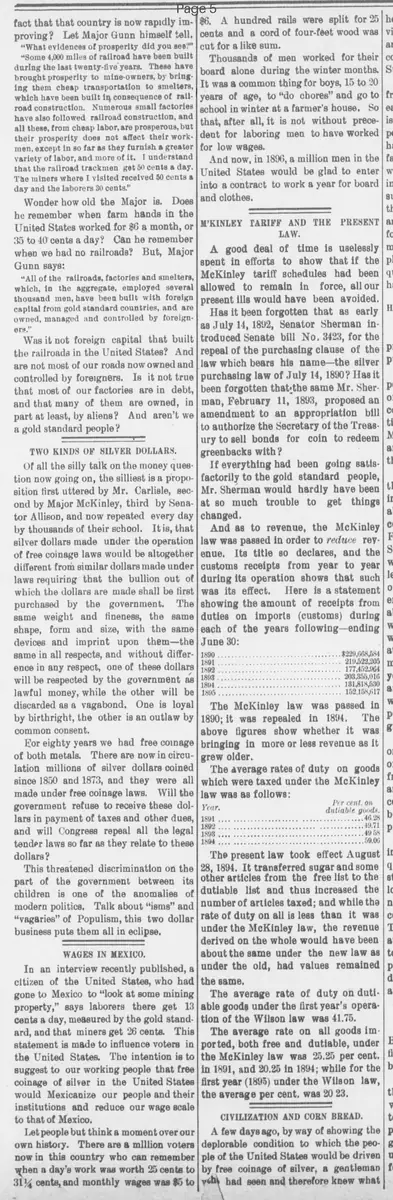
In an interview recently published, a citizen of the United States, who had gone to Mexico to "look at some mining property," says laborers there get 13 cents a day, measured by the gold standard, and that miners get 26 cents. This statement is made to influence voters in the United States. The intention is to suggest to our working people that free coinage of silver in the United States would Mexicanize our people and their institutions and reduce our wage scale to that of Mexico.
Let people but think a moment over our own history. There are 8 million voters now in this country who can remember when a day's work was worth 25 to 31 cents, and monthly wages was $5 to $6. A hundred rails were split for 25 cents and a cord of four-feet wood was cut for a like sum. Thousands of men worked for their board alone during the winter months. It was a common thing for boys, 15 to 20 years of age, to "do chores" and go to school in winter at a farmer's house. So that, after all, it is not without precedent for laboring men to have worked for low wages. And now, in 1896, a million men in the United States would be glad to enter into a contract to work a year for board and clothes.
In an interview recently published, a citizen of the United States, who had gone to Mexico to "look at some mining property," says laborers there get 13 cents a day, measured by the gold standard, and that miners get 26 cents. This statement is made to influence voters in the United States. The intention is to suggest to our working people that free coinage of silver in the United States would Mexicanize our people and their institutions and reduce our wage scale to that of Mexico.
Let people but think a moment over our own history. There are 8 million voters now in this country who can remember when a day's work was worth 25 to 31 cents, and monthly wages was $5 to $6. A hundred rails were split for 25 cents and a cord of four-feet wood was cut for a like sum. Thousands of men worked for their board alone during the winter months. It was a common thing for boys, 15 to 20 years of age, to "do chores" and go to school in winter at a farmer's house. So that, after all, it is not without precedent for laboring men to have worked for low wages. And now, in 1896, a million men in the United States would be glad to enter into a contract to work a year for board and clothes.
What sub-type of article is it?
Economic Policy
Labor
What keywords are associated?
Free Silver
Mexican Wages
Us Labor History
Low Wages
Unemployment Desperation
What entities or persons were involved?
Mexico
United States
Laborers
Miners
Editorial Details
Primary Topic
Countering Fears Of Free Silver Reducing Us Wages To Mexican Levels
Stance / Tone
Defensive Historical Rebuttal
Key Figures
Mexico
United States
Laborers
Miners
Key Arguments
Mexican Laborers Earn 13 Cents/Day And Miners 26 Cents By Gold Standard
Free Silver Claim Aims To Scare Us Voters By Suggesting Wage Reduction To Mexican Levels
Us History Shows Past Wages Of 25 31 Cents/Day And $5 6/Month
Historical Examples Include Splitting Rails Or Cutting Wood For 25 Cents
Many Worked For Board Alone In Winter
Boys Did Chores For Board And School
In 1896, A Million Us Men Would Accept Year Long Work For Board And Clothes