Thank you for visiting SNEWPapers!
Sign up free
Letter to Editor
June 28, 1819
Alexandria Gazette & Daily Advertiser
Alexandria, Virginia
What is this article about?
A. B. Martin shares the composition of a newly discovered compost made from sulphate of lime, porous carbonate of lime, nitrate of potass, carbonate of potass, muriate of potass, and carbonate of soda, explaining its fertilizing properties and benefits for agriculture.
Clipping
OCR Quality
95%
Excellent
Full Text
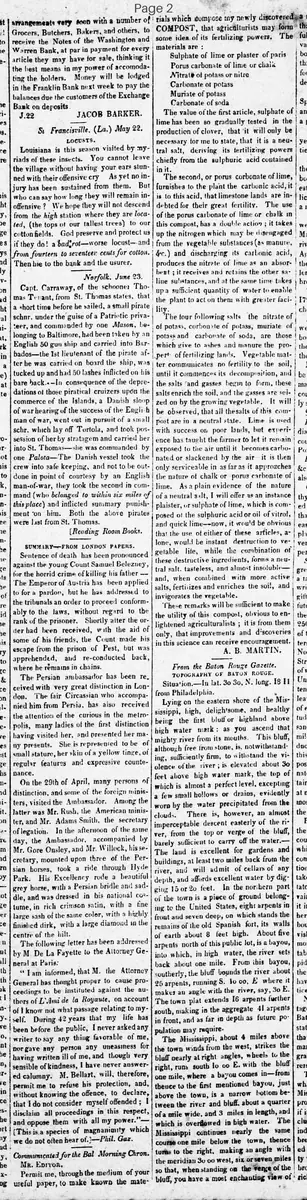
Communicated for the Bal Morning Chron.
MR. EDITOR,
Permit me, through the medium of your useful paper, to make known the materials which compose my newly discovered COMPOST, that agricul-turists may form some idea of its fertilizing powers. The materials are:
Sulphate of lime or plaster of paris
Porus carbonate of lime or chalk
Nitrate of potass or nitre
Carbonate of potass
Muriate of potass
Carbonate of soda
The value of the first article, sulphate of lime has been so gradually tested in the production of clover, that it will only be necessary for me to state, that it is a neutral salt, deriving its fertilizing powers chiefly from the sulphuric acid contained in it.
The second, or porus carbonate of lime, furnishes to the plant the carbonic acid, it is to this acid, that limestone lands are indebted for their great fertility. The use of the porus carbonate of lime or chalk in this compost, has a double action; it takes up the nitrogen which may be disengaged from the vegetable substances (as manure, &c.) and discharging its carbonic acid, produces the nitrate of lime as an absorbent: it receives and retains the other saline substances, and at the same time takes up a sufficient quantity of water to enable the plant to act on them with greater facility.
The four following salts the nitrate of potass, carbonate of potass, muriate of potass and carbonate of soda, are those which give to ashes and manure the property of fertilizing lands. Vegetable matter communicates no fertility to the soil, until it commences its decomposition, and the salts and gasses begin to form, these salts enrich the soil, and the gasses are seized on by the growing vegetable. It will be observed, that all the salts of this compost are in a neutral state. Lime is used with success on poor lands, but experience has taught the farmer to let it remain exposed to the air until it becomes carbonated or slackened by the air- it is then only serviceable in as far as it approaches the nature of chalk or porus carbonate of lime. As a plain evidence of the nature of a neutral salt, I will offer as an instance plaister, or sulphate of lime, which is composed of the sulphuric acid or oil of vitriol, and quick lime--now, it would be obvious that the use of either of these articles, alone, would be instant destruction to vegetable life, while the combination of these destructive ingredients, forms a neutral salt, tasteless, and almost insoluble- and, when combined with more active salts, fertilizes and enriches the soil, and invigorates the vegetable.
These remarks will be sufficient to make the utility of this compost, obvious to enlightened agriculturalists; it is from them only, that improvements and discoveries in this science can receive encouragement.
A. B. MARTIN.
MR. EDITOR,
Permit me, through the medium of your useful paper, to make known the materials which compose my newly discovered COMPOST, that agricul-turists may form some idea of its fertilizing powers. The materials are:
Sulphate of lime or plaster of paris
Porus carbonate of lime or chalk
Nitrate of potass or nitre
Carbonate of potass
Muriate of potass
Carbonate of soda
The value of the first article, sulphate of lime has been so gradually tested in the production of clover, that it will only be necessary for me to state, that it is a neutral salt, deriving its fertilizing powers chiefly from the sulphuric acid contained in it.
The second, or porus carbonate of lime, furnishes to the plant the carbonic acid, it is to this acid, that limestone lands are indebted for their great fertility. The use of the porus carbonate of lime or chalk in this compost, has a double action; it takes up the nitrogen which may be disengaged from the vegetable substances (as manure, &c.) and discharging its carbonic acid, produces the nitrate of lime as an absorbent: it receives and retains the other saline substances, and at the same time takes up a sufficient quantity of water to enable the plant to act on them with greater facility.
The four following salts the nitrate of potass, carbonate of potass, muriate of potass and carbonate of soda, are those which give to ashes and manure the property of fertilizing lands. Vegetable matter communicates no fertility to the soil, until it commences its decomposition, and the salts and gasses begin to form, these salts enrich the soil, and the gasses are seized on by the growing vegetable. It will be observed, that all the salts of this compost are in a neutral state. Lime is used with success on poor lands, but experience has taught the farmer to let it remain exposed to the air until it becomes carbonated or slackened by the air- it is then only serviceable in as far as it approaches the nature of chalk or porus carbonate of lime. As a plain evidence of the nature of a neutral salt, I will offer as an instance plaister, or sulphate of lime, which is composed of the sulphuric acid or oil of vitriol, and quick lime--now, it would be obvious that the use of either of these articles, alone, would be instant destruction to vegetable life, while the combination of these destructive ingredients, forms a neutral salt, tasteless, and almost insoluble- and, when combined with more active salts, fertilizes and enriches the soil, and invigorates the vegetable.
These remarks will be sufficient to make the utility of this compost, obvious to enlightened agriculturalists; it is from them only, that improvements and discoveries in this science can receive encouragement.
A. B. MARTIN.
What sub-type of article is it?
Informative
Persuasive
What themes does it cover?
Agriculture
Science Nature
What keywords are associated?
Compost
Fertilizer
Sulphate Of Lime
Carbonate Of Lime
Potass Salts
Agriculture
Soil Enrichment
Neutral Salts
What entities or persons were involved?
A. B. Martin
Mr. Editor
Letter to Editor Details
Author
A. B. Martin
Recipient
Mr. Editor
Main Argument
the newly discovered compost, composed of sulphate of lime, porous carbonate of lime, nitrate of potass, carbonate of potass, muriate of potass, and carbonate of soda, provides fertilizing powers through neutral salts that enrich soil and support plant growth, benefiting agriculturists.
Notable Details
Explains Fertilizing Action Of Each Component
Emphasizes Neutral State Of Salts For Safety And Efficacy
References Use In Clover Production And Limestone Fertility