Thank you for visiting SNEWPapers!
Sign up free
Story
April 3, 1868
Morning Republican
Little Rock, Pulaski County, Arkansas
What is this article about?
Southern newspapers like the Charleston Courier and Richmond Whig advocate for intensified agricultural production, crop diversification, youth involvement in farming, and freedmen's need to work for independence to achieve post-war prosperity and reconstruction.
Clipping
OCR Quality
98%
Excellent
Full Text
Good Sense from the South.
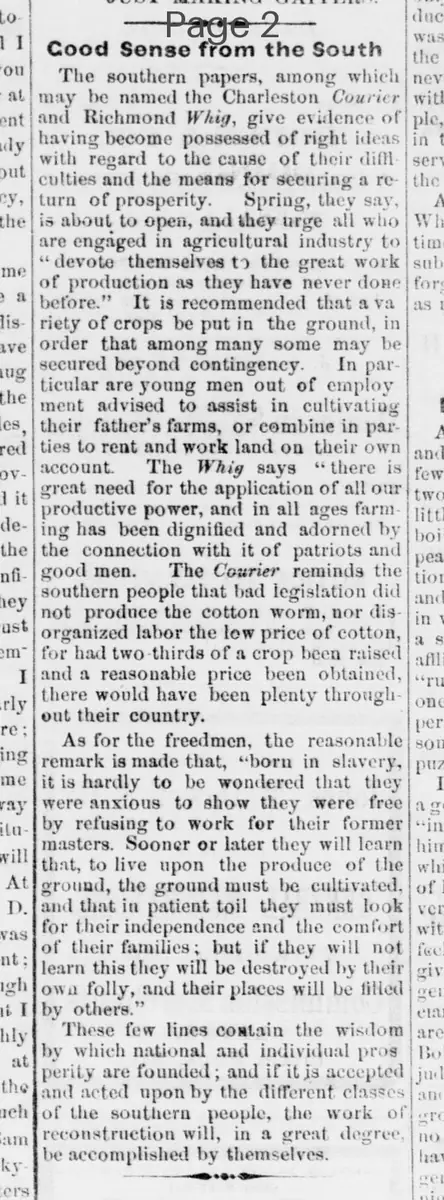
The southern papers, among which may be named the Charleston Courier and Richmond Whig, give evidence of having become possessed of right ideas with regard to the cause of their difficulties and the means for securing a return of prosperity. Spring, they say, is about to open, and they urge all who are engaged in agricultural industry to 'devote themselves to the great work of production as they have never done before.' It is recommended that a variety of crops be put in the ground, in order that among many some may be secured beyond contingency. In particular are young men out of employment advised to assist in cultivating their father's farms, or combine in parties to rent and work land on their own account. The Whig says 'there is great need for the application of all our productive power, and in all ages farming has been dignified and adorned by the connection with it of patriots and good men.'
The Courier reminds the southern people that bad legislation did not produce the cotton worm, nor dis-organized labor the low price of cotton, for had two-thirds of a crop been raised and a reasonable price been obtained, there would have been plenty throughout their country.
As for the freedmen, the reasonable remark is made that, 'born in slavery, it is hardly to be wondered that they were anxious to show they were free by refusing to work for their former masters. Sooner or later they will learn that, to live upon the produce of the ground, the ground must be cultivated, and that in patient toil they must look for their independence and the comfort of their families; but if they will not learn this they will be destroyed by their own folly, and their places will be filled by others.'
These few lines contain the wisdom by which national and individual prosperity are founded; and if it is accepted and acted upon by the different classes of the southern people, the work of reconstruction will, in a great degree, be accomplished by themselves.
The southern papers, among which may be named the Charleston Courier and Richmond Whig, give evidence of having become possessed of right ideas with regard to the cause of their difficulties and the means for securing a return of prosperity. Spring, they say, is about to open, and they urge all who are engaged in agricultural industry to 'devote themselves to the great work of production as they have never done before.' It is recommended that a variety of crops be put in the ground, in order that among many some may be secured beyond contingency. In particular are young men out of employment advised to assist in cultivating their father's farms, or combine in parties to rent and work land on their own account. The Whig says 'there is great need for the application of all our productive power, and in all ages farming has been dignified and adorned by the connection with it of patriots and good men.'
The Courier reminds the southern people that bad legislation did not produce the cotton worm, nor dis-organized labor the low price of cotton, for had two-thirds of a crop been raised and a reasonable price been obtained, there would have been plenty throughout their country.
As for the freedmen, the reasonable remark is made that, 'born in slavery, it is hardly to be wondered that they were anxious to show they were free by refusing to work for their former masters. Sooner or later they will learn that, to live upon the produce of the ground, the ground must be cultivated, and that in patient toil they must look for their independence and the comfort of their families; but if they will not learn this they will be destroyed by their own folly, and their places will be filled by others.'
These few lines contain the wisdom by which national and individual prosperity are founded; and if it is accepted and acted upon by the different classes of the southern people, the work of reconstruction will, in a great degree, be accomplished by themselves.
What sub-type of article is it?
Historical Event
What themes does it cover?
Recovery
Moral Virtue
Survival
What keywords are associated?
Southern Reconstruction
Agricultural Production
Crop Diversification
Freedmen Labor
Post War Economy
Cotton Crisis
Where did it happen?
The South
Story Details
Location
The South
Story Details
Southern newspapers urge focus on agriculture, crop variety, youth farming participation, and freedmen learning the value of toil for independence and prosperity amid reconstruction.