Thank you for visiting SNEWPapers!
Sign up free
Editorial
November 24, 1941
The Ypsilanti Daily Press
Ypsilanti, Washtenaw County, Michigan
What is this article about?
Editorial advocates for enhanced educational and social programs in problem areas like Harlem to prevent juvenile delinquency. The New York Teachers Guild proposes smaller classes, new school buildings, vocational training, recreation, and expanded services to guide children and build good citizens.
Clipping
OCR Quality
98%
Excellent
Full Text
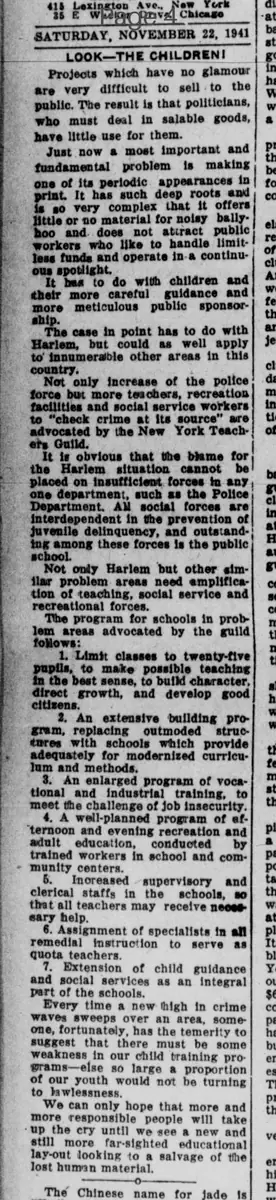
SATURDAY, NOVEMBER 22, 1941
LOOK—THE CHILDREN
Projects which have no glamour are very difficult to sell to the public. The result is that politicians, who must deal in salable goods, have little use for them.
Just now a most important and fundamental problem is making one of its periodic appearances in print. It has such deep roots and is so very complex that it offers little or no material for noisy ballyhoo and does not attract public workers who like to handle limitless funds and operate in a continuous spotlight.
It has to do with children and their more careful guidance and more meticulous public sponsorship.
The case in point has to do with Harlem, but could as well apply to innumerable other areas in this country.
Not only increase of the police force but more teachers, recreation facilities and social service workers to "check crime at its source" are advocated by the New York Teachers Guild.
It is obvious that the blame for the Harlem situation cannot be placed on insufficient forces in any one department, such as the Police Department. All social forces are interdependent in the prevention of juvenile delinquency, and outstanding among these forces is the public school.
Not only Harlem but other similar problem areas need amplification of teaching, social service and recreational forces.
The program for schools in problem areas advocated by the guild follows:
1. Limit classes to twenty-five pupils, to make possible teaching in the best sense, to build character, direct growth, and develop good citizens.
2. An extensive building program, replacing outmoded structures with schools which provide adequately for modernized curriculum and methods.
3. An enlarged program of vocational and industrial training, to meet the challenge of job insecurity.
4. A well-planned program of afternoon and evening recreation and adult education, conducted by trained workers in school and community centers.
5. Increased supervisory and clerical staffs in the schools, so that all teachers may receive necessary help.
6. Assignment of specialists in all remedial instruction to serve as quota teachers.
7. Extension of child guidance and social services as an integral part of the schools.
Every time a new high in crime waves sweeps over an area, someone, fortunately, has the temerity to suggest that there must be some weakness in our child training programs—else so large a proportion of our youth would not be turning to lawlessness.
We can only hope that more and more responsible people will take up the cry until we see a new and still more far-sighted educational lay-out looking to a salvage of the lost human material.
LOOK—THE CHILDREN
Projects which have no glamour are very difficult to sell to the public. The result is that politicians, who must deal in salable goods, have little use for them.
Just now a most important and fundamental problem is making one of its periodic appearances in print. It has such deep roots and is so very complex that it offers little or no material for noisy ballyhoo and does not attract public workers who like to handle limitless funds and operate in a continuous spotlight.
It has to do with children and their more careful guidance and more meticulous public sponsorship.
The case in point has to do with Harlem, but could as well apply to innumerable other areas in this country.
Not only increase of the police force but more teachers, recreation facilities and social service workers to "check crime at its source" are advocated by the New York Teachers Guild.
It is obvious that the blame for the Harlem situation cannot be placed on insufficient forces in any one department, such as the Police Department. All social forces are interdependent in the prevention of juvenile delinquency, and outstanding among these forces is the public school.
Not only Harlem but other similar problem areas need amplification of teaching, social service and recreational forces.
The program for schools in problem areas advocated by the guild follows:
1. Limit classes to twenty-five pupils, to make possible teaching in the best sense, to build character, direct growth, and develop good citizens.
2. An extensive building program, replacing outmoded structures with schools which provide adequately for modernized curriculum and methods.
3. An enlarged program of vocational and industrial training, to meet the challenge of job insecurity.
4. A well-planned program of afternoon and evening recreation and adult education, conducted by trained workers in school and community centers.
5. Increased supervisory and clerical staffs in the schools, so that all teachers may receive necessary help.
6. Assignment of specialists in all remedial instruction to serve as quota teachers.
7. Extension of child guidance and social services as an integral part of the schools.
Every time a new high in crime waves sweeps over an area, someone, fortunately, has the temerity to suggest that there must be some weakness in our child training programs—else so large a proportion of our youth would not be turning to lawlessness.
We can only hope that more and more responsible people will take up the cry until we see a new and still more far-sighted educational lay-out looking to a salvage of the lost human material.
What sub-type of article is it?
Education
Social Reform
Crime Or Punishment
What keywords are associated?
Juvenile Delinquency
Harlem
Education Reform
New York Teachers Guild
Child Guidance
Social Services
Recreation Facilities
Vocational Training
What entities or persons were involved?
New York Teachers Guild
Harlem
Public Schools
Police Department
Editorial Details
Primary Topic
Preventing Juvenile Delinquency Through Enhanced Education And Social Services In Harlem And Similar Areas
Stance / Tone
Advocacy For Improved Child Guidance And Public Sponsorship
Key Figures
New York Teachers Guild
Harlem
Public Schools
Police Department
Key Arguments
Projects Without Glamour Like Child Guidance Are Neglected By Politicians.
Harlem's Issues Require More Teachers, Recreation, And Social Workers To Check Crime At Its Source.
All Social Forces, Especially Public Schools, Are Interdependent In Preventing Juvenile Delinquency.
Guild's Program: Limit Classes To 25 Pupils For Better Teaching And Character Building.
Guild's Program: Extensive Building Program For Modern Schools.
Guild's Program: Enlarged Vocational And Industrial Training For Job Security.
Guild's Program: Afternoon/Evening Recreation And Adult Education In Centers.
Guild's Program: Increased Supervisory And Clerical Staff For Teachers.
Guild's Program: Specialists For Remedial Instruction.
Guild's Program: Extend Child Guidance And Social Services In Schools.
Crime Waves Indicate Weaknesses In Child Training Programs.
Hope For More Support For Far Sighted Educational Reforms To Salvage Youth.