Thank you for visiting SNEWPapers!
Sign up free
Editorial
December 6, 1901
The Commoner
Lincoln, Lancaster County, Nebraska
What is this article about?
Editorial advocates extending the Chinese Exclusion Act to all Asiatic races, including Japanese, and addressing Filipino immigration, arguing for national homogeneity, opposition to cheap labor, and Philippine independence to avoid imperial inconsistencies. Urges Democratic support.
Clipping
OCR Quality
100%
Excellent
Full Text
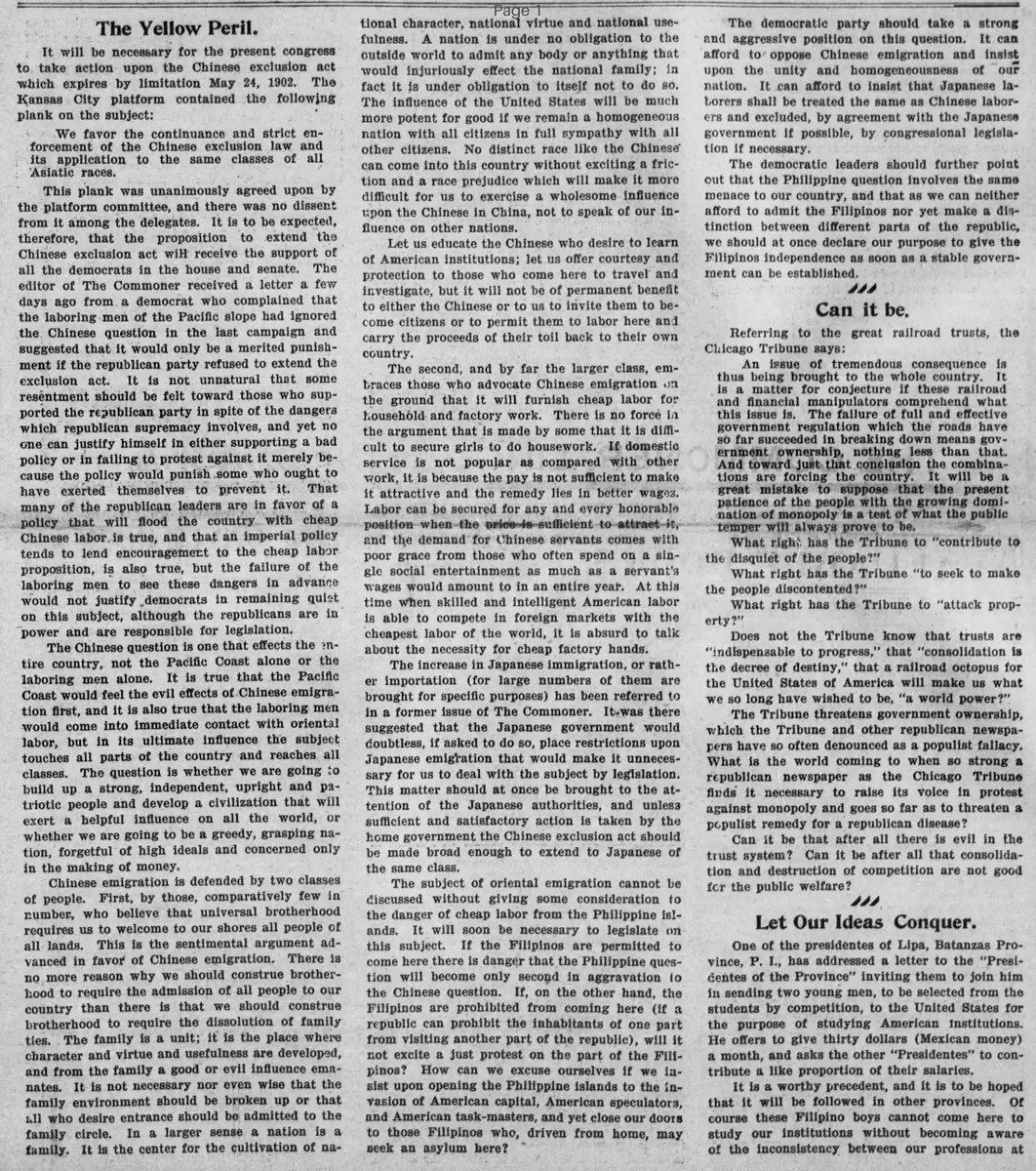
The Yellow Peril.
It will be necessary for the present congress to take action upon the Chinese exclusion act which expires by limitation May 24, 1902. The Kansas City platform contained the following plank on the subject:
We favor the continuance and strict enforcement of the Chinese exclusion law and its application to the same classes of all Asiatic races.
This plank was unanimously agreed upon by the platform committee, and there was no dissent from it among the delegates. It is to be expected, therefore, that the proposition to extend the Chinese exclusion act will receive the support of all the democrats in the house and senate. The editor of The Commoner received a letter a few days ago from a democrat who complained that the laboring men of the Pacific slope had ignored the Chinese question in the last campaign and suggested that it would only be a merited punishment if the republican party refused to extend the exclusion act. It is not unnatural that some resentment should be felt toward those who supported the republican party in spite of the dangers which republican supremacy involves, and yet no one can justify himself in either supporting a bad policy or in failing to protest against it merely because the policy would punish some who ought to have exerted themselves to prevent it. That many of the republican leaders are in favor of a policy that will flood the country with cheap Chinese labor is true, and that an imperial policy tends to lend encouragement to the cheap labor proposition, is also true, but the failure of the laboring men to see these dangers in advance would not justify democrats in remaining quiet on this subject, although the republicans are in power and are responsible for legislation.
The Chinese question is one that affects the entire country, not the Pacific Coast alone or the laboring men alone. It is true that the Pacific Coast would feel the evil effects of Chinese emigration first, and it is also true that the laboring men would come into immediate contact with oriental labor, but in its ultimate influence the subject touches all parts of the country and reaches all classes. The question is whether we are going to build up a strong, independent, upright and patriotic people and develop a civilization that will exert a helpful influence on all the world, or whether we are going to be a greedy, grasping nation, forgetful of high ideals and concerned only in the making of money.
Chinese emigration is defended by two classes of people. First, by those, comparatively few in number, who believe that universal brotherhood requires us to welcome to our shores all people of all lands. This is the sentimental argument advanced in favor of Chinese emigration. There is no more reason why we should construe brotherhood to require the admission of all people to our country than there is that we should construe brotherhood to require the dissolution of family ties. The family is a unit; it is the place where character and virtue and usefulness are developed, and from the family a good or evil influence emanates. It is not necessary nor even wise that the family environment should be broken up or that all who desire entrance should be admitted to the family circle. In a larger sense a nation is a family. It is the center for the cultivation of national character, national virtue and national usefulness. A nation is under no obligation to the outside world to admit anybody or anything that would injuriously affect the national family; in fact it is under obligation to itself not to do so.
The influence of the United States will be much more potent for good if we remain a homogeneous nation with all citizens in full sympathy with all other citizens. No distinct race like the Chinese can come into this country without exciting a friction and a race prejudice which will make it more difficult for us to exercise a wholesome influence upon the Chinese in China, not to speak of our influence on other nations.
Let us educate the Chinese who desire to learn of American institutions; let us offer courtesy and protection to those who come here to travel and investigate, but it will not be of permanent benefit to either the Chinese or to us to invite them to become citizens or to permit them to labor here and carry the proceeds of their toil back to their own country.
The second, and by far the larger class, embraces those who advocate Chinese emigration on the ground that it will furnish cheap labor for household and factory work. There is no force in the argument that is made by some that it is difficult to secure girls to do housework. If domestic service is not popular as compared with other work, it is because the pay is not sufficient to make it attractive and the remedy lies in better wages. Labor can be secured for any and every honorable position when the price is sufficient to attract it, and the demand for Chinese servants comes with poor grace from those who often spend on a single social entertainment as much as a servant's wages would amount to in an entire year. At this time when skilled and intelligent American labor is able to compete in foreign markets with the cheapest labor of the world, it is absurd to talk about the necessity for cheap factory hands.
The increase in Japanese immigration, or rather importation (for large numbers of them are brought for specific purposes) has been referred to in a former issue of The Commoner. It was there suggested that the Japanese government would doubtless, if asked to do so, place restrictions upon Japanese emigration that would make it unnecessary for us to deal with the subject by legislation. This matter should at once be brought to the attention of the Japanese authorities, and unless sufficient and satisfactory action is taken by the home government the Chinese exclusion act should be made broad enough to extend to Japanese of the same class.
The subject of oriental emigration cannot be discussed without giving some consideration to the danger of cheap labor from the Philippine islands. It will soon be necessary to legislate on this subject. If the Filipinos are permitted to come here there is danger that the Philippine question will become only second in aggravation to the Chinese question. If, on the other hand, the Filipinos are prohibited from coming here (if a republic can prohibit the inhabitants of one part from visiting another part of the republic), will it not excite a just protest on the part of the Filipinos? How can we excuse ourselves if we insist upon opening the Philippine islands to the invasion of American capital, American speculators, and American task-masters, and yet close our doors to those Filipinos who, driven from home, may seek an asylum here?
The democratic party should take a strong and aggressive position on this question. It can afford to oppose Chinese emigration and insist upon the unity and homogeneousness of our nation. It can afford to insist that Japanese laborers shall be treated the same as Chinese laborers and excluded, by agreement with the Japanese government if possible, by congressional legislation if necessary.
The democratic leaders should further point out that the Philippine question involves the same menace to our country, and that as we can neither afford to admit the Filipinos nor yet make a distinction between different parts of the republic, we should at once declare our purpose to give the Filipinos independence as soon as a stable government can be established.
It will be necessary for the present congress to take action upon the Chinese exclusion act which expires by limitation May 24, 1902. The Kansas City platform contained the following plank on the subject:
We favor the continuance and strict enforcement of the Chinese exclusion law and its application to the same classes of all Asiatic races.
This plank was unanimously agreed upon by the platform committee, and there was no dissent from it among the delegates. It is to be expected, therefore, that the proposition to extend the Chinese exclusion act will receive the support of all the democrats in the house and senate. The editor of The Commoner received a letter a few days ago from a democrat who complained that the laboring men of the Pacific slope had ignored the Chinese question in the last campaign and suggested that it would only be a merited punishment if the republican party refused to extend the exclusion act. It is not unnatural that some resentment should be felt toward those who supported the republican party in spite of the dangers which republican supremacy involves, and yet no one can justify himself in either supporting a bad policy or in failing to protest against it merely because the policy would punish some who ought to have exerted themselves to prevent it. That many of the republican leaders are in favor of a policy that will flood the country with cheap Chinese labor is true, and that an imperial policy tends to lend encouragement to the cheap labor proposition, is also true, but the failure of the laboring men to see these dangers in advance would not justify democrats in remaining quiet on this subject, although the republicans are in power and are responsible for legislation.
The Chinese question is one that affects the entire country, not the Pacific Coast alone or the laboring men alone. It is true that the Pacific Coast would feel the evil effects of Chinese emigration first, and it is also true that the laboring men would come into immediate contact with oriental labor, but in its ultimate influence the subject touches all parts of the country and reaches all classes. The question is whether we are going to build up a strong, independent, upright and patriotic people and develop a civilization that will exert a helpful influence on all the world, or whether we are going to be a greedy, grasping nation, forgetful of high ideals and concerned only in the making of money.
Chinese emigration is defended by two classes of people. First, by those, comparatively few in number, who believe that universal brotherhood requires us to welcome to our shores all people of all lands. This is the sentimental argument advanced in favor of Chinese emigration. There is no more reason why we should construe brotherhood to require the admission of all people to our country than there is that we should construe brotherhood to require the dissolution of family ties. The family is a unit; it is the place where character and virtue and usefulness are developed, and from the family a good or evil influence emanates. It is not necessary nor even wise that the family environment should be broken up or that all who desire entrance should be admitted to the family circle. In a larger sense a nation is a family. It is the center for the cultivation of national character, national virtue and national usefulness. A nation is under no obligation to the outside world to admit anybody or anything that would injuriously affect the national family; in fact it is under obligation to itself not to do so.
The influence of the United States will be much more potent for good if we remain a homogeneous nation with all citizens in full sympathy with all other citizens. No distinct race like the Chinese can come into this country without exciting a friction and a race prejudice which will make it more difficult for us to exercise a wholesome influence upon the Chinese in China, not to speak of our influence on other nations.
Let us educate the Chinese who desire to learn of American institutions; let us offer courtesy and protection to those who come here to travel and investigate, but it will not be of permanent benefit to either the Chinese or to us to invite them to become citizens or to permit them to labor here and carry the proceeds of their toil back to their own country.
The second, and by far the larger class, embraces those who advocate Chinese emigration on the ground that it will furnish cheap labor for household and factory work. There is no force in the argument that is made by some that it is difficult to secure girls to do housework. If domestic service is not popular as compared with other work, it is because the pay is not sufficient to make it attractive and the remedy lies in better wages. Labor can be secured for any and every honorable position when the price is sufficient to attract it, and the demand for Chinese servants comes with poor grace from those who often spend on a single social entertainment as much as a servant's wages would amount to in an entire year. At this time when skilled and intelligent American labor is able to compete in foreign markets with the cheapest labor of the world, it is absurd to talk about the necessity for cheap factory hands.
The increase in Japanese immigration, or rather importation (for large numbers of them are brought for specific purposes) has been referred to in a former issue of The Commoner. It was there suggested that the Japanese government would doubtless, if asked to do so, place restrictions upon Japanese emigration that would make it unnecessary for us to deal with the subject by legislation. This matter should at once be brought to the attention of the Japanese authorities, and unless sufficient and satisfactory action is taken by the home government the Chinese exclusion act should be made broad enough to extend to Japanese of the same class.
The subject of oriental emigration cannot be discussed without giving some consideration to the danger of cheap labor from the Philippine islands. It will soon be necessary to legislate on this subject. If the Filipinos are permitted to come here there is danger that the Philippine question will become only second in aggravation to the Chinese question. If, on the other hand, the Filipinos are prohibited from coming here (if a republic can prohibit the inhabitants of one part from visiting another part of the republic), will it not excite a just protest on the part of the Filipinos? How can we excuse ourselves if we insist upon opening the Philippine islands to the invasion of American capital, American speculators, and American task-masters, and yet close our doors to those Filipinos who, driven from home, may seek an asylum here?
The democratic party should take a strong and aggressive position on this question. It can afford to oppose Chinese emigration and insist upon the unity and homogeneousness of our nation. It can afford to insist that Japanese laborers shall be treated the same as Chinese laborers and excluded, by agreement with the Japanese government if possible, by congressional legislation if necessary.
The democratic leaders should further point out that the Philippine question involves the same menace to our country, and that as we can neither afford to admit the Filipinos nor yet make a distinction between different parts of the republic, we should at once declare our purpose to give the Filipinos independence as soon as a stable government can be established.
What sub-type of article is it?
Immigration
Economic Policy
Imperialism
What keywords are associated?
Chinese Exclusion
Asian Immigration
Cheap Labor
National Homogeneity
Japanese Restrictions
Philippine Independence
Democratic Position
What entities or persons were involved?
Democratic Party
Republican Party
Congress
Japanese Government
Filipinos
Pacific Coast Laboring Men
Editorial Details
Primary Topic
Extension Of Chinese Exclusion Act And Opposition To Asian Immigration
Stance / Tone
Strongly Supportive Of Excluding Chinese, Japanese, And Filipino Laborers To Maintain National Homogeneity
Key Figures
Democratic Party
Republican Party
Congress
Japanese Government
Filipinos
Pacific Coast Laboring Men
Key Arguments
Favor Continuance And Strict Enforcement Of Chinese Exclusion Law To All Asiatic Races
Democrats Should Support Extension Despite Some Laboring Men's Support For Republicans
Chinese Immigration Affects Entire Country, Not Just Pacific Coast Or Laborers
Oppose Sentimental Argument For Universal Brotherhood Admitting All Immigrants
Nation As Family Should Not Admit Those Injuring National Character
Exclude Chinese To Better Influence China And Maintain Homogeneity
Oppose Cheap Labor Argument; Better Wages Attract American Workers
Restrict Japanese Immigration Via Agreement Or Legislation
Address Philippine Immigration To Avoid Similar Issues
Grant Filipinos Independence To Resolve Inconsistencies In Republic Policy