Thank you for visiting SNEWPapers!
Sign up free
Editorial
June 24, 1808
Alexandria Daily Advertiser
Alexandria, Virginia
What is this article about?
Editorial criticizes federal government, formed to protect commerce, for policies locking vessels in port, rotting produce, and driving commerce-dependent workers abroad, calling for swift dismissal of rulers to remedy economic harm.
Clipping
OCR Quality
98%
Excellent
Full Text
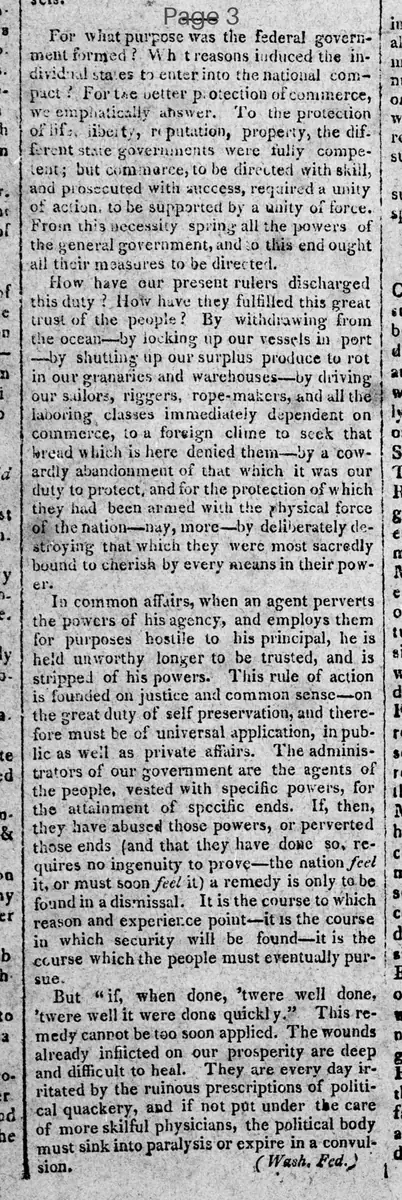
For what purpose was the federal government formed? What reasons induced the individual states to enter into the national compact? For the better protection of commerce, we emphatically answer. To the protection of life, liberty, reputation, property, the different state governments were fully competent; but commerce, to be directed with skill, and prosecuted with success, required a unity of action, to be supported by a unity of force.
From this necessity spring all the powers of the general government, and to this end ought all their measures to be directed.
How have our present rulers discharged this duty? How have they fulfilled this great trust of the people? By withdrawing from the ocean—by locking up our vessels in port—by shutting up our surplus produce to rot in our granaries and warehouses—by driving our sailors, riggers, rope-makers, and all the laboring classes immediately dependent on commerce, to a foreign clime to seek that bread which is here denied them—by a cowardly abandonment of that which it was our duty to protect, and for the protection of which they had been armed with the physical force of the nation—nay, more—by deliberately destroying that which they were most sacredly bound to cherish by every means in their power.
In common affairs, when an agent perverts the powers of his agency, and employs them for purposes hostile to his principal, he is held unworthy longer to be trusted, and is stripped of his powers. This rule of action is founded on justice and common sense—on the great duty of self preservation, and therefore must be of universal application, in public as well as private affairs. The administrators of our government are the agents of the people, vested with specific powers, for the attainment of specific ends. If, then, they have abused those powers, or perverted those ends (and that they have done so, requires no ingenuity to prove—the nation feels it, or must soon feel it) a remedy is only to be found in a dismissal. It is the course to which reason and experience point—it is the course in which security will be found—it is the course which the people must eventually pursue.
But "if, when done, 'twere well it were done quickly." This remedy cannot be too soon applied. The wounds already inflicted on our prosperity are deep and difficult to heal. They are every day irritated by the ruinous prescriptions of political quackery, and if not put under the care of more skilful physicians, the political body must sink into paralysis or expire in a convulsion.
(Wash. Fed.)
From this necessity spring all the powers of the general government, and to this end ought all their measures to be directed.
How have our present rulers discharged this duty? How have they fulfilled this great trust of the people? By withdrawing from the ocean—by locking up our vessels in port—by shutting up our surplus produce to rot in our granaries and warehouses—by driving our sailors, riggers, rope-makers, and all the laboring classes immediately dependent on commerce, to a foreign clime to seek that bread which is here denied them—by a cowardly abandonment of that which it was our duty to protect, and for the protection of which they had been armed with the physical force of the nation—nay, more—by deliberately destroying that which they were most sacredly bound to cherish by every means in their power.
In common affairs, when an agent perverts the powers of his agency, and employs them for purposes hostile to his principal, he is held unworthy longer to be trusted, and is stripped of his powers. This rule of action is founded on justice and common sense—on the great duty of self preservation, and therefore must be of universal application, in public as well as private affairs. The administrators of our government are the agents of the people, vested with specific powers, for the attainment of specific ends. If, then, they have abused those powers, or perverted those ends (and that they have done so, requires no ingenuity to prove—the nation feels it, or must soon feel it) a remedy is only to be found in a dismissal. It is the course to which reason and experience point—it is the course in which security will be found—it is the course which the people must eventually pursue.
But "if, when done, 'twere well it were done quickly." This remedy cannot be too soon applied. The wounds already inflicted on our prosperity are deep and difficult to heal. They are every day irritated by the ruinous prescriptions of political quackery, and if not put under the care of more skilful physicians, the political body must sink into paralysis or expire in a convulsion.
(Wash. Fed.)
What sub-type of article is it?
Trade Or Commerce
Economic Policy
Partisan Politics
What keywords are associated?
Commerce Protection
Federal Duty
Trade Abandonment
Economic Ruin
Political Dismissal
Surplus Produce
Sailors Abroad
National Compact
What entities or persons were involved?
Federal Government
Present Rulers
Administrators Of Our Government
Editorial Details
Primary Topic
Failure Of Federal Government To Protect Commerce
Stance / Tone
Strongly Critical Of Current Rulers
Key Figures
Federal Government
Present Rulers
Administrators Of Our Government
Key Arguments
Federal Government Formed For Better Protection Of Commerce
State Governments Competent For Life, Liberty, Reputation, Property
Commerce Requires Unity Of Action And Force
Rulers Have Withdrawn From Ocean, Locked Vessels In Port, Shut Surplus Produce
Driven Sailors And Laboring Classes Dependent On Commerce Abroad
Abandonment And Destruction Of Commerce Contrary To Duty
Agents Perverting Powers Should Be Dismissed
Remedy In Dismissal Of Administrators
Apply Remedy Quickly To Heal Wounds On Prosperity