Thank you for visiting SNEWPapers!
Sign up free
Editorial
August 31, 1839
The Connecticut Observer, And New York Congregationalist
Hartford, Hartford County, Connecticut
What is this article about?
Editorial from Connecticut affirming the core Protestant principle that the Bible alone constitutes the religion of Protestants, distinguishing between authoritative matters of faith from the Scriptures and non-binding opinions, to ensure church harmony and avoid schism.
Clipping
OCR Quality
98%
Excellent
Full Text
CONNECTICUT
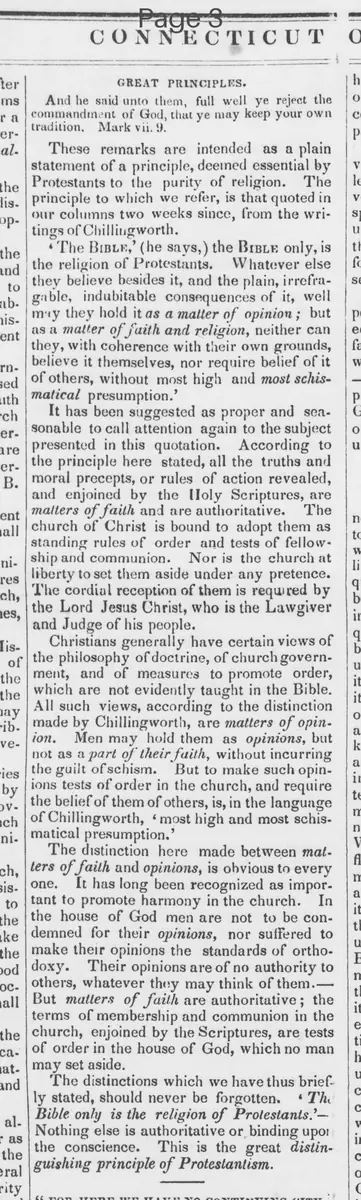
GREAT PRINCIPLES.
And he said unto them, full well ye reject the commandment of God, that ye may keep your own tradition, Mark vii. 9.
These remarks are intended as a plain statement of a principle, deemed essential by Protestants to the purity of religion. The principle to which we refer, is that quoted in our columns two weeks since, from the writings of Chillingworth.
The Bible, (he says,) the Bible only, is the religion of Protestants. Whatever else they believe besides it, and the plain, irrefutable, indubitable consequences of it, well may they hold it as a matter of opinion; but as a matter of faith and religion, neither can they, with coherence with their own grounds, believe it themselves, nor require belief of it of others, without most high and most schismatical presumption.
It has been suggested as proper and seasonable to call attention again to the subject presented in this quotation. According to the principle here stated, all the truths and moral precepts, or rules of action revealed, and enjoined by the Holy Scriptures, are matters of faith and are authoritative. The church of Christ is bound to adopt them as standing rules of order and tests of fellowship and communion. Nor is the church at liberty to set them aside under any pretence. The cordial reception of them is required by the Lord Jesus Christ, who is the Lawgiver and Judge of his people.
Christians generally have certain views of the philosophy of doctrine, of church government, and of measures to promote order, which are not evidently taught in the Bible. All such views, according to the distinction made by Chillingworth, are matters of opinion. Men may hold them as opinions, but not as a part of their faith, without incurring the guilt of schism. But to make such opinions tests of order in the church, and require the belief of them of others, is, in the language of Chillingworth, 'most high and most schismatical presumption.'
The distinction here made between matters of faith and opinions, is obvious to every one. It has long been recognized as important to promote harmony in the church. In the house of God men are not to be condemned for their opinions, nor suffered to make their opinions the standards of orthodoxy. Their opinions are of no authority to others, whatever they may think of them. But matters of faith are authoritative; the terms of membership and communion in the church, enjoined by the Scriptures, are tests of order in the house of God, which no man may set aside.
The distinctions which we have thus briefly stated, should never be forgotten. The Bible only is the religion of Protestants.' Nothing else is authoritative or binding upon the conscience. This is the great distinguishing principle of Protestantism.
GREAT PRINCIPLES.
And he said unto them, full well ye reject the commandment of God, that ye may keep your own tradition, Mark vii. 9.
These remarks are intended as a plain statement of a principle, deemed essential by Protestants to the purity of religion. The principle to which we refer, is that quoted in our columns two weeks since, from the writings of Chillingworth.
The Bible, (he says,) the Bible only, is the religion of Protestants. Whatever else they believe besides it, and the plain, irrefutable, indubitable consequences of it, well may they hold it as a matter of opinion; but as a matter of faith and religion, neither can they, with coherence with their own grounds, believe it themselves, nor require belief of it of others, without most high and most schismatical presumption.
It has been suggested as proper and seasonable to call attention again to the subject presented in this quotation. According to the principle here stated, all the truths and moral precepts, or rules of action revealed, and enjoined by the Holy Scriptures, are matters of faith and are authoritative. The church of Christ is bound to adopt them as standing rules of order and tests of fellowship and communion. Nor is the church at liberty to set them aside under any pretence. The cordial reception of them is required by the Lord Jesus Christ, who is the Lawgiver and Judge of his people.
Christians generally have certain views of the philosophy of doctrine, of church government, and of measures to promote order, which are not evidently taught in the Bible. All such views, according to the distinction made by Chillingworth, are matters of opinion. Men may hold them as opinions, but not as a part of their faith, without incurring the guilt of schism. But to make such opinions tests of order in the church, and require the belief of them of others, is, in the language of Chillingworth, 'most high and most schismatical presumption.'
The distinction here made between matters of faith and opinions, is obvious to every one. It has long been recognized as important to promote harmony in the church. In the house of God men are not to be condemned for their opinions, nor suffered to make their opinions the standards of orthodoxy. Their opinions are of no authority to others, whatever they may think of them. But matters of faith are authoritative; the terms of membership and communion in the church, enjoined by the Scriptures, are tests of order in the house of God, which no man may set aside.
The distinctions which we have thus briefly stated, should never be forgotten. The Bible only is the religion of Protestants.' Nothing else is authoritative or binding upon the conscience. This is the great distinguishing principle of Protestantism.
What sub-type of article is it?
Moral Or Religious
What keywords are associated?
Protestantism
Bible Authority
Faith Vs Opinion
Church Harmony
Schism
Sola Scriptura
What entities or persons were involved?
Chillingworth
Protestants
Church Of Christ
Lord Jesus Christ
Editorial Details
Primary Topic
Protestant Principle Of Bible As Sole Authority For Faith
Stance / Tone
Affirmation Of Sola Scriptura And Church Harmony
Key Figures
Chillingworth
Protestants
Church Of Christ
Lord Jesus Christ
Key Arguments
The Bible Only Is The Religion Of Protestants
Scriptural Truths Are Matters Of Faith And Authoritative
Non Scriptural Views Are Opinions, Not Binding On Faith
Imposing Opinions As Tests Of Orthodoxy Leads To Schism
Distinction Promotes Harmony In The Church