Thank you for visiting SNEWPapers!
Sign up free
Literary
January 2, 1827
Phenix Gazette
Alexandria, Virginia
What is this article about?
Two inseparable friends, Martino and Lelio, both secretly in love. Martino betrays Lelio by trying to seduce his fiancée Lauretta, who remains faithful. Lelio revenges by exposing Martino's affair, forcing him to marry his virtuous mistress Rosina. Both couples achieve conjugal happiness, highlighting moral virtue in friendship and love.
Clipping
OCR Quality
98%
Excellent
Full Text
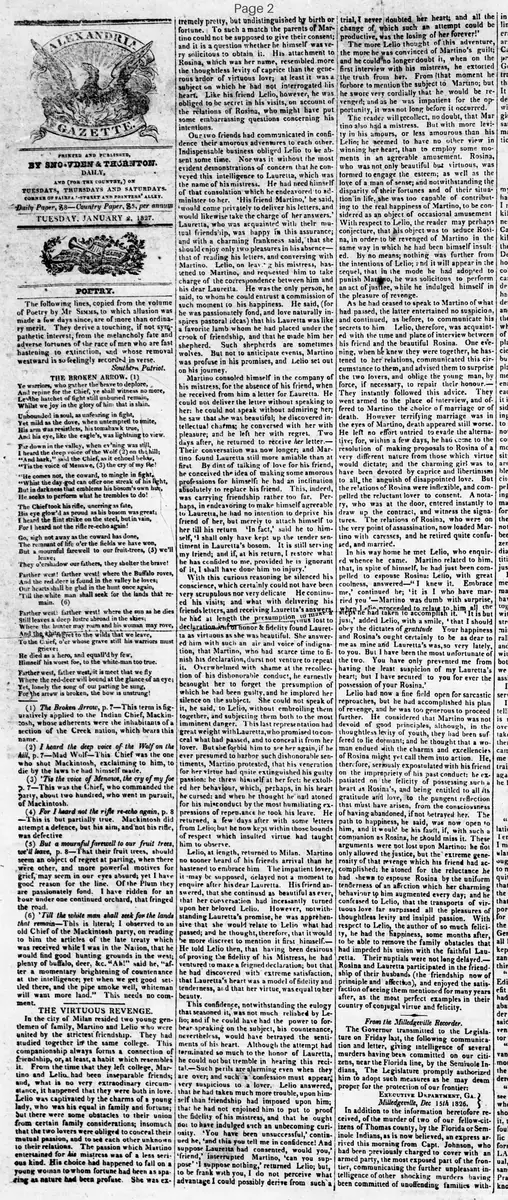
THE VIRTUOUS REVENGE.
In the city of Milan resided two young gentlemen of family, Martino and Lelio who were united by the strictest friendship. They had studied together in the same college. This companionship always forms a connection of friendship, or, at least, a habit which resembles it. From the time that they left college, Martino and Lelio had been inseparable friends; and, what is no very extraordinary circumstance, it happened that they were both in love.
Lelio was captivated by the charms of a young lady, who was his equal in family and fortune; but there were some obstacles to their union from certain family considerations; insomuch that the two lovers were obliged to conceal their mutual passion, and to see each other unknown to their relations. The passion which Martino entertained for his mistress was of a less serious kind. His choice had happened to fall on a young woman to whom fortune had been as sparing as nature had been profuse. She was extremely pretty, but undistinguished by birth or fortune. To such a match the parents of Martino could not be supposed to give their consent; and it is a question whether he himself was very solicitous to obtain it. His attachment to Rosina, which was her name, resembled more the thoughtless levity of caprice than the generous ardor of virtuous love; at least it was a subject on which he had not interrogated his heart. Like his friend Lelio, however, he was obliged to be secret in his visits, on account of the relations of Rosina, who might have put some embarrassing questions concerning his intentions.
Our two friends had communicated in confidence their amorous adventures to each other. Indispensable business obliged Lelio to be absent some time. Nor was it without the most evident demonstrations of concern that he conveyed this intelligence to Lauretta, which was the name of his mistress. He had need himself of that consolation which he endeavored to administer to her. 'His friend Martino,' he said, 'would come privately to deliver his letters, and would likewise take the charge of her answers.' Lauretta, who was acquainted with their mutual friendship, was happy in this assurance; and with a charming frankness said, that she should enjoy only two pleasures in his absence—that of reading his letters, and conversing with Martino. Lelio, on leaving his mistress, hastened to Martino, and requested him to take charge of the correspondence between him and his dear Lauretta. He was the only person, he said, to whom he could entrust a commission of such moment to his happiness. He said, (for he was passionately fond, and love naturally inspires pastoral ideas) that his Lauretta was like a favorite lamb whom he had placed under the crook of friendship, and that he made him her shepherd. Such shepherds are sometimes wolves. But not to anticipate events, Martino was profuse in his promises, and Lelio set out on his journey.
Martino consoled himself in the company of his mistress, for the absence of his friend, when he received from him a letter for Lauretta. He could not deliver the letter without speaking to her: he could not speak without admiring her; he saw that she was beautiful; he discovered intellectual charms; he conversed with her with pleasure; and he left her with regret. Two days after, he returned to receive her letter. Their conversation was now longer; and Martino found Lauretta still more amiable than at first. By dint of talking of love for his friend, he conceived the idea of making some amorous professions for himself: he had an inclination absolutely to replace his friend. This, indeed, was carrying friendship rather too far. Perhaps, in endeavoring to make himself agreeable to Lauretta, he had no intention to deprive his friend of her, but merely to attach himself to her till his return. 'In fact,' said he to himself, 'I shall only have kept up the tender sentiment in Lauretta's bosom. It is still serving my friend; and if, at his return, I restore what he has confided to me, provided he is ignorant of it, I shall have done him no injury.'
With this curious reasoning he silenced his conscience, which certainly could not have been very scrupulous nor very delicate. He continued his visits; and what with delivering his friend's letters, and receiving Lauretta's answers, he had at length the presumption to make a declaration. For honor & fidelity found Lauretta as virtuous as she was beautiful. She answered him with such an air and voice of indignation, that Martino, who had scarce time to finish his declaration, durst not venture to repeat it. Overwhelmed with shame at the recollection of his dishonorable conduct, he earnestly besought her to forget the presumption of which he had been guilty, and he implored her silence on the subject. She could not speak of it, he said, to Lelio, without embroiling them together, and subjecting them both to the most imminent danger. This last representation had great weight with Lauretta, who promised to conceal what had passed, and to conceal it from her lover. But she forbid him to see her again, if he ever presumed to harbor such dishonorable sentiments. Martino protested, that his veneration for her virtue had quite extinguished his guilty passion: he threw himself at her feet: he extolled her behaviour, which, perhaps, in his heart he cursed: and when he thought he had atoned for his misconduct by the most humiliating expressions of repentance he took his leave. He returned, a few days after with some letters from Lelio; but he now kept within those bounds of respect which insulted virtue had taught him to observe.
Lelio, at length, returned to Milan. Martino no sooner heard of his friend's arrival than he hastened to embrace him. The impatient lover, it may be supposed, delayed not a moment to enquire after his dear Lauretta. His friend answered, that she continued as beautiful as ever, that her conversation had incessantly turned upon her beloved Lelio. However, notwithstanding Lauretta's promise, he was apprehensive that she would relate to Lelio what had passed; and he thought, therefore, that it would be more discreet to mention it first himself. He told Lelio then, that having been desirous of proving the fidelity of his Mistress, he had ventured to make a feigned declaration; but that he had discovered with extreme satisfaction, that Lauretta's heart was a model of fidelity and tenderness, and that her virtue, was equal to her beauty.
This confidence, notwithstanding the eulogy that seasoned it, was not much relished by Lelio; and if he could have had the power to forbear speaking on the subject, his countenance, nevertheless, would have betrayed the sentiments of his heart. Although the attempt had terminated so much to the honor of Lauretta, he could not but tremble in hearing this recital. Such perils are alarming even when they are over; and such a confession must appear very suspicious to a lover. Lelio answered, that he had taken much more trouble upon himself than friendship had imposed upon him; that he had not enjoined him to put to proof the fidelity of his mistress, and that he ought not to have indulged such an unbecoming curiosity. 'You have been unsuccessful,' continued he, 'and this you tell me in confidence! And suppose Lauretta had consented, would you,' 'friend,' interrupted Martino, 'can you suppose' 'I suppose nothing,' returned Lelio; but, to be frank with you, I do not perceive what advantage I could possibly derive from such a trial. I never doubted her heart; and all the change of which such an attempt could be productive, was the losing of her forever!'
The more Lelio thought of this adventure, the more he was convinced of Martino's guilt; and he could no longer doubt it, when on the first interview with his mistress, he extorted the truth from her. From that moment he forbore to mention the subject to Martino; but he swore very cordially that he would be revenged; and as he was impatient for the opportunity, it was not long before it occurred.
The reader will recollect, no doubt, that Martino also had a mistress. But with more levity in his amours, or less amorous than his Lelio; he seemed to have no other view in winning her heart, than to employ some moments in an agreeable amusement. Rosina, who was not only beautiful but virtuous, was formed to engage the esteem; as well as the love of a man of sense; and notwithstanding the disparity of their fortunes and of their situation in life, she was too capable of contributing to the real happiness of Martino, to be considered as an object of occasional amusement. With respect to Lelio, the reader may perhaps conjecture, that his object was to seduce Rosina, in order to be revenged of Martino in the same way in which he had been himself insulted. By no means; nothing was further from the intentions of Lelio; and it will appear in the sequel, that in the mode he had adopted to punish Martino, he was solicitous to perform an act of justice, while he indulged himself in the pleasure of revenge.
As he had ceased to speak to Martino of what had passed, the latter entertained no suspicion, and continued, as before, to communicate his secrets to him. Lelio, therefore, was acquainted with the time and place of interview between his friend and the beautiful Rosina. One evening, when he knew they were together, he hastened to her relations, communicated this circumstance to them, and advised them to surprise the two lovers, and oblige the young man, by force, if necessary, to repair their honour. They instantly followed this advice. They went armed to the place of interview, and offered to Martino the choice of marriage or of death. However terrifying marriage was in the eyes of Martino, death appeared still worse. He left no effort untried to evade the alternative; for, within a few days, he had came to the resolution of making proposals to Rosina of a very different nature from those which virtue would dictate; and the charming girl was to have been devoted by caprice and libertinism to all the anguish of disappointed love. But the relations of Rosina were inflexible, and compelled the reluctant lover to consent. A notary, who was at the door, entered instantly to draw up the contract, and witness the signatures. The relations of Rosina, who were on the very point of assassination, now loaded Martino with caresses, and he retired quite confused, and married.
In his way home he met Lelio, who enquired whence he came. Martino related to him, that, in spite of himself, he had just been compelled to espouse Rosina: Lelio, with great coolness, answered—'I knew it. Embrace me,' continued he; 'it is I who have married you.' Martino was dumb with surprise. 'Just,' added Lelio, with a smile, 'that I should obey the dictates of gratitude. Your happiness and Rosina's ought certainly to be as dear to me as mine and Lauretta's was, so very lately, to you. But I have been the most unfortunate of the two. You have only prevented me from having the least suspicion of my Lauretta's heart; but I have secured to you for ever the possession of your Rosina.'
Lelio had now a fine field open for sarcastic reproaches, but he had accomplished his plan of revenge, and he was too generous to proceed further. He considered that Martino was not devoid of good principles, although, in the thoughtless levity of youth, they had been suffered to lie dormant; and he thought that a woman endued with the charms and excellencies of Rosina might yet call them into action. He, therefore, seriously expostulated with his friend on the impropriety of his past conduct: he expatiated on the felicity of possessing such a heart as Rosina's, and being entitled to all its gratitude and love, to the pungent reflection that must have arisen, from the consciousness of having abandoned, if not betrayed her. The path to happiness, he said, was now open to him, and it would be his fault, if, with such a companion as Rosina, he should miss it. These arguments were not lost upon Martino: he not only allowed the justice, but the extreme generosity of that revenge which his friend had accomplished: he atoned for the reluctance he had shewn to espouse Rosina by the uniform tenderness of an affection which her charming behaviour to him augmented every day; and he confessed to Lelio, that the transports of virtuous love far surpassed all the pleasures of thoughtless levity and insipid passion. With respect to Lelio, the author of so much felicity, he had the happiness, some months after, to be able to remove the family obstacles that had impeded his union with the faithful Lauretta. Their nuptials were not long delayed. Rosina and Lauretta participated in the friendship of their husbands (the friendship now of principle and affection), and enjoyed the satisfaction of seeing them mentioned for many years after, as the most perfect examples in their country of conjugal virtue and felicity.
In the city of Milan resided two young gentlemen of family, Martino and Lelio who were united by the strictest friendship. They had studied together in the same college. This companionship always forms a connection of friendship, or, at least, a habit which resembles it. From the time that they left college, Martino and Lelio had been inseparable friends; and, what is no very extraordinary circumstance, it happened that they were both in love.
Lelio was captivated by the charms of a young lady, who was his equal in family and fortune; but there were some obstacles to their union from certain family considerations; insomuch that the two lovers were obliged to conceal their mutual passion, and to see each other unknown to their relations. The passion which Martino entertained for his mistress was of a less serious kind. His choice had happened to fall on a young woman to whom fortune had been as sparing as nature had been profuse. She was extremely pretty, but undistinguished by birth or fortune. To such a match the parents of Martino could not be supposed to give their consent; and it is a question whether he himself was very solicitous to obtain it. His attachment to Rosina, which was her name, resembled more the thoughtless levity of caprice than the generous ardor of virtuous love; at least it was a subject on which he had not interrogated his heart. Like his friend Lelio, however, he was obliged to be secret in his visits, on account of the relations of Rosina, who might have put some embarrassing questions concerning his intentions.
Our two friends had communicated in confidence their amorous adventures to each other. Indispensable business obliged Lelio to be absent some time. Nor was it without the most evident demonstrations of concern that he conveyed this intelligence to Lauretta, which was the name of his mistress. He had need himself of that consolation which he endeavored to administer to her. 'His friend Martino,' he said, 'would come privately to deliver his letters, and would likewise take the charge of her answers.' Lauretta, who was acquainted with their mutual friendship, was happy in this assurance; and with a charming frankness said, that she should enjoy only two pleasures in his absence—that of reading his letters, and conversing with Martino. Lelio, on leaving his mistress, hastened to Martino, and requested him to take charge of the correspondence between him and his dear Lauretta. He was the only person, he said, to whom he could entrust a commission of such moment to his happiness. He said, (for he was passionately fond, and love naturally inspires pastoral ideas) that his Lauretta was like a favorite lamb whom he had placed under the crook of friendship, and that he made him her shepherd. Such shepherds are sometimes wolves. But not to anticipate events, Martino was profuse in his promises, and Lelio set out on his journey.
Martino consoled himself in the company of his mistress, for the absence of his friend, when he received from him a letter for Lauretta. He could not deliver the letter without speaking to her: he could not speak without admiring her; he saw that she was beautiful; he discovered intellectual charms; he conversed with her with pleasure; and he left her with regret. Two days after, he returned to receive her letter. Their conversation was now longer; and Martino found Lauretta still more amiable than at first. By dint of talking of love for his friend, he conceived the idea of making some amorous professions for himself: he had an inclination absolutely to replace his friend. This, indeed, was carrying friendship rather too far. Perhaps, in endeavoring to make himself agreeable to Lauretta, he had no intention to deprive his friend of her, but merely to attach himself to her till his return. 'In fact,' said he to himself, 'I shall only have kept up the tender sentiment in Lauretta's bosom. It is still serving my friend; and if, at his return, I restore what he has confided to me, provided he is ignorant of it, I shall have done him no injury.'
With this curious reasoning he silenced his conscience, which certainly could not have been very scrupulous nor very delicate. He continued his visits; and what with delivering his friend's letters, and receiving Lauretta's answers, he had at length the presumption to make a declaration. For honor & fidelity found Lauretta as virtuous as she was beautiful. She answered him with such an air and voice of indignation, that Martino, who had scarce time to finish his declaration, durst not venture to repeat it. Overwhelmed with shame at the recollection of his dishonorable conduct, he earnestly besought her to forget the presumption of which he had been guilty, and he implored her silence on the subject. She could not speak of it, he said, to Lelio, without embroiling them together, and subjecting them both to the most imminent danger. This last representation had great weight with Lauretta, who promised to conceal what had passed, and to conceal it from her lover. But she forbid him to see her again, if he ever presumed to harbor such dishonorable sentiments. Martino protested, that his veneration for her virtue had quite extinguished his guilty passion: he threw himself at her feet: he extolled her behaviour, which, perhaps, in his heart he cursed: and when he thought he had atoned for his misconduct by the most humiliating expressions of repentance he took his leave. He returned, a few days after with some letters from Lelio; but he now kept within those bounds of respect which insulted virtue had taught him to observe.
Lelio, at length, returned to Milan. Martino no sooner heard of his friend's arrival than he hastened to embrace him. The impatient lover, it may be supposed, delayed not a moment to enquire after his dear Lauretta. His friend answered, that she continued as beautiful as ever, that her conversation had incessantly turned upon her beloved Lelio. However, notwithstanding Lauretta's promise, he was apprehensive that she would relate to Lelio what had passed; and he thought, therefore, that it would be more discreet to mention it first himself. He told Lelio then, that having been desirous of proving the fidelity of his Mistress, he had ventured to make a feigned declaration; but that he had discovered with extreme satisfaction, that Lauretta's heart was a model of fidelity and tenderness, and that her virtue, was equal to her beauty.
This confidence, notwithstanding the eulogy that seasoned it, was not much relished by Lelio; and if he could have had the power to forbear speaking on the subject, his countenance, nevertheless, would have betrayed the sentiments of his heart. Although the attempt had terminated so much to the honor of Lauretta, he could not but tremble in hearing this recital. Such perils are alarming even when they are over; and such a confession must appear very suspicious to a lover. Lelio answered, that he had taken much more trouble upon himself than friendship had imposed upon him; that he had not enjoined him to put to proof the fidelity of his mistress, and that he ought not to have indulged such an unbecoming curiosity. 'You have been unsuccessful,' continued he, 'and this you tell me in confidence! And suppose Lauretta had consented, would you,' 'friend,' interrupted Martino, 'can you suppose' 'I suppose nothing,' returned Lelio; but, to be frank with you, I do not perceive what advantage I could possibly derive from such a trial. I never doubted her heart; and all the change of which such an attempt could be productive, was the losing of her forever!'
The more Lelio thought of this adventure, the more he was convinced of Martino's guilt; and he could no longer doubt it, when on the first interview with his mistress, he extorted the truth from her. From that moment he forbore to mention the subject to Martino; but he swore very cordially that he would be revenged; and as he was impatient for the opportunity, it was not long before it occurred.
The reader will recollect, no doubt, that Martino also had a mistress. But with more levity in his amours, or less amorous than his Lelio; he seemed to have no other view in winning her heart, than to employ some moments in an agreeable amusement. Rosina, who was not only beautiful but virtuous, was formed to engage the esteem; as well as the love of a man of sense; and notwithstanding the disparity of their fortunes and of their situation in life, she was too capable of contributing to the real happiness of Martino, to be considered as an object of occasional amusement. With respect to Lelio, the reader may perhaps conjecture, that his object was to seduce Rosina, in order to be revenged of Martino in the same way in which he had been himself insulted. By no means; nothing was further from the intentions of Lelio; and it will appear in the sequel, that in the mode he had adopted to punish Martino, he was solicitous to perform an act of justice, while he indulged himself in the pleasure of revenge.
As he had ceased to speak to Martino of what had passed, the latter entertained no suspicion, and continued, as before, to communicate his secrets to him. Lelio, therefore, was acquainted with the time and place of interview between his friend and the beautiful Rosina. One evening, when he knew they were together, he hastened to her relations, communicated this circumstance to them, and advised them to surprise the two lovers, and oblige the young man, by force, if necessary, to repair their honour. They instantly followed this advice. They went armed to the place of interview, and offered to Martino the choice of marriage or of death. However terrifying marriage was in the eyes of Martino, death appeared still worse. He left no effort untried to evade the alternative; for, within a few days, he had came to the resolution of making proposals to Rosina of a very different nature from those which virtue would dictate; and the charming girl was to have been devoted by caprice and libertinism to all the anguish of disappointed love. But the relations of Rosina were inflexible, and compelled the reluctant lover to consent. A notary, who was at the door, entered instantly to draw up the contract, and witness the signatures. The relations of Rosina, who were on the very point of assassination, now loaded Martino with caresses, and he retired quite confused, and married.
In his way home he met Lelio, who enquired whence he came. Martino related to him, that, in spite of himself, he had just been compelled to espouse Rosina: Lelio, with great coolness, answered—'I knew it. Embrace me,' continued he; 'it is I who have married you.' Martino was dumb with surprise. 'Just,' added Lelio, with a smile, 'that I should obey the dictates of gratitude. Your happiness and Rosina's ought certainly to be as dear to me as mine and Lauretta's was, so very lately, to you. But I have been the most unfortunate of the two. You have only prevented me from having the least suspicion of my Lauretta's heart; but I have secured to you for ever the possession of your Rosina.'
Lelio had now a fine field open for sarcastic reproaches, but he had accomplished his plan of revenge, and he was too generous to proceed further. He considered that Martino was not devoid of good principles, although, in the thoughtless levity of youth, they had been suffered to lie dormant; and he thought that a woman endued with the charms and excellencies of Rosina might yet call them into action. He, therefore, seriously expostulated with his friend on the impropriety of his past conduct: he expatiated on the felicity of possessing such a heart as Rosina's, and being entitled to all its gratitude and love, to the pungent reflection that must have arisen, from the consciousness of having abandoned, if not betrayed her. The path to happiness, he said, was now open to him, and it would be his fault, if, with such a companion as Rosina, he should miss it. These arguments were not lost upon Martino: he not only allowed the justice, but the extreme generosity of that revenge which his friend had accomplished: he atoned for the reluctance he had shewn to espouse Rosina by the uniform tenderness of an affection which her charming behaviour to him augmented every day; and he confessed to Lelio, that the transports of virtuous love far surpassed all the pleasures of thoughtless levity and insipid passion. With respect to Lelio, the author of so much felicity, he had the happiness, some months after, to be able to remove the family obstacles that had impeded his union with the faithful Lauretta. Their nuptials were not long delayed. Rosina and Lauretta participated in the friendship of their husbands (the friendship now of principle and affection), and enjoyed the satisfaction of seeing them mentioned for many years after, as the most perfect examples in their country of conjugal virtue and felicity.
What sub-type of article is it?
Prose Fiction
What themes does it cover?
Friendship
Love Romance
Moral Virtue
What keywords are associated?
Virtuous Revenge
Friendship Betrayal
Moral Tale
Romantic Fidelity
Conjugal Happiness
Secret Loves
Forced Marriage
Literary Details
Title
The Virtuous Revenge.
Key Lines
'In Fact,' Said He To Himself, 'I Shall Only Have Kept Up The Tender Sentiment In Lauretta's Bosom. It Is Still Serving My Friend; And If, At His Return, I Restore What He Has Confided To Me, Provided He Is Ignorant Of It, I Shall Have Done Him No Injury.'
'I Knew It. Embrace Me,' Continued He; 'It Is I Who Have Married You.'
'Just,' Added Lelio, With A Smile, 'That I Should Obey The Dictates Of Gratitude. Your Happiness And Rosina's Ought Certainly To Be As Dear To Me As Mine And Lauretta's Was, So Very Lately, To You.'
He Confessed To Lelio, That The Transports Of Virtuous Love Far Surpassed All The Pleasures Of Thoughtless Levity And Insipid Passion.
As The Most Perfect Examples In Their Country Of Conjugal Virtue And Felicity.