Thank you for visiting SNEWPapers!
Sign up free
The Onslow County News And Views
Jacksonville, Onslow County, North Carolina
What is this article about?
Language differences in English, Russian, German, and French versions of the Potsdam Agreement are causing interpretation difficulties and delays for officials implementing its terms, leading to misunderstandings in the Allied Control Council in Berlin.
Merged-components note: Image is the photograph of the Big Three at Potsdam referenced in the story.
Clipping
OCR Quality
Full Text
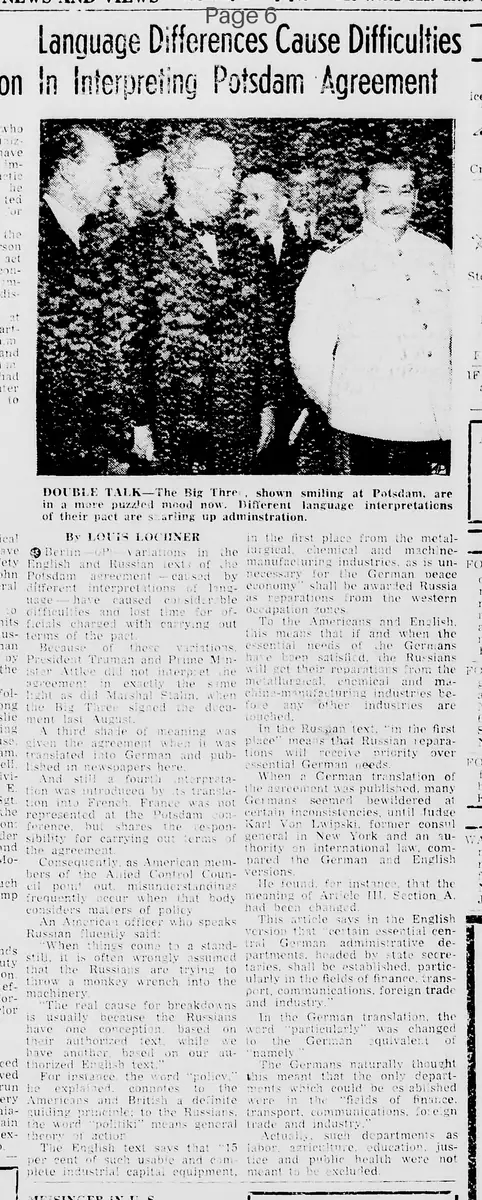
DOUBLE TALK-The Big Three, shown smiling at Potsdam, are in a more puzzled mood now. Different language interpretations of their pact are snarling up administration.
BY LOUIS LOCHNER Berlin variations in the English and Russian text, of the Potsdam agreement - caused by different interpretations of language- have caused considerable difficulties and lost time for officials charged with carrying out terms of the pact. Because of These Variations, President Truman and Prime Minister Attlee did not interpret the agreement in exactly the same way as did Marshal Stalin, when the Big Three signed the document last August.
A third shade of meaning was given the agreement when it was translated into German and published in newspapers here. And still a fourth interpretation was introduced by its translation into French. France was not represented at the Potsdam conference, but shares the responsibility for carrying out terms of the agreement.
Consequently, as American members of the Allied Control Council point out misunderstandings frequently occur when that body considers matters of policy. An American officer who speaks Russian fluently said:
'When things come to a standstill, it is often wrongly assumed that the Russians are trying to throw a monkey wrench into the machinery.
'The real cause for breakdowns is usually because the Russians have one conception based on their authorized text while we have another based on our authorized English text.'
For instance the word "policy," he explained, connotes to the Americans and British a definite guiding principle: to the Russians, the word "politiki" means general theory of action.
The English text says that 15 per cent of such usable and complete industrial capital equipment, in the first place from the metallurgical, chemical and machine-manufacturing industries, as is unnecessary for the German peace economy" shall be awarded Russia as reparations from the western occupation zones.
To the Americans and English, this means that if and when the essential needs of the Germans have been satisfied, the Russians will get their reparations from the metallurgical chemical and machine-manufacturing industries before any other industries are touched.
In the Russian text, "in the first place" means that Russian reparations will receive priority over essential German needs.
When a German translation of the document was published, many Germans seemed bewildered at certain inconsistencies, until Judge Karl von Lewinski, former consul general in New York and an authority on international law, compared the German and English versions.
He found, for instance, that the meaning of Article III, Section A, had been changed. This article says in the English version that certain essential central German administrative departments, headed by state secretaries, shall be established, particularly in the fields of finance, transport, communications, foreign trade and industry."
In the German translation, the word "particularly" was changed to the German equivalent of ' namely. The Germans naturally thought this meant that the only departments which could be established were in the "fields of finance, transport, communications, foreign trade and industry."
Actually such departments as labor, agriculture, education, justice and public health were not meant to be excluded.
What sub-type of article is it?
What keywords are associated?
What entities or persons were involved?
Where did it happen?
Foreign News Details
Primary Location
Berlin
Event Date
Last August
Key Persons
Outcome
misunderstandings and lost time in implementing the potsdam agreement due to language variations, affecting policy decisions in the allied control council.
Event Details
Variations in English and Russian texts of the Potsdam Agreement, caused by different language interpretations, have led to difficulties for officials. Truman and Attlee interpreted it differently from Stalin. German and French translations introduced further shades of meaning. Examples include differing connotations of 'policy' and 'in the first place' regarding reparations, and 'particularly' vs. 'namely' in administrative departments.