Thank you for visiting SNEWPapers!
Sign up free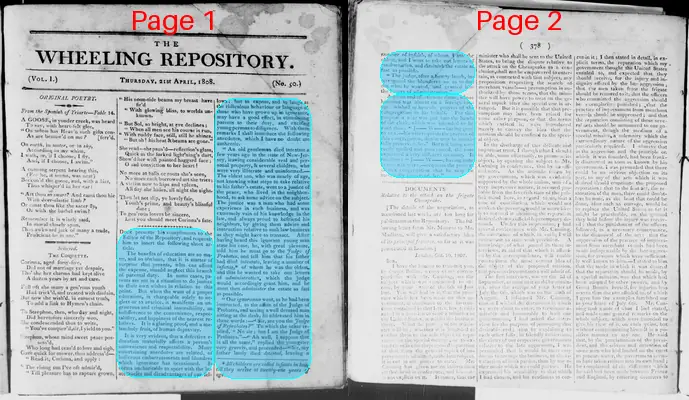
The Wheeling Repository
Wheeling, Ohio County, West Virginia
What is this article about?
A letter from 'Dick' to the Editor emphasizes the importance of parental duty in educating children, decrying neglect as criminal insensibility. It illustrates the pitfalls of ignorance through two anecdotes: a New Jersey youth's bungled probate request and a misread church prayer note.
Merged-components note: Merged across pages as this is a single letter to the editor introducing and containing multiple anecdotes; original fillers are continuations of the letter.
Clippings
1 of 2
OCR Quality
Full Text
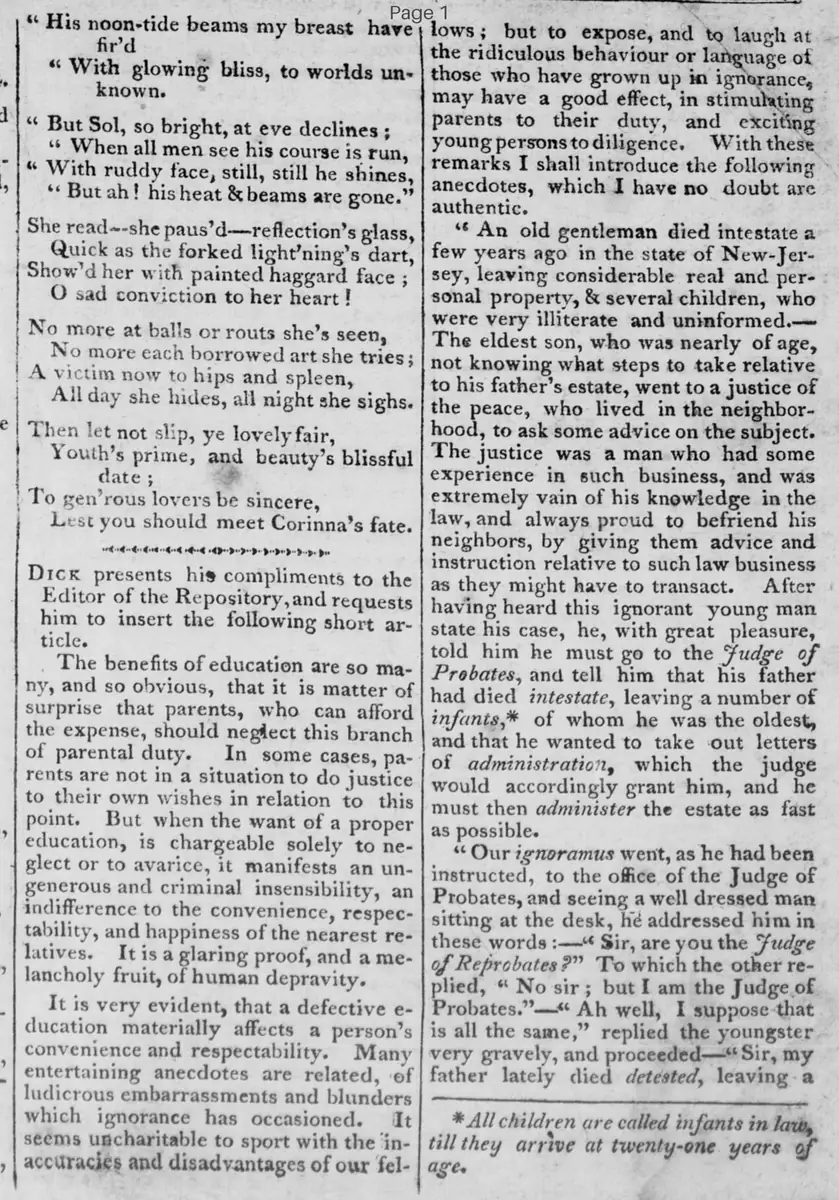
The benefits of education are so many, and so obvious, that it is matter of surprise that parents, who can afford the expense, should neglect this branch of parental duty.
In some cases, parents are not in a situation to do justice to their own wishes in relation to this point.
But when the want of a proper education, is chargeable solely to neglect or to avarice, it manifests an ungenerous and criminal insensibility, an indifference to the convenience, respectability, and happiness of the nearest relatives.
It is a glaring proof, and a melancholy fruit, of human depravity.
It is very evident, that a defective education materially affects a person's convenience and respectability.
Many entertaining anecdotes are related, of ludicrous embarrassments and blunders which ignorance has occasioned.
It seems uncharitable to sport with the inaccuracies and disadvantages of our fellows; but to expose, and to laugh at the ridiculous behaviour or language of those who have grown up in ignorance, may have a good effect, in stimulating parents to their duty, and exciting young persons to diligence. With these remarks I shall introduce the following anecdotes, which I have no doubt are authentic.
"An old gentleman died intestate a few years ago in the state of New-Jersey, leaving considerable real and personal property, & several children, who were very illiterate and uninformed.—
The eldest son, who was nearly of age, not knowing what steps to take relative to his father's estate, went to a justice of the peace, who lived in the neighborhood, to ask some advice on the subject.
The justice was a man who had some experience in such business, and was extremely vain of his knowledge in the law, and always proud to befriend his neighbors, by giving them advice and instruction relative to such law business as they might have to transact.
After having heard this ignorant young man state his case, he, with great pleasure, told him he must go to the Judge of Probates, and tell him that his father had died intestate, leaving a number of infants,* of whom he was the oldest, and that he wanted to take out letters of administration, which the judge would accordingly grant him, and he must then administer the estate as fast as possible.
"Our ignoramus went, as he had been instructed, to the office of the Judge of Probates, and seeing a well dressed man sitting at the desk, he addressed him in these words: —"Sir, are you the Judge of Probates?" To which the other replied, "No sir; but I am the Judge of Probates."
"Ah well, I suppose that is all the same," replied the youngster very gravely, and proceeded "Sir, my father lately died intestate, leaving a
* All children are called infants in law, till they arrive at twenty-one years of age.
number of infidels, of whom I am the oldest, and I want to take out letters of administration, and diminish the estate as fast as possible.
"The judge, after a hearty laugh, interrogated the blunderer so as to find out what he wanted, and granted him the letters of administration."
A pious and affectionate dame, whose husband was absent on a foreign voyage, wished to have the prayers of the congregation in his behalf. For this purpose a note was put into the hands of the clerk, which was intended to be read thus: "J-- W-- having gone to sea,--his wife requests the prayers of this congregation, that he may be mercifully preserved, &c." But not being correctly spelled and punctuated, the note expressed a very different meaning.
It ran thus: "Is Wm, having gone to see his wife,--requests the prayers of this congregation that he may be mercifully preserved, &c."
What sub-type of article is it?
What themes does it cover?
What keywords are associated?
What entities or persons were involved?
Letter to Editor Details
Author
Dick
Recipient
Editor Of The Repository
Main Argument
parents who can afford it should not neglect educating their children, as ignorance leads to embarrassment and diminishes respectability; neglect stems from depravity and harms family happiness.
Notable Details