Thank you for visiting SNEWPapers!
Sign up free
Editorial
September 12, 1811
Virginia Argus
Richmond, Virginia
What is this article about?
Editorial defends Commodore Rodgers' honorable conduct in the Little Belt affair, condemns pro-British American partisans for spreading falsehoods to aid Britain, and asserts American readiness to defend against invasion, referencing past conflicts like the Chesapeake and Bunker Hill.
Clipping
OCR Quality
75%
Good
Full Text
THE AFFAIR OF THE LITTLE BELT,
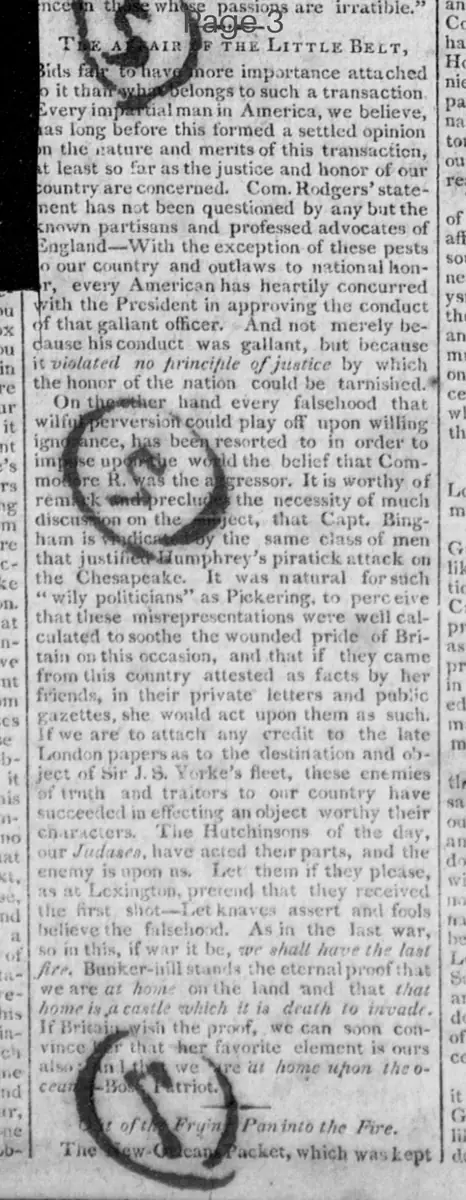
Bids us pause more importance attached to it than by right belongs to such a transaction. Every impartial man in America, we believe, has long before this formed a settled opinion on the nature and merits of this transaction, at least so far as the justice and honor of our Country are concerned. Com. Rodgers' statement has not been questioned by any but the known partisans and professed advocates of England—With the exception of these pests of our country and outlaws to national honor, every American has heartily concurred with the President in approving the conduct of that gallant officer. And not merely because his conduct was gallant, but because it violated no principle of justice by which the honor of the nation could be tarnished. On the other hand every falsehood that wilful perversion could play off upon willing ignorance, has been resorted to in order to impose upon the world the belief that Com. Rodgers was the aggressor. It is worthy of remark and precludes the necessity of much discussion on the subject, that Capt. Bingham is vindicated by the same class of men that justified Humphrey's piratical attack on the Chesapeake. It was natural for such "wily politicians" as Pickering, to perceive that these misrepresentations were well calculated to soothe the wounded pride of Britain on this occasion, and that if they came from this country attested as facts by her friends, in their private letters and public gazettes, she would act upon them as such. If we are to attach any credit to the late London papers as to the destination and object of Sir J. S. Yorke's fleet, these enemies of truth and traitors to our country have succeeded in effecting an object worthy their characters. The Hutchinsons of the day, our Judases, have acted their parts, and the enemy is upon us. Let them if they please, as at Lexington, pretend that they received the first shot—Let knaves assert and fools believe the falsehood. As in the last war, so in this, if war it be, we shall have the last fire. Bunker-hill stands the eternal proof that we are at home on the land and that that home is a castle which it is death to invade. If Britain wish the proof, we can soon convince her that the defensive element is ours but home upon the ocean into the fire, picket, which was kept
Bids us pause more importance attached to it than by right belongs to such a transaction. Every impartial man in America, we believe, has long before this formed a settled opinion on the nature and merits of this transaction, at least so far as the justice and honor of our Country are concerned. Com. Rodgers' statement has not been questioned by any but the known partisans and professed advocates of England—With the exception of these pests of our country and outlaws to national honor, every American has heartily concurred with the President in approving the conduct of that gallant officer. And not merely because his conduct was gallant, but because it violated no principle of justice by which the honor of the nation could be tarnished. On the other hand every falsehood that wilful perversion could play off upon willing ignorance, has been resorted to in order to impose upon the world the belief that Com. Rodgers was the aggressor. It is worthy of remark and precludes the necessity of much discussion on the subject, that Capt. Bingham is vindicated by the same class of men that justified Humphrey's piratical attack on the Chesapeake. It was natural for such "wily politicians" as Pickering, to perceive that these misrepresentations were well calculated to soothe the wounded pride of Britain on this occasion, and that if they came from this country attested as facts by her friends, in their private letters and public gazettes, she would act upon them as such. If we are to attach any credit to the late London papers as to the destination and object of Sir J. S. Yorke's fleet, these enemies of truth and traitors to our country have succeeded in effecting an object worthy their characters. The Hutchinsons of the day, our Judases, have acted their parts, and the enemy is upon us. Let them if they please, as at Lexington, pretend that they received the first shot—Let knaves assert and fools believe the falsehood. As in the last war, so in this, if war it be, we shall have the last fire. Bunker-hill stands the eternal proof that we are at home on the land and that that home is a castle which it is death to invade. If Britain wish the proof, we can soon convince her that the defensive element is ours but home upon the ocean into the fire, picket, which was kept
What sub-type of article is it?
Military Affairs
Foreign Affairs
Partisan Politics
What keywords are associated?
Little Belt Affair
Commodore Rodgers
British Aggression
American Honor
Naval Incident
Partisan Betrayal
War Readiness
What entities or persons were involved?
Com. Rodgers
Capt. Bingham
President
Pickering
Sir J. S. Yorke
Britain
Humphrey
Hutchinsons
Judases
Editorial Details
Primary Topic
Defense Of Commodore Rodgers In The Little Belt Affair
Stance / Tone
Patriotic Defense Of American Actions Against British Aggression And Domestic Traitors
Key Figures
Com. Rodgers
Capt. Bingham
President
Pickering
Sir J. S. Yorke
Britain
Humphrey
Hutchinsons
Judases
Key Arguments
Rodgers' Conduct Was Gallant And Just, Approved By The President And Most Americans
Pro British Partisans Spread Falsehoods To Portray Rodgers As Aggressor
These Traitors Aid Britain, Similar To Justifications Of Past Attacks Like Chesapeake
Britain's Fleet Movements Suggest Impending Aggression Influenced By American Misinformation
America Will Defend Itself Successfully On Land And Sea, As Proven At Bunker Hill