Thank you for visiting SNEWPapers!
Sign up free
Virginia Argus
Richmond, Virginia
What is this article about?
Congressional committee report recommends authorizing the President to explore remote parts of the Louisiana territory, particularly along the Red and Arkansas Rivers, to map boundaries, assess resources, and gather scientific knowledge, building on the Lewis and Clark expedition.
Merged-components note: Continuation of the committee report on exploring Louisiana across two components on page 5.
Clipping
OCR Quality
Full Text
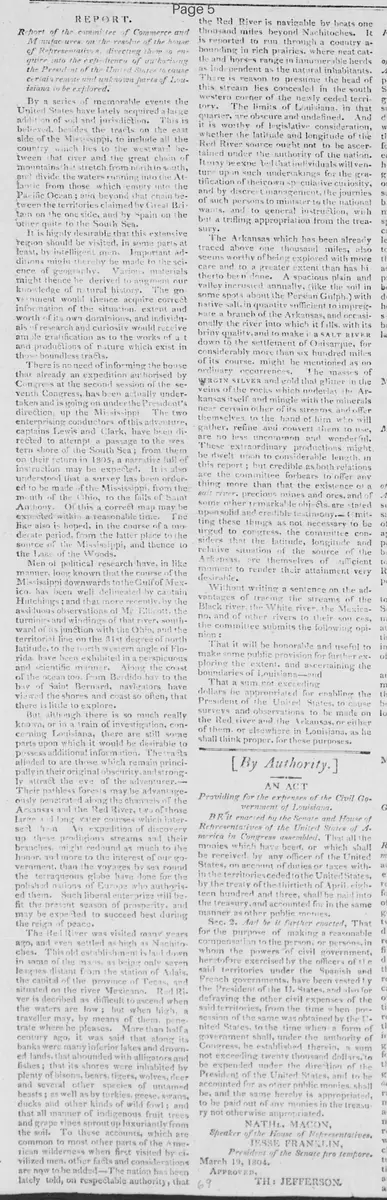
Report of the committee of Commerce and Manufactures, on the resolution of the House of Representatives, directing them to enquire into the expediency of authorising the President of the United States to cause certain remote and unknown parts of Louisiana to be explored.
By a series of memorable events the United States have lately acquired a large addition of soil and jurisdiction. This is believed, besides the tracts on the east side of the Mississippi, to include all the country which lies to the westward thereof, between that river and the great chain of mountains which stretch from north to south, and divide the waters running into the Atlantic from those which empty into the Pacific Ocean; as well beyond that chain between the territories claimed by Great Britain on the one side, and by Spain on the other, quite to the South Sea.
It is highly desirable that this extensive region should be visited, in some parts at least, by intelligent men. Important additions might thereby be made to the science of geography. Various materials might thence be derived to augment our knowledge of natural history. The government would thence acquire correct information of the situation, extent and worth of its own dominions, and individuals of research and curiosity would receive ample gratification as to the works and productions of nature which exist in those boundless tracts.
There is no need of informing the house that already an expedition authorised by Congress at the second session of the seventh Congress, has been actually undertaken and is going on under the President's direction, up the Mississippi. The two enterprising conductors of this adventure, captains Lewis and Clark, have been directed to attempt a passage to the western shore of the South Sea; from them on their return in 1805, a narrative full of instruction may be expected. It is also understood that a survey has been ordered to be made of the Mississippi, from the mouth of the Ohio, to the falls of Saint Anthony. Of this a correct map may be expected within a reasonable time. In like also is hoped, in the course of a moderate period, from the latter place to the source of the Mississippi, and thence to the Lake of the Woods.
Men of political research have, in like manner, long known that the course of the Mississippi downwards to the Gulf of Mexico, has been well delineated by captain Hutchins; and that more recently, by the assiduous observations of Mr. Ellicott, the turnings and windings of that river, southward of its junction with the Ohio, and the territorial line on the 31st degree of north latitude, to the north western angle of Florida, have been exhibited in a perspicuous and scientific manner. Along the coast of the ocean too, from Perdido bay to the bay of Saint Bernard, navigators have viewed the shores and coast so often, that there is little to explore.
But although there is so much really known, or in a train of investigation, concerning Louisiana, there are still some parts upon which it would be desirable to possess additional information. The tracts alluded to are those which remain principally in their original obscurity, and strongly attract the eye of the adventurer. Their pathless forests may be advantageously penetrated along the channels of the Arkansas and the Red River, two of those large and long river courses which intersect it. An expedition of discovery up those prodigious streams and their branches, might redound as much to the honor, if not more to the interest of our government, than the voyages by sea round the terrestrial globe have done for the polished nations of Europe who authorised them. Such liberal enterprises will be fit the present season of prosperity, and may be expected to succeed best during the reign of peace.
The Red River was visited many years ago, and even settled as high as Nachitoches. This old establishment is laid down in some of the maps, as being only seven leagues distant from the station of Adais, the capital of the province of Texas, and situated on the river Mexicano. Red River is described as difficult to ascend when the waters are low; but when high, a traveller may, by means of them, penetrate where he pleases. More than half a century ago, it was said that along its banks were many inferior lakes and drowned lands, that abounded with alligators and fishes: that its shores were inhabited by plenty of bisons, bears, tigers, wolves, deer and several other species of untamed beasts; as well as by turkeys, geese, swans, ducks and other kinds of wild fowl; and that all manner of indigenous fruit trees and grape vines sprout up luxuriantly from the soil. To these accounts, which are common to most other parts of the American wilderness when first visited by civilized men, other facts and considerations are now to be added. The nation has been lately told, on respectable authority, that
the Red River is navigable by boats one thousand miles beyond Nachitoches. It is reported to run through a country abounding in rich prairies, where neat cattle and horses range in innumerable herds as independent as the natural inhabitants. There is reason to presume the head of this stream lies concealed in the south western corner of the newly ceded territory. The limits of Louisiana, in that quarter, are obscure and undefined. And it is worthy of legislative consideration, whether the latitude and longitude of the Red River source ought not to be ascertained under the authority of the nation. It may be expected that individuals will venture up on such undertakings for the gratification of their own speculative curiosity, and by discreet management, the journeys of such persons to minister to the national wants, and to general instruction, with but a trifling appropriation from the treasury.
The Arkansas which has been already traced above one thousand miles, also seems worthy of being explored with more care and to a greater extent than has hitherto been done. A spacious plain and valley incrusted annually, (like the soil in some spots about the Persian Gulf,) with native salt, in quantity sufficient to impregnate a branch of the Arkansas, and occasionally the river into which it falls, with its briny quality, and to make it a SALT RIVER down to the settlement of Ouachita, for considerably more than six hundred miles of its course, might be mentioned as no ordinary occurrences. The masses of virgin silver and gold that glitter in the veins of the rocks which underlay Arkansas itself and mingle with the minerals near certain other of its streams and offer themselves to the hand of him who will gather, refine and convert them to use, are no less uncommon and wonderful.
These extraordinary productions might be dwelt upon to considerable length, in this report: but credible as both relations are the committee forbears to offer any thing more than that the existence of a salt river, precious mines and ores, and of some other remarkable objects, are stated upon solid and credible testimony. Omitting these things as not necessary to be urged to Congress, the committee considers that the latitude, longitude and relative situation of the source of the Arkansas, are themselves of sufficient moment to render their attainment very desirable.
Without writing a sentence on the advantages of tracing the streams of the Black river, the White river, the Mexicano, and of other rivers to their sources, the committee submits the following opinion:
That it will be honorable and useful to make some public provision for further exploring the extent, and ascertaining the boundaries of Louisiana—and
That a sum not exceeding [blank] dollars be appropriated for enabling the President of the United States, to cause surveys and observations to be made on the Red river and the Arkansas, or either of them, or elsewhere in Louisiana, as he shall think proper, for these purposes.
What sub-type of article is it?
What keywords are associated?
What entities or persons were involved?
Where did it happen?
Domestic News Details
Primary Location
Louisiana
Key Persons
Outcome
committee recommends appropriation of funds not exceeding [blank] dollars for presidentially directed surveys and explorations of the red river, arkansas river, or other parts of louisiana to ascertain boundaries and extent.
Event Details
The Committee of Commerce and Manufactures reports on the House resolution inquiring into authorizing the President to explore remote parts of Louisiana. It highlights the recent acquisition of territory west of the Mississippi, desires for geographic and natural history knowledge, references ongoing Lewis and Clark expedition and other surveys, and specifically recommends exploring the Arkansas and Red Rivers for their sources, resources like salt plains and minerals, and boundary clarification.