Thank you for visiting SNEWPapers!
Sign up free
The New Hampshire Gazette
Portsmouth, Rockingham County, New Hampshire
What is this article about?
U.S. Congressional sessions from December 26-31, 1833, debated removal of deposits from the Bank of the United States, with speeches by Clay and others; resolutions on pensions, military pay equalization, public lands pricing, and appropriations were introduced, postponed, or passed.
Merged-components note: Merged two sequential components reporting on Congress proceedings, as the text continues directly from one to the other.
Clipping
OCR Quality
Full Text
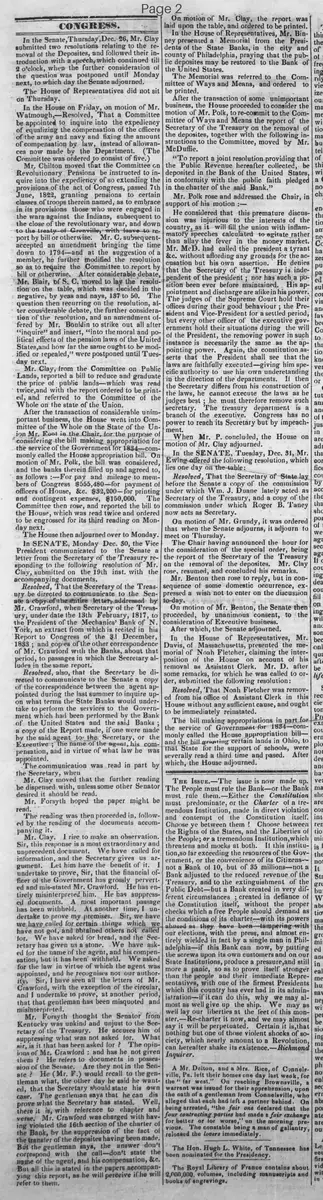
In the Senate, Thursday, Dec. 26, Mr. Clay submitted two resolutions relating to the removal of the Deposits, and followed their introduction with a speech, which continued till 2 o'clock, when the further consideration of the question was postponed until Monday next, to which day the Senate adjourned.
The House of Representatives did not sit on Thursday.
In the House on Friday, on motion of Mr. Watmough,—Resolved, That a Committee be appointed to inquire into the expediency of equalizing the compensation of the officers of the army and navy and fixing the amount of compensation by law, instead of allowances now made by the Department. (The Committee was ordered to consist of five.)
Mr. Chilton moved that the Committee on Revolutionary Pensions be instructed to inquire into the expediency of so extending the provisions of the act of Congress, passed 7th June, 1822, granting pensions to certain classes of troops therein named, as to embrace in its provisions those who were engaged in the wars against the Indians, subsequent to the close of the revolutionary war, and down to the treaty of Greenville, with leave to report by bill or otherwise. Mr. C. subsequently accepted an amendment bringing the time down to 1794—and at the suggestion of a member, he further modified the resolution so as to require the Committee to report by bill or otherwise. After considerable debate, Mr. Blair, of S. C. moved to lay the resolution on the table, which was decided in the negative, by yeas and nays, 137 to 50. The question then recurring on the resolution, after considerable debate, the further consideration of the resolution, and an amendment offered by Mr. Bouldin to strike out all after 'inquire' and insert, 'into the moral and political effects of the pension laws of the United States, and how far the same ought to be modified or repealed,' were postponed until Tuesday next.
Mr. Clay, from the Committee on Public Lands, reported a bill to reduce and graduate the price of public lands—which was read twice, and with the report ordered to be printed, and referred to the Committee of the Whole on the state of the Union.
After the transaction of considerable unimportant business, the House went into Committee of the Whole on the State of the Union, Mr. Foot in the Chair, for the purpose of considering the bill making appropriation for the service of the Government for 1834—commonly called the House appropriation bill. On motion of Mr. Polk, the bill was considered, and the blanks therein filled up and agreed to, as follows:—For pay and mileage to members of Congress $555,480—for payment of officers of House, &c. $32,200—for printing and contingent expenses, $150,000. The Committee then rose, and reported the bill to the House, which was read twice and ordered to be engrossed for its third reading on Monday next.
The House then adjourned over to Monday.
In SENATE. Monday Dec. 30, the Vice President communicated to the Senate a letter from the Secretary of the Treasury responding to the following resolution of Mr. Clay, submitted on the 19th inst. with the accompanying documents.
Resolved, That the Secretary of the Treasury be directed to communicate to the Senate a copy of the entire letter, addressed by Mr. Crawford, when Secretary of the Treasury, under date the 13th February, 1817, to the President of the Mechanics' Bank of N. York, an extract from which is recited in his Report to Congress of the 31 December, 1833: and copies of the other correspondence of Mr. Crawford with the Banks, about that period, to passages in which the Secretary alludes in the same report.
Resolved, also, that the Secretary be directed to communicate to the Senate a copy of the correspondence between the agent appointed during the last summer to inquire upon what terms the State Banks would undertake to perform the services to the Government which had been performed by the Bank of the United States and the said Banks; a copy of the Report made, if one were made by the said agent to the Secretary, or the Executive; the name of the agent, his compensation, and in virtue of what law he was appointed.
The communication was read in part by the Secretary, when Mr. Clay moved that the further reading be dispensed with, unless some other Senator desired it should be read.
Mr. Forsyth hoped the paper might be read.
The reading was then proceeded in, followed by the reading of the documents accompanying it.
Mr. Clay. I rise to make an observation. Sir, this response is a most extraordinary and unprecedented document. We have called for information, and the Secretary gives us argument. Let him have the benefit of it. I undertake to prove, Sir, that the financial officer of the Government has grossly perverted and mis-stated Mr. Crawford. He has entirely misinterpreted him. He has suppressed documents. A most important passage has been withheld. At another time, I undertake to prove my premises. Sir, we have we have called for certain things which we have not got, and obtained others not called for.—We have asked for bread, and the Secretary has given us a stone. We have asked for the name of the agent, and his compensation, but it has been withheld. We asked for the law in virtue of which the agent was appointed, and he recognises not our authority. Sir, I have seen all the letters of Mr. Crawford, with the exception of the circular, and I undertake to prove, at another period, that that gentleman has been misquoted and misinterpreted.
Mr. Forsyth thought the Senator from Kentucky was unkind and unjust to the Secretary of the Treasury. He accuses him of suppressing what was not asked for. What sir, is it that has been asked for? The opinions of Mr. Crawford: and has he not given them? He refers to documents in possession of the Senate. Are they not in the Senate? He (Mr. F.) would recall to the gentleman what, the other day he said he wanted, that the Secretary should state his own case. The gentleman says that he can disprove what the Secretary has stated. Well, there it is, with reference to chapter and verse. Mr. Crawford was charged with having violated the 16th section of the charter of the Bank, by the suppression of the fact of the transfer of the deposits having been made. But the gentleman says, the answer—don't correspond with the call—don't state the name of the agent, and his compensation, &c. But all this is stated in the papers accompanying this report, as he will perceive if he will refer to them.
On motion of Mr. Clay, the report was laid upon the table, and ordered to be printed.
In the House of Representatives, Mr. Binney presented a Memorial from the Presidents of the State Banks, in the city and county of Philadelphia, praying that the public deposits may be restored to the Bank of the United States.
The Memorial was referred to the Committee of Ways and Means, and ordered to be printed.
After the transaction of some unimportant business, the House proceeded to consider the motion of Mr. Polk, to re-commit to the Committee of Ways and Means the report of the Secretary of the Treasury on the removal of the deposits, together with the following instructions to the Committee, moved by Mr. McDuffie.
"To report a joint resolution providing that the Public Revenue hereafter collected, be deposited in the Bank of the United States, in conformity with the public faith pledged in the charter of the said Bank."
Mr. Polk rose and addressed the Chair, in support of his motion:—
He considered that this premature discussion was injurious to the interests of the country, as it will fill the union with inflammatory speeches calculated to agitate rather than allay the fever in the money market.
Mr. McD. had called the president a tyrant &c. without affording any grounds for the accusation but his own assertion. He denies that the Secretary of the Treasury is independent of the president; nor has such a position been ever before maintained. His appointment and discharge are alike in his power.
The judges of the Supreme Court hold their offices during their good behaviour; the President and Vice-President for a settled period. but every other officer of the executive government hold their situations during the will of the President, the removing power in such instance is necessarily the same as the appointing power. Again, the constitution asserts that the President shall see that the laws are faithfully executed—giving him specific authority to use his own understanding in the direction of the departments. If then the Secretary differs from his construction of the laws, he cannot execute the laws as he judges best; he must therefore remove such secretary. The treasury department is a branch of the executive. Congress has no power to reach its Secretary but by impeachment.
When Mr. P. concluded, the House on motion of Mr. Clay adjourned.
In the SENATE, Tuesday, Dec. 31, Mr. Ewing offered the following resolution, which lies one day on the table:
Resolved, That the Secretary of State lay before the Senate a copy of the commission under which Wm. J. Duane lately acted as Secretary of the Treasury, and a copy of the commission under which Roger B. Taney now acts as Secretary.
On motion of Mr. Grundy, it was ordered that when the Senate adjourns, it adjourn to meet on Thursday.
The Chair having announced the hour for the consideration of the special order, being the report of the Secretary of the Treasury on the removal of the deposits. Mr. Clay rose, resumed, and concluded his remarks.
Mr. Benton then rose to reply, but in consequence of some domestic occurrence, expressed a wish not to enter on the discussion to-day.
On motion of Mr. Benton, the Senate then proceeded, by unanimous consent, to the consideration of Executive business.
After which, the Senate adjourned.
In the House of Representatives, Mr. Davis, of Massachusetts, presented the memorial of Noah Fletcher, claiming the interposition of the House on account of his removal as Assistant Clerk. Mr. D. after some remarks, for which he was called to order, submitted the following resolution:
Resolved, 'That Noah Fletcher was removed from his office of Assistant Clerk in this House without any sufficient cause, and ought to be immediately reinstated.'
The bill making appropriations in part for the service of Government for 1834—commonly called the House appropriation bill—and the bill granting certain lands in Ohio, to that State for the support of schools, were severally read a third time and passed. After which, the House adjourned.
What sub-type of article is it?
What keywords are associated?
What entities or persons were involved?
Domestic News Details
Event Date
December 26 31, 1833
Key Persons
Outcome
resolutions postponed or referred; bills reported, printed, or passed; debates on deposits removal continued; appropriation bill advanced.
Event Details
Congressional proceedings in Senate and House included submissions of resolutions on deposits removal by Clay, pension extensions, military compensation equalization, public lands pricing reduction; debates and speeches on Treasury Secretary's report; memorials presented; appropriation bill considered and advanced.