Thank you for visiting SNEWPapers!
Sign up free
Story
February 3, 1876
The Working Christian
York, Charleston, Columbia, York County, Charleston County, Richland County, South Carolina
What is this article about?
Editorial from Alabama Baptist critiques the tone of Congress's recent Amnesty debate, defends the South's post-Civil War stance, rejects historical libels, and urges documentation of true war history for future vindication.
Clipping
OCR Quality
95%
Excellent
Full Text
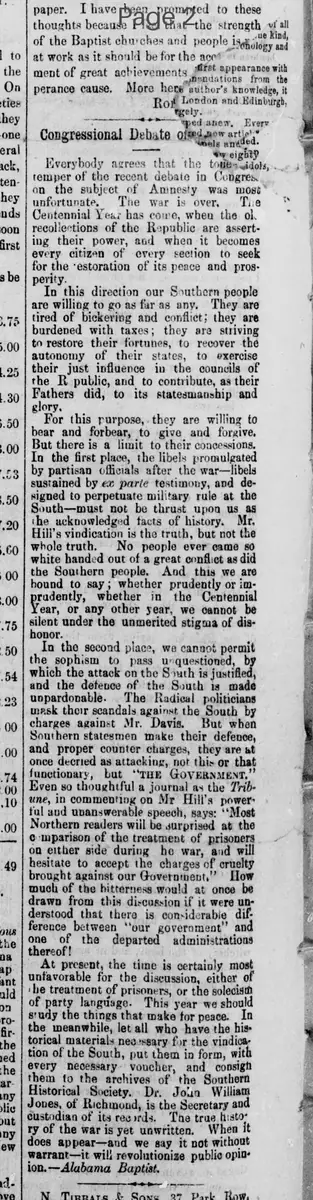
Everybody agrees that the tone - temper of the recent debate in Congress on the subject of Amnesty was most unfortunate. The war is over. The Centennial Year has come, when the old recollections of the Republic are asserting their power, and when it becomes every citizen of every section to seek for the restoration of its peace and prosperity.
In this direction our Southern people are willing to go as far as any. They are tired of bickering and conflict; they are burdened with taxes; they are striving to restore their fortunes, to recover the autonomy of their states, to exercise their just influence in the councils of the Republic, and to contribute, as their Fathers did, to its statesmanship and glory.
For this purpose, they are willing to bear and forbear, to give and forgive. But there is a limit to their concessions.
In the first place, the libels promulgated by partisan officials after the war - libels sustained by ex parte testimony, and designed to perpetuate military rule at the South - must not be thrust upon us as the acknowledged facts of history. Mr. Hill's vindication is the truth, but not the whole truth. No people ever came so white handed out of a great conflict as did the Southern people. And this we are bound to say; whether prudently or imprudently, whether in the Centennial Year, or any other year, we cannot be silent under the unmerited stigma of dishonor.
In the second place, we cannot permit the sophism to pass unquestioned, by which the attack on the South is justified, and the defence of the South is made unpardonable. The Radical politicians mask their scandals against the South by charges against Mr. Davis. But when Southern statesmen make their defence, and proper counter charges, they are at once decried as attacking, not this or that functionary, but "THE GOVERNMENT."
Even so thoughtful a journal as the Tribune, in commenting on Mr. Hill's powerful and unanswerable speech, says: "Most Northern readers will be surprised at the comparison of the treatment of prisoners on either side during the war, and will hesitate to accept the charges of cruelty brought against our Government." How much of the bitterness would at once be drawn from this discussion if it were understood that there is considerable difference between "our government" and one of the departed administrations thereof!
At present, the time is certainly most unfavorable for the discussion, either of the treatment of prisoners, or the solecism of party language. This year we should study the things that make for peace. In the meanwhile, let all who have the historical materials necessary for the vindication of the South, put them in form, with every necessary voucher, and consign them to the archives of the Southern Historical Society. Dr. John William Jones, of Richmond, is the Secretary and custodian of its records. The true history of the war is yet unwritten. When it does appear - and we say it not without warrant - it will revolutionize public opinion. - Alabama Baptist.
In this direction our Southern people are willing to go as far as any. They are tired of bickering and conflict; they are burdened with taxes; they are striving to restore their fortunes, to recover the autonomy of their states, to exercise their just influence in the councils of the Republic, and to contribute, as their Fathers did, to its statesmanship and glory.
For this purpose, they are willing to bear and forbear, to give and forgive. But there is a limit to their concessions.
In the first place, the libels promulgated by partisan officials after the war - libels sustained by ex parte testimony, and designed to perpetuate military rule at the South - must not be thrust upon us as the acknowledged facts of history. Mr. Hill's vindication is the truth, but not the whole truth. No people ever came so white handed out of a great conflict as did the Southern people. And this we are bound to say; whether prudently or imprudently, whether in the Centennial Year, or any other year, we cannot be silent under the unmerited stigma of dishonor.
In the second place, we cannot permit the sophism to pass unquestioned, by which the attack on the South is justified, and the defence of the South is made unpardonable. The Radical politicians mask their scandals against the South by charges against Mr. Davis. But when Southern statesmen make their defence, and proper counter charges, they are at once decried as attacking, not this or that functionary, but "THE GOVERNMENT."
Even so thoughtful a journal as the Tribune, in commenting on Mr. Hill's powerful and unanswerable speech, says: "Most Northern readers will be surprised at the comparison of the treatment of prisoners on either side during the war, and will hesitate to accept the charges of cruelty brought against our Government." How much of the bitterness would at once be drawn from this discussion if it were understood that there is considerable difference between "our government" and one of the departed administrations thereof!
At present, the time is certainly most unfavorable for the discussion, either of the treatment of prisoners, or the solecism of party language. This year we should study the things that make for peace. In the meanwhile, let all who have the historical materials necessary for the vindication of the South, put them in form, with every necessary voucher, and consign them to the archives of the Southern Historical Society. Dr. John William Jones, of Richmond, is the Secretary and custodian of its records. The true history of the war is yet unwritten. When it does appear - and we say it not without warrant - it will revolutionize public opinion. - Alabama Baptist.
What sub-type of article is it?
Historical Event
What themes does it cover?
Justice
Misfortune
What keywords are associated?
Amnesty Debate
Civil War History
Southern Vindication
Prisoner Treatment
Historical Society
What entities or persons were involved?
Mr. Hill
Mr. Davis
Dr. John William Jones
Where did it happen?
Southern States, Congress
Story Details
Key Persons
Mr. Hill
Mr. Davis
Dr. John William Jones
Location
Southern States, Congress
Event Date
Centennial Year
Story Details
The editorial defends the South's position in the Amnesty debate, rejecting post-war libels and calling for accurate historical records of the Civil War, including prisoner treatment, to vindicate Southern honor and promote reconciliation.