Thank you for visiting SNEWPapers!
Sign up free
Literary
July 27, 1776
The Freeman's Journal, Or, New Hampshire Gazette
Portsmouth, Rockingham County, New Hampshire
What is this article about?
Extract from Postlethwayt's Dictionary on flax management, detailing the Flanders method of soil preparation, sowing, pulling, watering, and dressing flax, introduced to Scotland. Compares it favorably to inefficient Scottish practices, emphasizing better yields and quality.
Clipping
OCR Quality
98%
Excellent
Full Text
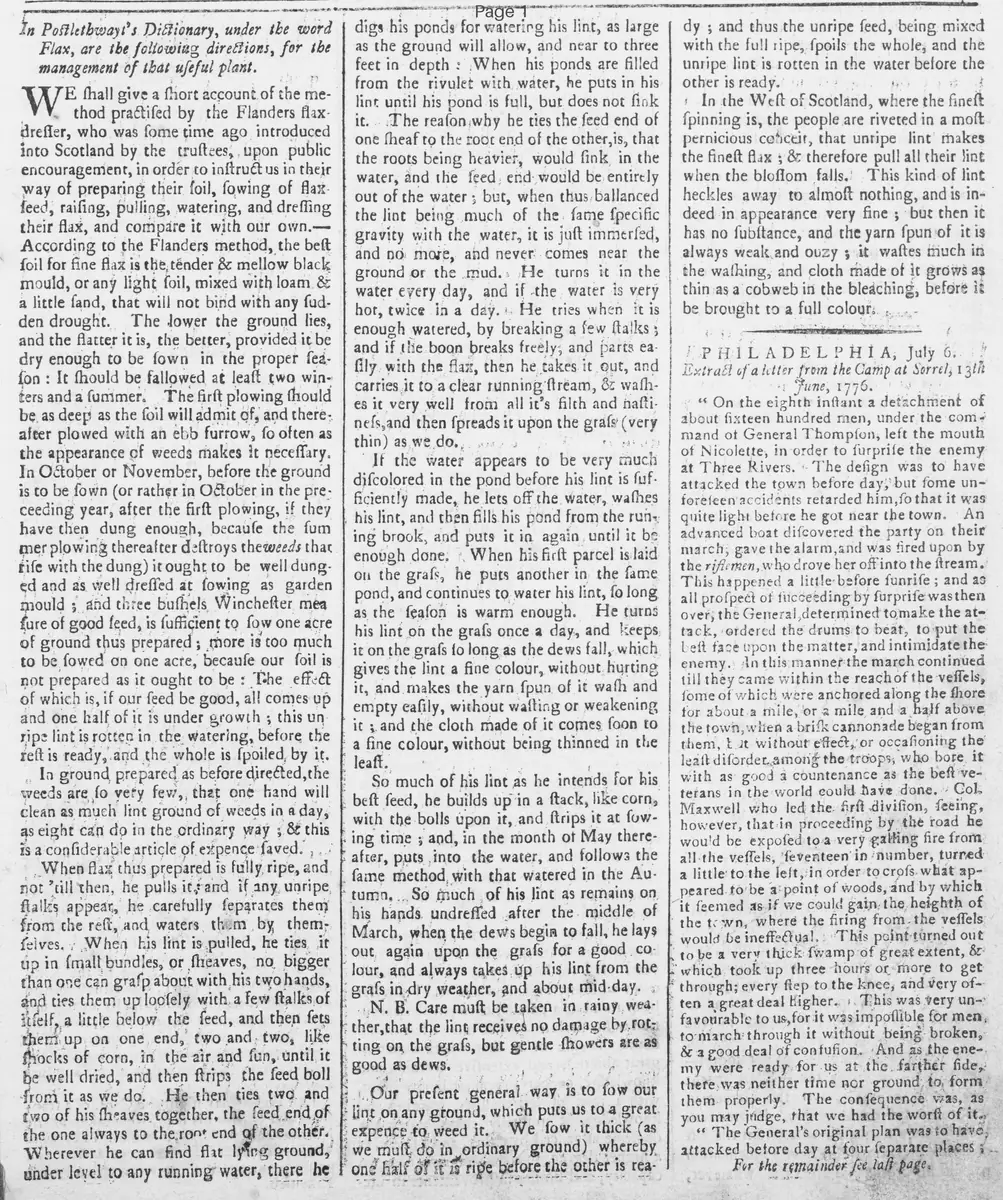
In Postlethwayt's Dictionary, under the word Flax, are the following directions, for the management of that useful plant.
We shall give a short account of the method practised by the Flanders flax-dresser, who was some time ago introduced into Scotland by the trustees, upon public encouragement, in order to instruct us in their way of preparing their soil, sowing of flax seed, raising, pulling, watering, and dressing their flax, and compare it with our own.
According to the Flanders method, the best soil for fine flax is the tender & mellow black mould, or any light soil, mixed with loam & a little sand, that will not bind with any sudden drought. The lower the ground lies, and the flatter it is, the better, provided it be dry enough to be sown in the proper season: It should be fallowed at least two winters and a summer. The first plowing should be as deep as the soil will admit of, and thereafter plowed with an ebb furrow, so often as the appearance of weeds makes it necessary.
In October or November, before the ground is to be sown (or rather in October in the preceding year, after the first plowing, if they have then dung enough, because the summer plowing thereafter destroys the weeds that rise with the dung) it ought to be well dunged and as well dressed at sowing as garden mould; and three bushels Winchester measure of good seed, is sufficient to sow one acre of ground thus prepared; more is too much to be sown on one acre, because our soil is not prepared as it ought to be: The effect of which is, if our seed be good, all comes up and one half of it is under growth; this unripe lint is rotten in the watering, before the rest is ready, and the whole is spoiled by it.
In ground prepared as before directed, the weeds are so very few, that one hand will clean as much flax ground of weeds in a day, as eight can do in the ordinary way; & this is a considerable article of expense saved.
When flax thus prepared is fully ripe, and not 'till then, he pulls it, and if any unripe stalks appear, he carefully separates them from the rest, and waters them by themselves. - When his flax is pulled, he ties it up in small bundles, or sheaves, no bigger than one can grasp about with his two hands, and ties them up loosely with a few stalks of itself, a little below the seed, and then sets them up on one end, two and two, like shocks of corn, in the air and sun, until it be well dried, and then strips the seed boll from it as we do. He then ties two and two of his sheaves together, the seed end of the one always to the root end of the other.
Wherever he can find flat lying ground, under level to any running water, there he digs his ponds for watering his flax, as large as the ground will allow, and near to three feet in depth: When his ponds are filled from the rivulet with water, he puts in his flax until his pond is full, but does not sink it. The reason why he ties the seed end of one sheaf to the root end of the other, is, that the roots being heavier, would sink in the water, and the seed end would be entirely out of the water: but, when thus balanced the flax being much of the same specific gravity with the water, it is just immersed, and no more, and never comes near the ground or the mud. He turns it in the water every day, and if the water is very hot, twice in a day. He tries when it is enough watered, by breaking a few stalks; and if the boon breaks freely, and parts easily with the flax, then he takes it out, and carries it to a clear running stream, & washes it very well from all its filth and nastiness, and then spreads it upon the grass (very thin) as we do.
If the water appears to be very much discolored in the pond before his flax is sufficiently made, he lets off the water, washes his flax, and then fills his pond from the running brook, and puts it in again, until it be enough done. When his first parcel is laid on the grass, he puts another in the same pond, and continues to water his flax, so long as the season is warm enough. He turns his flax on the grass once a day, and keeps it on the grass so long as the dews fall, which gives the flax a fine colour, without hurting it, and makes the yarn spun of it wash and empty easily, without wasting or weakening it: and the cloth made of it comes soon to a fine colour, without being thinned in the least.
So much of his flax as he intends for his best seed, he builds up in a stack, like corn with the bolls upon it, and strips it at sowing time; and, in the month of May thereafter, puts into the water, and follows the same method with that watered in the Autumn. So much of his flax as remains on his hands, undressed after the middle of March, when the dews begin to fall, he lays out again upon the grass for a good colour, and always takes up his flax from the grass in dry weather, and about mid-day.
N. B. Care must be taken in rainy weather, that the flax receives no damage by rotting on the grass, but gentle showers are as good as dews.
I. Our present general way is to sow our flax on any ground, which puts us to a great expense to weed it. We sow it thick (as we must do in ordinary ground) whereby one half of it is ripe before the other is ready; and thus the unripe seed, being mixed with the full ripe, spoils the whole, and the unripe lint is rotten in the water before the other is ready.
In the West of Scotland, where the finest linen is, the people are riveted in a most pernicious conceit, that unripe flax makes the finest flax; & therefore pull all their flax when the blossom falls. This kind of flax hackles away to almost nothing, and is indeed in appearance very fine; but then it has no substance, and the yarn spun of it is always weak and oozy; it wastes much in the washing, and cloth made of it grows as thin as a cobweb in the bleaching, before it be brought to a full colour.
We shall give a short account of the method practised by the Flanders flax-dresser, who was some time ago introduced into Scotland by the trustees, upon public encouragement, in order to instruct us in their way of preparing their soil, sowing of flax seed, raising, pulling, watering, and dressing their flax, and compare it with our own.
According to the Flanders method, the best soil for fine flax is the tender & mellow black mould, or any light soil, mixed with loam & a little sand, that will not bind with any sudden drought. The lower the ground lies, and the flatter it is, the better, provided it be dry enough to be sown in the proper season: It should be fallowed at least two winters and a summer. The first plowing should be as deep as the soil will admit of, and thereafter plowed with an ebb furrow, so often as the appearance of weeds makes it necessary.
In October or November, before the ground is to be sown (or rather in October in the preceding year, after the first plowing, if they have then dung enough, because the summer plowing thereafter destroys the weeds that rise with the dung) it ought to be well dunged and as well dressed at sowing as garden mould; and three bushels Winchester measure of good seed, is sufficient to sow one acre of ground thus prepared; more is too much to be sown on one acre, because our soil is not prepared as it ought to be: The effect of which is, if our seed be good, all comes up and one half of it is under growth; this unripe lint is rotten in the watering, before the rest is ready, and the whole is spoiled by it.
In ground prepared as before directed, the weeds are so very few, that one hand will clean as much flax ground of weeds in a day, as eight can do in the ordinary way; & this is a considerable article of expense saved.
When flax thus prepared is fully ripe, and not 'till then, he pulls it, and if any unripe stalks appear, he carefully separates them from the rest, and waters them by themselves. - When his flax is pulled, he ties it up in small bundles, or sheaves, no bigger than one can grasp about with his two hands, and ties them up loosely with a few stalks of itself, a little below the seed, and then sets them up on one end, two and two, like shocks of corn, in the air and sun, until it be well dried, and then strips the seed boll from it as we do. He then ties two and two of his sheaves together, the seed end of the one always to the root end of the other.
Wherever he can find flat lying ground, under level to any running water, there he digs his ponds for watering his flax, as large as the ground will allow, and near to three feet in depth: When his ponds are filled from the rivulet with water, he puts in his flax until his pond is full, but does not sink it. The reason why he ties the seed end of one sheaf to the root end of the other, is, that the roots being heavier, would sink in the water, and the seed end would be entirely out of the water: but, when thus balanced the flax being much of the same specific gravity with the water, it is just immersed, and no more, and never comes near the ground or the mud. He turns it in the water every day, and if the water is very hot, twice in a day. He tries when it is enough watered, by breaking a few stalks; and if the boon breaks freely, and parts easily with the flax, then he takes it out, and carries it to a clear running stream, & washes it very well from all its filth and nastiness, and then spreads it upon the grass (very thin) as we do.
If the water appears to be very much discolored in the pond before his flax is sufficiently made, he lets off the water, washes his flax, and then fills his pond from the running brook, and puts it in again, until it be enough done. When his first parcel is laid on the grass, he puts another in the same pond, and continues to water his flax, so long as the season is warm enough. He turns his flax on the grass once a day, and keeps it on the grass so long as the dews fall, which gives the flax a fine colour, without hurting it, and makes the yarn spun of it wash and empty easily, without wasting or weakening it: and the cloth made of it comes soon to a fine colour, without being thinned in the least.
So much of his flax as he intends for his best seed, he builds up in a stack, like corn with the bolls upon it, and strips it at sowing time; and, in the month of May thereafter, puts into the water, and follows the same method with that watered in the Autumn. So much of his flax as remains on his hands, undressed after the middle of March, when the dews begin to fall, he lays out again upon the grass for a good colour, and always takes up his flax from the grass in dry weather, and about mid-day.
N. B. Care must be taken in rainy weather, that the flax receives no damage by rotting on the grass, but gentle showers are as good as dews.
I. Our present general way is to sow our flax on any ground, which puts us to a great expense to weed it. We sow it thick (as we must do in ordinary ground) whereby one half of it is ripe before the other is ready; and thus the unripe seed, being mixed with the full ripe, spoils the whole, and the unripe lint is rotten in the water before the other is ready.
In the West of Scotland, where the finest linen is, the people are riveted in a most pernicious conceit, that unripe flax makes the finest flax; & therefore pull all their flax when the blossom falls. This kind of flax hackles away to almost nothing, and is indeed in appearance very fine; but then it has no substance, and the yarn spun of it is always weak and oozy; it wastes much in the washing, and cloth made of it grows as thin as a cobweb in the bleaching, before it be brought to a full colour.
What sub-type of article is it?
Essay
What themes does it cover?
Agriculture Rural
What keywords are associated?
Flax Management
Flanders Method
Scotland Farming
Linen Production
Soil Preparation
Watering Flax
What entities or persons were involved?
Postlethwayt's Dictionary
Literary Details
Author
Postlethwayt's Dictionary
Subject
Management Of Flax: Flanders Method Vs. Scottish Practices
Form / Style
Instructional Prose On Agriculture