Thank you for visiting SNEWPapers!
Sign up free
The Rock Island Argus
Rock Island, Rock Island County County, Illinois
What is this article about?
An editorial arguing that maintaining public credit requires fair adherence to debt contracts, not concessions to gold payment demands that exceed agreements, especially amid economic distress that burdens the people and risks impairing national faith.
Clipping
OCR Quality
Full Text
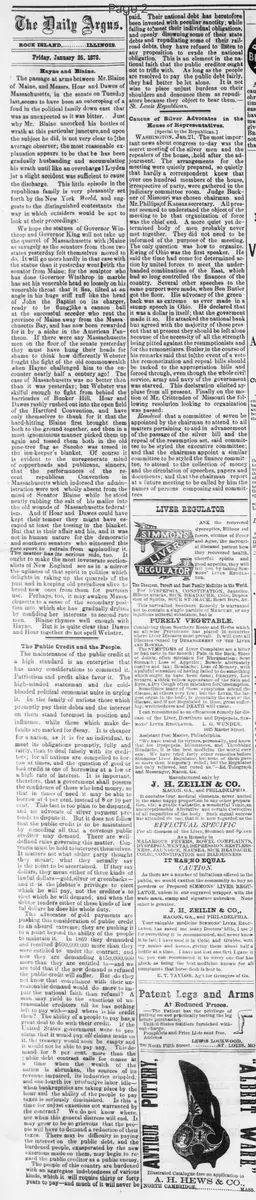
The maintenance of the public credit at a high standard is an enterprise that has many considerations to commend it. Patriotism and profit alike favor it. The high-minded statesman and the cold-blooded political economist unite in urging it. In the family of nations those which promptly pay their debts and the interest on them stand foremost in position and influence, while those which make defaults are marked for decay. It is cheaper for a nation, as it is for an individual, to meet its obligations promptly, fully and fairly, than to deal falsely with its creditors; for all nations are compelled to borrow at times, and the question of good or bad credit is one of borrowing at a low or a high rate of interest. It is important, therefore, that a government shall possess the confidence of those who lend money, so that in times of need it may be able to borrow at 4 per cent. instead of 8 or 10 per cent. This fact is too plain to be disputed, and no advocate of silver payment pretends to dispute it. But it does not follow that the public credit is to be maintained by conceding all that a covetous public creditor may demand. There are well defined rules governing this matter. Contracts must be held to interpret themselves. It matters not what either party thought they meant; what they actually say is the point to be ascertained. If they say dollars, they mean either of three kinds of lawful dollars—gold, silver or greenbacks—and it is the debtor's privilege to elect which he will pay, not the creditor's to elect which he will demand; and when the debtor tenders either of these kinds of lawful dollars he does his whole duty.
The advocates of gold payments are pushing this consideration of public credit to an absurd extreme: they are pushing it to a point beyond the ability of the people to maintain it. In 1869 they demanded and received $600,000,000 more than they were entitled to under the contract; and now they are demanding $150,000,000 more than they are entitled to—and we are told that if the new demand is refused the public credit will suffer. But do they not know that compliance with their unreasonable demand would do more to impair the national faith than refusal? A man may yield to the exactions of unreasonable creditors till he has nothing left to pay with—and where is his credit then? The ability of a people to pay has a great deal to do with their credit. If the United States government were to proclaim that it would pay all claims made on it, the treasury would soon be empty and it would not be able to pay any. This demand for 8 per cent. more than the public debt contract calls for comes at a time when the wealth of the nation is shrunken, the sources of its revenue impaired, its industries crippled, and one-fourth its productive labor idle—when bankruptcies are taking place by the hour and the ability of the people to pay taxes is seriously diminished. Is this a time for unjust exactions not warranted by the contract? We do not know where, nor when this general distress will end. It may grow to be so grievous that the people will have to demand a reduction of their taxes. There may be difficulty in paying the interest on the public debt, and the burdened people, exasperated by the new exactions made on them, may begin to regard the public creditor as a public enemy. The people of this country are burdened with an aggregate indebtedness of various kinds, which it will require thirty or forty years to pay—and much of it will never be paid. Their national debt has heretofore been invested with peculiar sanctity; while failing to meet their individual obligations, and openly disowning some of their state debts and repudiating some of their railroad debts, they have refused to listen to any proposition to evade the national obligation. This is an element in the national faith that the public creditor ought not to trifle with. As long as the people are resolved to pay the public debt fairly, they had better be let alone. It is not wise to place unjust burdens on their shoulders and denounce them as repudiators because they object to bear them.—St. Louis Republican.
What sub-type of article is it?
What themes does it cover?
What keywords are associated?
Where did it happen?
Story Details
Location
United States
Event Date
Post 1869
Story Details
The article argues for maintaining public credit through fair contract interpretation allowing payment in gold, silver, or greenbacks, criticizes gold payment advocates for demanding excess amounts like in 1869 and currently $150M more, warns that such exactions amid economic distress could impair national faith and lead to repudiation sentiments.