Thank you for visiting SNEWPapers!
Sign up free
The Liberator
Boston, Suffolk County, Massachusetts
What is this article about?
A letter from Nantucket describes a peaceful anti-slavery convention where slavery-related issues were discussed without disruption. The writer criticizes two groups dissatisfied with the event: pro-church abolitionists who avoid strong language against the church, and church members/ministers who oppose abolition while tolerating slavery in their congregations, citing specific local examples.
Clipping
OCR Quality
Full Text
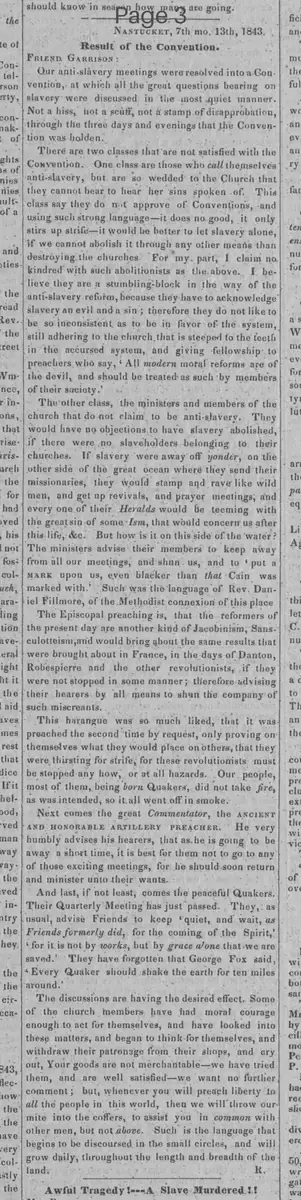
Result of the Convention
FRIEND GARRISON:
Our anti-slavery meetings were resolved into a Convention, at which all the great questions bearing on slavery were discussed in the most quiet manner. Not a hiss, not a scuff, not a stamp of disapprobation, through the three days and evenings that the Convention was holden.
There are two classes that are not satisfied with the Convention. One class are those who call themselves anti-slavery, but are so wedded to the Church that they cannot bear to hear her sins spoken of. This class say they do not approve of Conventions, and using such strong language—it does no good, it only stirs up strife—it would be better to let slavery alone, if we cannot abolish it through any other means than destroying the churches. For my part, I claim no kindred with such abolitionists as the above. I believe they are a stumbling-block in the way of the anti-slavery reform, because they have to acknowledge slavery an evil and a sin; therefore they do not like to be so inconsistent as to be in favor of the system, still adhering to the church that is steeped to the teeth in the accursed system, and giving fellowship to preachers who say, 'All modern moral reforms are of the devil, and should be treated as such by members of their society.'
The other class, the ministers and members of the church that do not claim to be anti-slavery. They would have no objections to have slavery abolished, if there were no slaveholders belonging to their churches. If slavery were away off yonder, on the other side of the great ocean where they send their missionaries, they would stamp and rave like wild men, and get up revivals, and prayer meetings, and every one of their Heralds would be teeming with the great sin of some Ism, that would concern us after this life, &c. But how is it on this side of the water? The ministers advise their members to keep away from all our meetings, and shun us, and to 'put a mark upon us, even blacker than that Cain was marked with.' Such was the language of Rev. Daniel Fillmore, of the Methodist connexion of this place. The Episcopal preaching is, that the reformers of the present day are another kind of Jacobinism, Sans-culotteism, and would bring about the same results that were brought about in France, in the days of Danton, Robespierre and the other revolutionists, if they were not stopped in some manner; therefore advising their hearers by all means to shun the company of such miscreants.
This harangue was so much liked, that it was preached the second time by request, only proving on themselves what they would place on others, that they were thirsting for strife, for these revolutionists must be stopped any how, or at all hazards. Our people, most of them, being born Quakers, did not take fire, as was intended, so it all went off in smoke.
Next comes the great Commentator, the ANCIENT AND HONORABLE ARTILLERY PREACHER. He VERY humbly advises his hearers, that as he is going to be away a short time, it is best for them not to go to any of those exciting meetings, for he should soon return and minister unto their wants.
And last, if not least, comes the peaceful Quakers. Their Quarterly Meeting has just passed. They, as usual, advise Friends to keep 'quiet, and wait, as Friends formerly did, for the coming of the Spirit, for it is not by works, but by grace alone that we are saved.' They have forgotten that George Fox said, Every Quaker should shake the earth for ten miles around.
The discussions are having the desired effect. Some of the church members have had moral courage enough to act for themselves, and have looked into these matters, and began to think for themselves, and withdraw their patronage from their shops, and cry out, Your goods are not merchantable—we have tried them, and are well satisfied—we want no further comment; but, whenever you will preach liberty to all the people in this world, then we will throw our mite into the coffers, to assist you in common with other men, but not above. Such is the language that begins to be discoursed in the small circles, and will grow daily, throughout the length and breadth of the land.
K.
What sub-type of article is it?
What themes does it cover?
What keywords are associated?
What entities or persons were involved?
Letter to Editor Details
Author
K.
Recipient
Friend Garrison
Main Argument
the anti-slavery convention successfully discussed slavery issues peacefully, but faces opposition from church-aligned abolitionists who avoid criticizing the church and from church ministers who tolerate slavery and warn against reformers, highlighting the need to confront church complicity in slavery for true abolition.
Notable Details