Thank you for visiting SNEWPapers!
Sign up free
Editorial
November 15, 1806
Herald Of The United States
Warren, Bristol County, Rhode Island
What is this article about?
Editorial comments on European news: Austria's peril from French dominance in Germanic confederation, Sweden's firm stance against it, and notes that US non-importation law against Britain cannot operate until US-British treaty expires on November 16, 1805.
Clipping
OCR Quality
95%
Excellent
Full Text
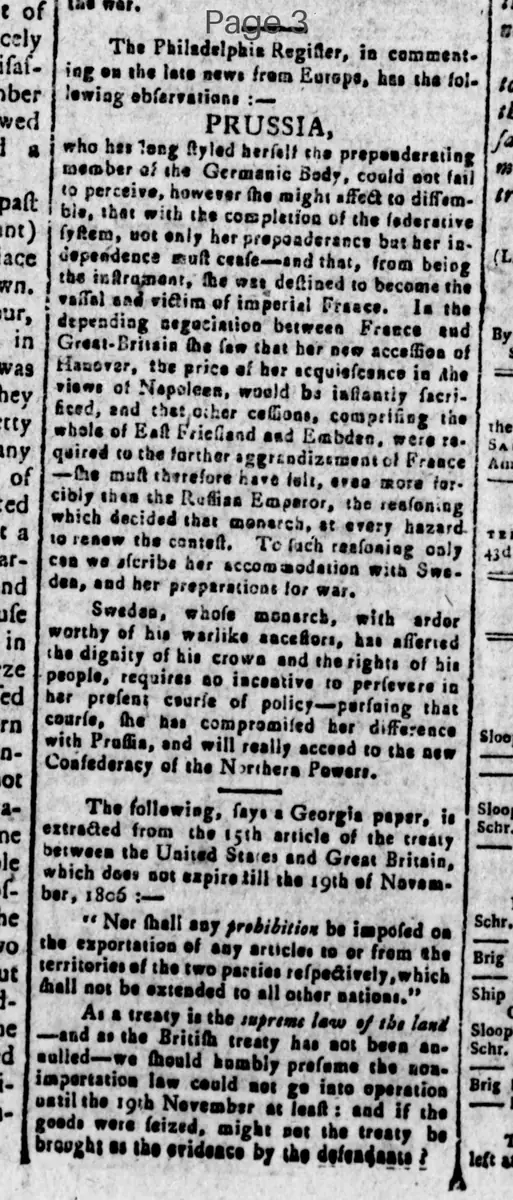
The Philadelphia Register, in commenting on the late news from Europe, has the following observations:--
who has long styled herself the preponderating member of the Germanic Body, could not fail to perceive, however she might affect to dissemble, that with the completion of the federative system, not only her preponderance but her independence must cease--and that, from being the instrument, she was destined to become the vassal and victim of imperial France. In the depending negotiation between France and Great-Britain she was one that her new accession of Hanover, the price of her acquiescence in the views of Napoleon, would be instantly sacrificed, and that other colonies, comprising the whole of East Friezeland and Embden, were required for the farther aggrandizement of France --she must therefore have felt, even more forcibly than the Roman Emperor, the reasoning which decided that monarch, at every hazard, to renew the contest. To such reasoning only can we ascribe her accommodation with Sweden, and her preparations for war.
Sweden, whose monarch, with ardor worthy of his warlike ancestors, has asserted the dignity of his crown and the rights of his people, requires no incentive to persevere in her present course of policy--pursuing that course, she has compromised her differences with Prussia, and will really accede to the new Confederacy of the Northern Powers.
The following, says a Georgia paper, is extracted from the 15th article of the treaty between the United States and Great Britain, which does not expire till the 16th of November, 1805:
"Nor shall any prohibition be imposed on the exportation of any articles to or from the territories of the two parties respectively, which shall not be extended to all other nations."
As a treaty is the supreme law of the land --and as the British treaty has not been annulled--we should humbly presume the non-importation law could not go into operation until the 16th November at least: and if the goods were seized, might not the treaty be brought as the evidence by the defendant?
who has long styled herself the preponderating member of the Germanic Body, could not fail to perceive, however she might affect to dissemble, that with the completion of the federative system, not only her preponderance but her independence must cease--and that, from being the instrument, she was destined to become the vassal and victim of imperial France. In the depending negotiation between France and Great-Britain she was one that her new accession of Hanover, the price of her acquiescence in the views of Napoleon, would be instantly sacrificed, and that other colonies, comprising the whole of East Friezeland and Embden, were required for the farther aggrandizement of France --she must therefore have felt, even more forcibly than the Roman Emperor, the reasoning which decided that monarch, at every hazard, to renew the contest. To such reasoning only can we ascribe her accommodation with Sweden, and her preparations for war.
Sweden, whose monarch, with ardor worthy of his warlike ancestors, has asserted the dignity of his crown and the rights of his people, requires no incentive to persevere in her present course of policy--pursuing that course, she has compromised her differences with Prussia, and will really accede to the new Confederacy of the Northern Powers.
The following, says a Georgia paper, is extracted from the 15th article of the treaty between the United States and Great Britain, which does not expire till the 16th of November, 1805:
"Nor shall any prohibition be imposed on the exportation of any articles to or from the territories of the two parties respectively, which shall not be extended to all other nations."
As a treaty is the supreme law of the land --and as the British treaty has not been annulled--we should humbly presume the non-importation law could not go into operation until the 16th November at least: and if the goods were seized, might not the treaty be brought as the evidence by the defendant?
What sub-type of article is it?
Foreign Affairs
War Or Peace
Trade Or Commerce
What keywords are associated?
Germanic Confederacy
French Aggrandizement
Austria Independence
Sweden Policy
Northern Powers
Us British Treaty
Non Importation Law
Napoleon Views
What entities or persons were involved?
Austria
France
Napoleon
Great Britain
Sweden
Prussia
United States
Hanover
East Friezeland
Embden
Editorial Details
Primary Topic
European Resistance To French Dominance And Us British Trade Treaty Implications
Stance / Tone
Opposition To French Aggrandizement And Defense Of Treaty Obligations
Key Figures
Austria
France
Napoleon
Great Britain
Sweden
Prussia
United States
Hanover
East Friezeland
Embden
Key Arguments
Austria's Independence Threatened By French Led Germanic Confederation
Austria's Hanover Accession Would Be Sacrificed To France
Austria Accommodates Sweden And Prepares For War Against France
Sweden Asserts Crown Dignity And Compromises With Prussia To Join Northern Confederacy
Us British Treaty Article Prohibits Discriminatory Export Bans Until November 16, 1805
Non Importation Law Cannot Operate Until Treaty Expiration
Treaty Serves As Supreme Law And Evidence Against Seizures